

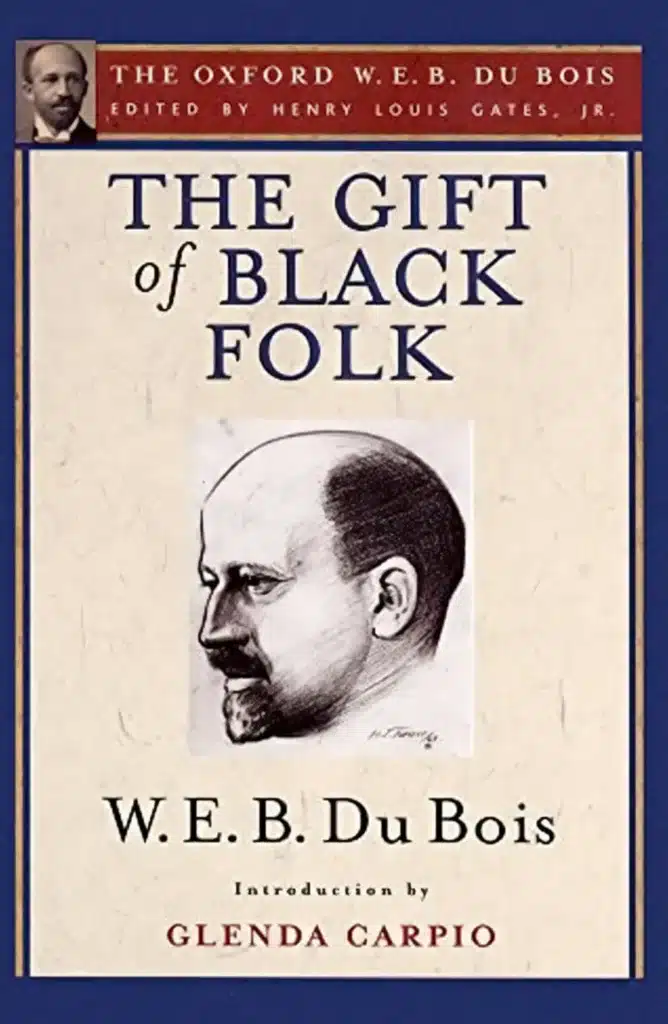
“Who made America?” ponders William Edward Burghardt Du Bois (1868–1963) in the prescript of The Gift of Black Folk. From that pondering, the acclaimed public intellectual and academically accredited professor of history, sociology, and classical languages answers by writing people of African descent fully into the American narrative. (I use the demonym “American” and it cognates to refer both to the United States of America which is Du Bois’ primary focus in this work, but also with reference to the West Indies and Latin America, as did Du Bois also in this study, implying the fuller meaning of “American” as designating the Americas [North, South, Central, and the Caribbean], the so-called “New World.”)
We cannot fully appreciate how radical Du Bois’ work was in its time. In an era predominated by the pseudoscience of eugenics, lynch mobs, white supremacist ideologies, the societal deconstruction of Reconstruction, and systematized inferiority, he dared to chronicle the under-regarded achievements of black people and to propose that their pursuit of liberty was a constitutive feature of American democracy. Du Bois lauds both America and people of African descent—who despite this particular “grotesque failure,” are yet replete with “magnificent promise.”
The record of black contributors to early America represented not only a key participation, Du Bois suggests, but was consequential as something sui generis to “raise a vision of democracy in America such as neither Americans nor Europeans conceived” (Du Bois 2021 [1924], 64). More specifically this book’s central premise is that it was “the rise and growth among the slaves of a determination to be free and an active part of American democracy that forced American democracy continually to look into the depths” (Du Bois 2021, 65). From that passionate introspection came the democratic innovation shaped by black yearning for liberty. This collision and collusion of cultures brought about by slavery, in Du Bois’ words, “forced the consideration” that the “idea of democracy” included persons of “all races and colors” (Du Bois 2021, 66).
Du Bois’ thoughts easily organize themselves within a consecutive: religion, culture, and democracy. An argument can be posited from Du Bois’ work in The Gift of Black Folk that the particular spirituality of people of African descent in the new world gave birth to a distinct resilience which, as is noted, bolstered the emerging democratic spine of the fledgling new world.
Religion
Du Bois himself was not a traditional, trinitarian Christian who affirmed an orthodox christocentric soteriology. But his anthropological and sociological research certainly opened him to an accurate description of the horizontal implications of the divine truth in the Judeo-Christian ethos.
For example, Du Bois first published his prose poem, “Credo,” in 1904, but then re-published it in 1920 (Du Bois 1969 [1920], 3-4), around the time he was conceiving, researching, and writing The Gift of Black Folk (I am indebted academically and spiritually to the Rev. Dr. Frazier Norton Odom [1937–2021] for the inheritance of his library which contained several rare volumes on the life and work of Du Bois, including this one). In other words, this theological thread was a persistent assertion in his work: that all humans are created for sibling-like relationships, they are “brothers in Christ, even though they be not brothers in law.” The operative idea here is that, irrespective of laws prohibiting racial intermarriage, there was a mystical, indissoluble relationality between persons.
I maintain that this analogy of relationship (analogia relationis) proceeds from a theological basis—whether or not this was emotionally felt, intellectually realized, or confessionally articulated by Du Bois. When a Cuban priest asked Du Bois whether he believed in a personal God he responded in a letter that he did not believe God to be “a person of vast power who consciously rules the universe for the good of mankind.” He went on to say, “I cannot disprove this assumption, but I certainly see no proof to sustain such a belief, neither in History nor in my personal experience.” And then this: “[If] you mean by ‘God’ a vague Force which, in some uncomprehensible way, dominates all life and change, then I answer, Yes; I recognize such Force, and if you wish to call it God, I do not object” (See Du Bois 1978, 3:223). The analogy of relationship emerges from the truth of a trinitarian God, Father, Son, and Holy Spirit, three-in-one and one-in-three. In this divine image all humans are created. This imago Dei is characterized by two characteristics, one of relationship and one of essence; as Du Bois puts it in “Credo,” all human persons are “alike in soul and the possibility of infinite development.” (I note this as a topic for further exploration: the extent to which the work of Martin Luther King and the Civil Rights Movement was grounded in the alikeness or equality of all human persons as 1) ensouled creatures and 2) bearing the “possibility of infinite development.”) This theological anthropology is built into the structure of creation and implicitly permeates the structure The Gift of Black Folk.
“Religion in the United States was not simply brought to the Negro by the missionaries” (Du Bois 2021, 163). While not typically familiar with the gospel of Jesus Christ as articulated in the New Testament narrative, African chattel slaves certainly carried in the bowels of slave ships a religiously informed worldview that would have been attentive to a conception that life was not haphazard or random, but rather inhered a providential design—even in its tragic forms—that forces were at work, likely with a dynamic vitalism view of the Spirit. Being transported to the new world meant “transplanting to the United States a certain spiritual entity, and an unbreakable set of world-old beliefs, manners, morals, superstitions and religious observances” (Du Bois 2021, 164). While not mentioned in this volume, likely since the anthropo-cultural category of “retentions” was not developed comprehensively in Du Bois’ time, there are African religious retentions which are readily observable among, for example, the Candomblé in Brazil, river revivalism in Jamaica, or black Pentecostalism in the USA. With the transport of slaves also came their religious core: “We must think of the transplanting of the Negro as transplanting to the United States a certain spiritual entity” (Du Bois 2021, 164). The religious ethos of this emerging nation did not arrive fully formed from Europe; it was influenced also by African spirituality.
Culture
Du Bois’ strategy, according to Martin Luther King speaking in 1968 at Carnegie Hall on the one-hundredth anniversary of Du Bois’ birth, consisted of knowing “that to lose one’s history is to lose one’s self-understanding and with it the roots for pride” (King 1970, 17). Du Bois seeks to regain and restate that history for the sake of propelling forward a marginalized and minoritized people.
Du Bois was not only a historian, a meaning-maker as an interpreter of history, but it is noteworthy that his life itself followed a historically magnanimous span. He was born less than three years after Juneteenth, June 19, 1865—the commemoration of the announcement at Galveston, Texas—two and half years after the abolition of slavery in the USA—of the freedom of 250,000 enslaved black people in Texas. Born 100 years before the assassination of Martin Luther King Jr., Du Bois himself died one day prior to MLK’s “I Have a Dream” speech at the March on Washington, August 28, 1963.
On the 100th anniversary of the birthday of W.E.B. Du Bois, in his last major public address, Martin Luther King gave a speech at Carnegie Hall in New York City insisting on the perduring relevance of Du Bois “when despair is all too prevalent.” If King’s assessment of the prevalence of despair was accurate half a century ago, how much more could the U.S. benefit from a Du Boisian approach in these times in which despite monumental advances in racial parity there persists a glaring and lagging reminder of the nation’s “grotesque failure.” Anthony B. Bradley turns our eyes towards contemporary evidences of such despair: “The black male crisis, out-of-wedlock births, the breakdown of the family and community, bad parenting, substandard education, media consumption without discernment, poor health choices, violence, and poverty” (Bradley 2020, 116).
These challenges represent a despairing urgency not only for the black community but for a national conversation of the same proportion as the suffering of slavery, segregation, and systemic exclusion was for earlier epochs. Rather than drawing upon the storehouse of ancestral wisdom emanating from traditions of faith and from the cultural capital of grit, modeled in the narratives of achievement of The Gift of Black Folk, too often too many in our time place their trust in social and political remedies.
Democracy
The biblical witness is clear: “Do not put your trust in princes [or in presidents, premiers, prime ministers, politicians, der weltlicher Bereich, or rulers of any kind], in mortals, in whom there is no help…. Happy are those who help is in the God of Jacob, whose hope is in the Lord their God” (Psalm 146:3, 5, NRSV). As contrasted with reliance on governmental or macro-structural solutions, I assert with Du Bois that historical sources provide an ample reserve of renewable energy in the black community’s fuller participation in the democratic experiment. This big idea of Du Bois is imbued with continuing contemporary consequences.
For example, when communities in response to the experience of racism express rage—due to injustices suffered or socio-economic opportunities denied—the temptation can arise to direct anger towards destructive ends, even the demolition of the societal structures. Martin Luther King, as a Nobel Peace Prize-winning proponent of non-violent resistance, aligned with the creative alternative he noted in Du Bois to re-channel anger constructively: “History had taught him it is not enough for people to be angry—the supreme task is to organize and unite people so that their anger becomes a transforming force.”
Mobilizing people to access the unique social mobility of the American democratic experiment was Du Bois’ project in this volume: in the face of diminutive stereotypes, despite people of African descent being categorized as abjectly inferior, he chronicled the triumph of black excellence. Du Bois’ goal was to show not only what was possible in America, but who made America, how this legacy of ordinary, even despised people striving toward extraordinary achievement in diverse fields, made America: discoverers and explorers, artists and orators, scientists and inventors.
For Du Bois, the movement between religion and culture and their combination of contributions was seamless.
Albert J. Raboteau (1943–2021), an American scholar of African American religion, ironically was born in a Roman Catholic family and later converted to Eastern Orthodoxy. He summarizes the interplay between religion and culture, between body and soul, between the spiritual and the physical realms:
In a society chronically split between body and spirit, African-American ritual exemplifies embodied spirit and inspirited body in gesture, dance, song, and performed word.… Contrary to the depersonalizing pressures of slavery and racial oppression, the person is of ultimate value as image of the divine. (Raboteau 1996, 190)
To modern sensibilities Du Bois’ take on the spiritual-culture traits of black people could strike ears as derogatory, hyper-symbolic, idyllic, idealizing, even fetishizing; he notes a “tropical love of life” accompanied by “an intense sensitiveness to spiritual values” and an encompassing “spiritual joyousness” (Du Bois 2021, 161).
Akin to T.S. Eliot’s observation of the British people and Anglicanism (Eliot 1949), Du Bois sees the mutual reinforcement of religion and culture, thematized in the dogma of the image of God, coupled with inspirited culture-producing, religiously induced expressions of freedom (gesture, dance, song, and performed word). Since, in Du Bois’ view, this spirituality was not genetically derived, not a form of racial essentialism, but was of a people’s culture, untethered from genetics, it could be (and indeed was) shared interculturally on the fresh template of American soil. Du Bois is adamant: “There are no races, in the sense of great, separate, pure breeds of men, differing in attainment, development, and capacity” (Zamir 1995).
He sidesteps the error of assigning racial essentialism to this cultural exhibit or any other group’s traits, habits, practices, or productions. Rather, he conjoins the indomitable joy he notes as accidental (in the Aristotelian sense) and as a contagious gift from African descendants to the broader American culture. Reference this volume’s title! Then, he traces how these gifts contribute to the totality of life in the USA. I wonder whether, moreover, how the ever-common trait of optimism, attributed globally and roundly to American people, might, in part, find rootage here, coming forth from “the imprint of Africa on Europe in America” (Du Bois 2021, 161).
Kwame Anthony Appiah maintains that Du Bois was intentionally disrupting the diehard idea that culture is tied to genetics; not only in this work, but Du Bois’ overall project demonstrated “how a group defined by common blood could share characteristics that were nevertheless not inherited in the blood” (Appiah 2014, 111). The emerging American identity differed from its European antecedents with its evolving way of understanding e pluribus unum. Certainly the concept “out of many, one people” is traceable to the ancients—Greeks like Heraclitus (ca. 5th century BC) and Latins like Augustine (354-430 AD)—but few embraced it as vigorously as the USA and no group insisted on its emancipatory ideals more than Americans of African descent. America was never a blank slate, but it was and remains a new world, readymade for democratization—politically and culturally.
Du Bois’ voice flourished not only because people of African descent welcomed with pride the recounting of their epochal contributions to the founding and formation of the new world, but also because the new world itself was by virtue of its democratic ideals resonant with the energy of those very contributors taking an unprecedented cultural trajectory: “A recognition of human beings as such and the giving of economic and social power to the powerless” (Du Bois 2021, 65). This American adaptation in nation-making was groundbreaking in human history: a single national fabric woven together by a multi-ethnic plurality of people committed to this most ironic of twists and tests: “In a peculiar way, then, the Negro in the United States has emancipated democracy, reconstructed the threatened edifice of Freedom and been a sort of eternal test of the sincerity of our democratic ideals” (Du Bois 2021, 128).
The Rev. John Arthur Nunes, PhD, is interim president of California Lutheran University and a senior fellow at the Center for Religion, Culture & Democracy.
References
Appiah, Kwame Anthony. 2014. Lines of Descent: W. E. B. Du Bois and the Emergence of Identity. Cambridge, MA: Harvard University Press.
Bradley, Anthony B. 2020. Why Black Lives Matter: African American Thriving for the Twenty-First Century. Eugene, OR: Cascade.
Du Bois, W. E. B. 2021 [1924]. The Gift of Black Folk. Mint Editions.
———. 1978. Letter to E. Peña Moreno, November 15, 1948. In The Correspondence of W. E. B. Du Bois. Edited by Herbert Aptheker, 3:223. Amherst: University of Massachusetts Press.
———. 1969 [1920]. Darkwater: Voices from Within the Veil. New York: Schocken.
Eliot, T. S. 1949. Notes towards the Definition of Culture. New York: Harcourt Brace.
King Jr., Martin Luther. 1970. “Honoring Dr Du Bois.” In W. E. B. Du Bois Speaks: Speeches and Addresses 1890-1919. Edited by Philip S. Foner. New York: Pathfinder Press.
Raboteau, Albert J. 1996. A Fire in the Bones: Reflections on African-American Religious History. Boston: Beacon Press.
Zamir, Shamoon. 1995. Dark Voices: W. E. B. Du Bois and American Thought, 1888-1903. Chicago: University of Chicago Press.