
On July 4, 2026, all patriotic Americans will mark the 250th anniversary of our country’s birth with fireworks displays, festive parades, and salutes to Old Glory. The semiquincentennial presents a unique occasion to celebrate and reflect on the immense gift that America’s founding generation gave us. That generation declared independence from the world’s then-superpower, fought for it, and won it. History, however, is littered with battles won and lost, countries shaped and reshaped. What makes America’s independence a cherished gift worthy of our enduring admiration today?
In his 1852 eulogy of Senator Henry Clay, Abraham Lincoln remarked that Clay “loved his country partly because it was his own country but mostly because it was a free country.” Lincoln, poet and prophetic statesman that he was, traced love of country back to the principles contained in that old Declaration of Independence, what he would later refer to in a biblical analogy as the apple of gold within the Constitution’s frame of silver. The metaphorical golden apple was America’s founding premise captured in the Declaration: the fundamental equality of all men before God, with inalienable rights of which a just government cannot deprive its citizens.
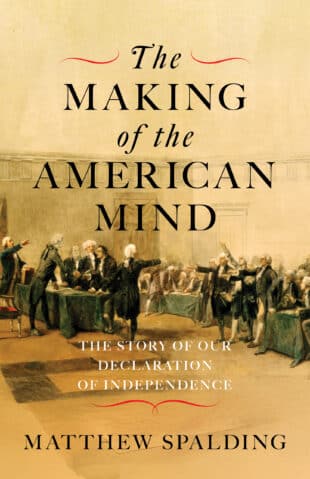
The Declaration as our most precious gift, our national patrimony, is the theme of Dr. Matthew Spalding’s newest book, The Making of the American Mind: The Story of Our Declaration of Independence. As Spalding writes in his splendid book’s introduction, “The Declaration unites our hearts and our minds in a civic friendship of enlightened patriotism. We must know the Declaration if we truly are to love America.” Spalding’s book is a well-timed gift during this momentous year that teaches us why we should love our country.
Spalding organizes his book by drawing on certain familiar phrases from the Declaration, such as “When in the Course of Human Events,” “Acts Which May Define a Tyrant,” and “Our Sacred Honor.” These phrases offer entry points into the principal gifts of the Declaration. In the chapter titled, “The Laws of Nature and of Nature’s God,” Spalding unfolds the central intellectual case for why the Declaration deserves our adoration as well as our fidelity. Thomas Jefferson, the Declaration’s primary drafter, accomplished an enormous feat by rooting the final cause (in Aristotelian terms) for independence in both “rational and divine” origins. The “Laws of Nature and Nature’s God” are those “unchanging laws” that “are to be the foundation of the rights and liberties enshrined” in the Declaration, Spalding explains. Jefferson was not inventing a new approach to understand our cherished rights and liberties, but rather drawing from Aristotle and Aquinas, as well as influential thinkers only a century or two from his own day: Edward Coke, Algernon Sidney, and Richard Hooker. The Declaration thus gifts us a synthesis of the timeless, classical Natural Law tradition applied toward the practical necessity of justifying independence.
Like Lincoln, Spalding emphasizes “All honor to Jefferson” for grounding the Declaration—and in turn the American regime—in these timeless principles. The Declaration is not merely an accomplishment for the Founding generation, but one for all time. How so? Some of the strongest sections of Spalding’s book detail how the Declaration’s intellectual roots rebut modern charges of historicism, or the view that the value of all human affairs (and, in this case, the Declaration) should be considered relatively.
Jefferson understood a proper appreciation of history “will qualify [students] as judges of the actions and designs of men.” The very act of declaring independence was not some “meaningless question” to the Founders, Spalding reminds us. While the Continental Congress had the power to declare independence, power alone could not supply a sufficient justification since, in the words of the Declaration, “a decent respect to the opinions of mankind requires that they should declare the causes which impel them to separation.” In adopting the Declaration, the Founders made an argument with the intent to be respected for all time, even as the outcome of the forthcoming war for independence was uncertain.
Although the Declaration is a deeply philosophic document, the Founders were not aloof aspirants to become platonic philosopher-kings. Rather, as Spalding notes, they were largely statesmen schooled in, and exercising, a proper understanding of prudence. The Natural Law tradition on which the Declaration is based significantly elevates prudence as the cardinal virtue of politics. “Prudence is central to moral virtue,” Spalding explains, “[I]t is the activity that makes virtue in the abstract virtue in fact.” The signers of the Declaration certainly featured lawyers, but also a colonial governor, farmers, former generals, and doctors. These varied backgrounds informed their deliberations over how to balance categorical principles with contingent possibilities in the run up to, as well as the aftermath of, declaring independence.
Weighing a variety of contingent possibilities without compromising first principles is at the heart of prudence rightly understood and exercised. And just as importantly, with the very act of adopting the Declaration, the signers of the Declaration made an enormous prudential judgment at significant personal risk. By putting their names down, they became “wanted men” in the eyes of the British Crown. And yet, by staking “their lives, their fortunes, and their sacred honor” to the cause for independence, their credibility and fidelity to the principles of the Declaration could never be in doubt. They truly were among the greatest of the “Iron Men,” as Lincoln would later describe the founding generation.
Spalding’s book is further a reminder that the Declaration is a gift for us to be read anew. Lawyers who litigate within the grooves of the Constitution should appreciate that Spalding’s book shows the importance of considering how background principles animate and inform adopted text. As mentioned earlier, the chapters of the book draw on certain key phrases from the Declaration as an entry point into unpacking the underlying philosophic basis of each phrase. The Declaration is unintelligible without these bases, just as the Constitution would be unintelligible without the Declaration. Spalding’s graduate school mentor, the late scholar Harry Jaffa, was one of the most prominent skeptics of constitutional interpretation that could be performed without reference to those principles of the Declaration. In our own day, Justice Clarence Thomas has come closest among our leading jurists to consider the Constitution through this interpretive lens, as notably demonstrated in his 1987 article in the Howard Law Review, “Toward a ‘Plain Reading’ of the Constitution—The Declaration of Independence in Constitutional Interpretation.” Conservative, self-described originalist lawyers in particular, many of whom assiduously avoid or even decry any explicit role for the Declaration in our constitutional interpretation, could learn much from Spalding’s approach.
Readers will, if they have not already, fall in love with Thomas Jefferson’s prose as Spalding unfolds his book. They should also fall in love with Spalding’s prose as the means by which they learn (or re-learn) to love the Declaration.
Garrett Snedeker (J.D., Antonin Scalia Law School at George Mason University) is Executive Director of the James Wilson Institute and a staff attorney at New Civil Liberties Alliance. He is admitted to practice law in the District of Columbia.