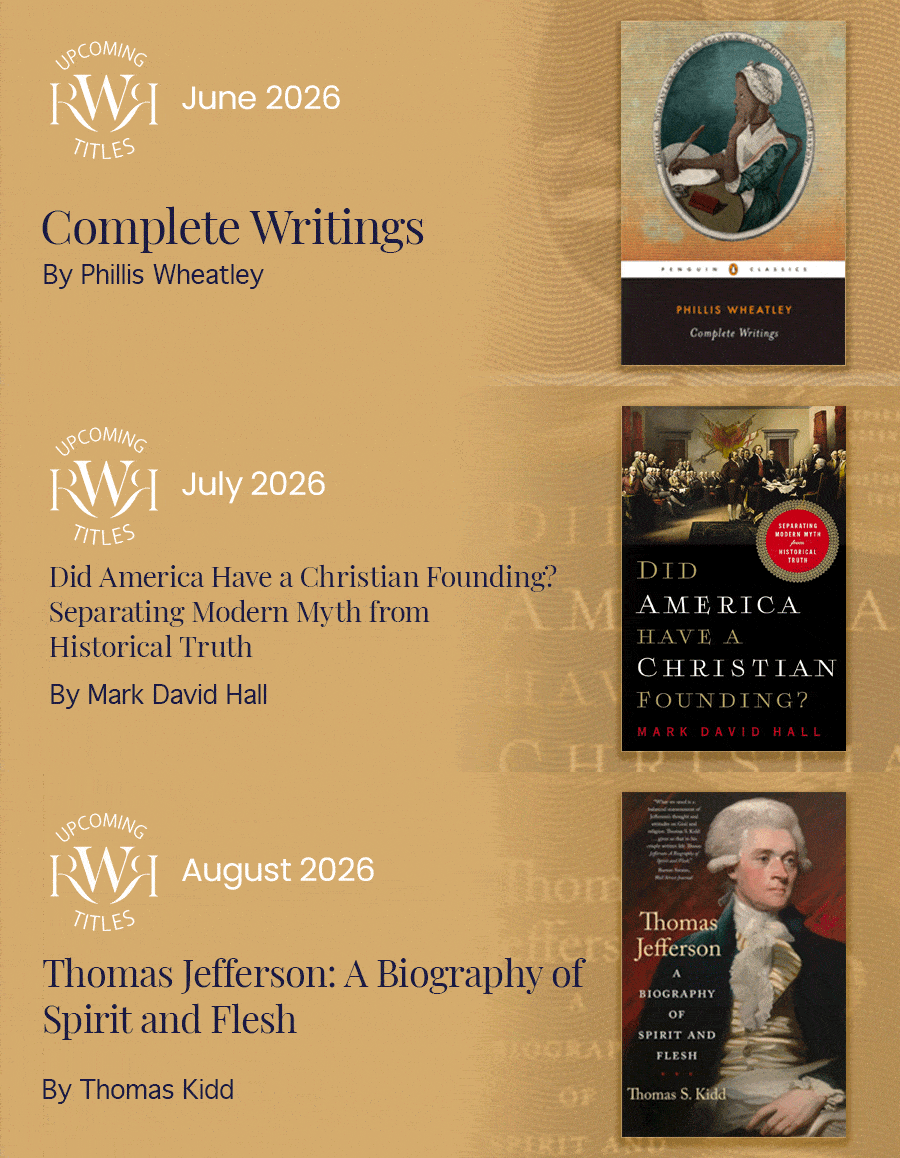

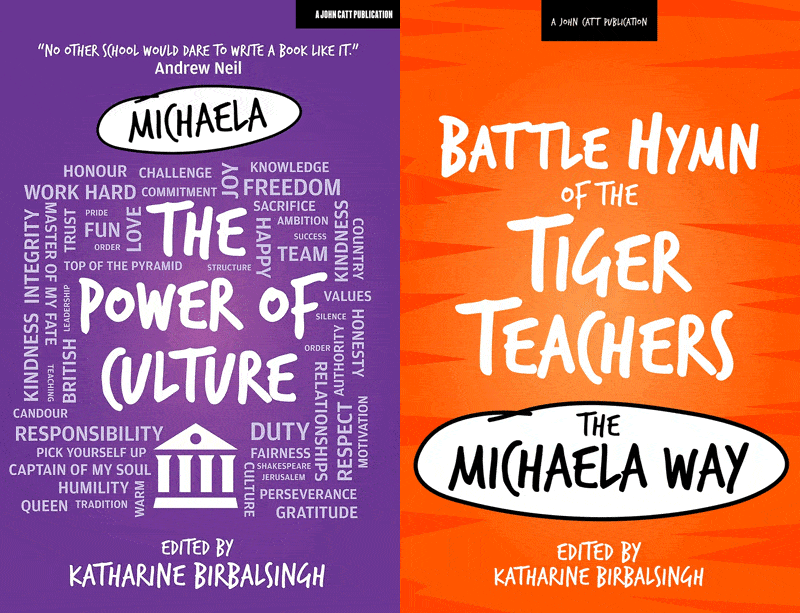
In both The Power of Culture and Battle Hymn of the Tiger Teachers, there is a repeated emphasis on the value of literature within the context of education. Students at the Michaela Community School read a myriad of classic texts, from Shakespeare to Dickens, in addition to contemporary and more immediately relevant books, such as Louis Sachar’s Holes and Robert Swindell’s Stone Cold. As it turns out, it is no mere coincidence that stories play such a prominent role in the school. Prominent twentieth-century philosopher Alasdair MacIntyre writes at length about the concept of humans as being uniquely narrative beings and suggests that storytelling is fundamental to what it means to be human. While he discusses this claim on a philosophical level, I want to focus on what makes stories particularly appealing to humans in general and how those stories can play a key role in cultivating national identity and civic virtue in young students.
Stories are powerful both in an emotional and rational sense. The emotional value of stories is the more obvious of the two. People are constantly engaging in narrative emotional experience, whether that be through movies, social media posts, or news. As humans we enjoy the process of entering into the life of a character and empathizing with their tragedies and victories, scandals and honors. Stories have the power to captivate the heart so that people are spurred to laugh and to cry and to yell in outrage at the appropriate moment in a book or movie. There is a deep extent to which our emotional engagement with stories forms our character. The classical thinkers suggest that the emotional experiences that we gain through pseudo-realities influence the way that people comprehend reality itself. Aristotle observes, “To have the habit of feeling delight (or distress) in things that are like reality is near to having the same disposition toward reality itself.” Thus, when people weep during a movie at the misfortune of a character or spring up in ecstasy at the moment of a close victory, they are actually developing habits of the heart that will transfer over to reality—whether for good or for ill.
At the same time, stories also have a rational, or logical, aspect. Although most people do not parade through life using formal logical syllogisms every time they want to make a point, we subconsciously use and understand stories in a very rational and, at times, argumentative way. For example, think about the way that small children argue when they find themselves facing punishment. They tell stories about how they did not actually do the crime for which they are being punished, or they provide a story that presents their actions in a positive light. Similarly, adults use stories constantly in their everyday lives. In a court case, the prosecution and defense tell stories to win over the rational judgment of the jury, and, in a coffee shop, two friends share their experiences and opinions through relating short narratives. Walter Fisher, a contemporary philosopher commenting on MacIntyre’s insight into the narrative nature of humans, writes that humans have an “inherent awareness of narrative probability, what constitutes a coherent story, and [a] constant habit of testing narrative fidelity, whether the stories they experience ring true with the stories they know to be true in their lives.” People subconsciously test the probability and truthfulness of the stories that they hear and then use those stories to build their understanding of reality.
Because storytelling is so deeply ingrained in human nature, stories play a key role in developing a child’s identity and in inculcating culture and character. Michael Taylor, one of the authors in The Power of Culture, writes, “Humans create shared stories and narrative which allow them to cooperate with other humans, though a unifying culture…. We have also created a shared narrative and identity based on collective traditions, history, institutions, literature and culture.” We see examples of this in a wide variety of contexts. For example, schools in the United States spend a disproportionate amount of time relating stories about heroes—such as the pilgrims, the Founding Fathers, or the leaders of the civil rights movement—when compared to the time that they spend discussing, for example, heroes from Japanese or Kenyan culture. Similarly, religious groups dedicate a large amount of time and resources ensuring that their children are well-versed in the stories of their faith—whether that be the crucifixion and resurrection of Jesus, the acts of Mohammad, or the parables of Buddha—and families frequently spend time sharing anecdotes about their ancestors. It is no coincidence that the three facets of life that are so deeply tied to identity—family, nation, and faith—all employ the use of stories in educating children into a particular heritage. Consciously or not, the leaders of these groups sense that stories are able to convey culture and values in a uniquely powerful way.
Stories are able to develop a strong sense of national identity even amidst a pluralistic or diverse society. One of the unique qualities of the Michaela Community School is that it welcomes students from a variety of religious, cultural, and economic backgrounds. While honoring the diverse backgrounds of the students, Michaela strives to unify the students by fostering a deep sense of national belonging. Although they could have employed countless methods, it is literature that plays a pivotal part in cultivating this national identity in the students. Students read Shakespeare, Dickens, and Sir Arthur Conan Doyle, among others, as they wrestle with the history and values of their country and develop an understanding of how they uniquely espouse what it means to be British. As Michael Taylor says in his essay, “National Identity,” “Learning about our country’s culture, history and geography enriches pupils and prepares them for life in modern Britain. It ensures pupils feel part of something bigger than themselves, giving pupils’ lives meaning and fulfillment.” Whether the students are recent immigrants or their families have lived in England for generations, introducing them to the stories of their nation invites every child to embrace the heritage that they have been offered as inhabitants of the country.
Stories also serve to provide a common language that unifies political and social discourse and strengthens a sense of community among citizens. Another author in The Power of Culture, Jonathan Porter, makes a fascinating point when he says, “By teaching the classics, we free our pupils to be able to converse in their culture…. A British man or woman who knows nothing of Shakespeare cannot be as free as they could otherwise be: they have been shut out from one of the most important conversations of their community and culture, as well as some of the most perceptive, and universal, insights into the human condition.” Although the society may not be as fluent in its classic texts as it was at one time, those same texts have infiltrated the culture more pervasively than one might realize. Consider, for example, the 1999 movie, The Matrix. Although many members of the younger generations may never have seen this movie, almost everyone would know what you meant if you referred to taking the red pill. There are similar examples for countless other stories, but the point is that these narratives provide a common language, a common experience, that unifies a nation.
Building a shared foundation on stories has many implications and applications. For example, the sense of national identity that narratives help to create goes hand-in-hand with cultivating civic virtue, a love of country that induces a desire to act for the country’s good. When discussing the emphasis on national identity at Michaela, author Michael Taylor says, “We
make a real effort to ensure that pupils know that what they have today has not been won lightly, and that they have a duty to preserve it and improve upon it.” The inculcation of national identity should lead students to cherish the heritage that they have received and to strive to preserve and protect it, whether that be through engaging in the culture, staying active in the politics of the country, or other means of participation in the nation’s values. In his essay, Porter says that this kind of civic virtue is only possible when the citizens have a deep knowledge of the country’s heritage. More often than not, that knowledge is conveyed through the ancient legends, heroic tales, and humorous anecdotes that form a country’s narrative.
Furthermore, stories give citizens a context from which to glean insight as they navigate contemporary issues. Porter says that, by teaching the classics, the school gives students “the freedom to take part in the generational questions and conversations of your community.” Directing students back toward how life questions have been answered in the past and showing them what has been valued in their community enables them to navigate those questions and values in the present. The narratives of a country provide guidance on how that people group has responded and interacted with certain issues or even with other people groups in the past and provides a framework for how to respond to similar situations in the present. Ultimately, the stories that we communicate both to our children and to one another shape the way that we see the world and the way that we choose to act in it. Narratives work powerfully as a conduit of culture.
Emma Rodrigues is a graduate of George Fox University and a teacher at St. Stephen’s Academy. She is an alumna of the Shaftesbury Fellowship (’24).