
James Madison wrote to W. T. Barry on August 4, 1822 that “knowledge will forever govern ignorance: And a people who mean to be their own Governors, must arm themselves with the power which knowledge gives.”
Madison, however, underestimated the extent to which ignorance could overtake knowledge in governance, education, and other major institutions. Two centuries of unrelenting rebellion against authority and tradition, and the triumph of the “therapeutic man” (in Philip Rieff’s phrase), has rendered much of modern education hollow and superficial. Schools have overwhelmingly abandoned their historic role in the cultivation of virtue in favor of a materialistic and ideological curriculum. The dominant paradigm in Western education is not the formation of a human person made in the image of God; it is, again in Philip Rieff’s words, a “deathwork” against self-government, liberty, culture, and a meaningful life. The results can be seen in the extraordinary prevalence of mental-health issues among students and their self-destructive radicalism.
To be clear, laying all the blame for our modern crises at the feet of educational institutions would be unfair—but only marginally. The breakdown of the family, plummeting social capital, declining civil society, dismal metabolic and mental health, abandonment of faith and religious traditions, and the increasing corruption and incompetence of government have all contributed to the problem. There is no disentangling the struggles at school from those in the home and the church. No teacher can fill the void left by broken homes and empty pews.
There is hope, however, with a growing army of educators and parents resisting the prevailing paradigms and restoring education to its traditional roots. In England, a particular platoon of resistance has rightly gained international attention for its recovery of a traditional education and its undeniable results. It has also, predictably, provoked the ire of those who cling to the anti-culture of progressivism or to misconceptions about what it even means to be a child.
The Michaela Community School, in the very diverse borough of Brent, northwest of London, is led by Katharine Birbalsingh, who is often referred to as “Britain’s Strictest Headmistress.” The daughter of a Guyanese academic and a Jamaican nurse, Birbalsingh taught in inner city schools until October 2010 when she lost her job for the heinous crime of telling the truth. Speaking at a Conservative Party Conference, she simply stated, “The (education) system is broken because it keeps poor children poor.” This, of course, is heresy in the progressive philosophy dominating Western education since at least John Dewey’s time. And, like most modern cultural heretics, she paid for her candor with unemployment, racism, threats, and more.
Today, Birbalsingh and her school remain controversial, but only to those who have deeply absorbed the intuition of critical theory, identity politics, and other spawn of Rousseau, Marx, and Freud. To those of us recovering an older and more humane tradition, she and her fellow teachers seem refreshingly sane and genuinely courageous. It is all the more surprising, then, to learn that Michaela is a free, state-funded, and independently run school. Time will tell if the recent political shift in the UK bodes well for them.
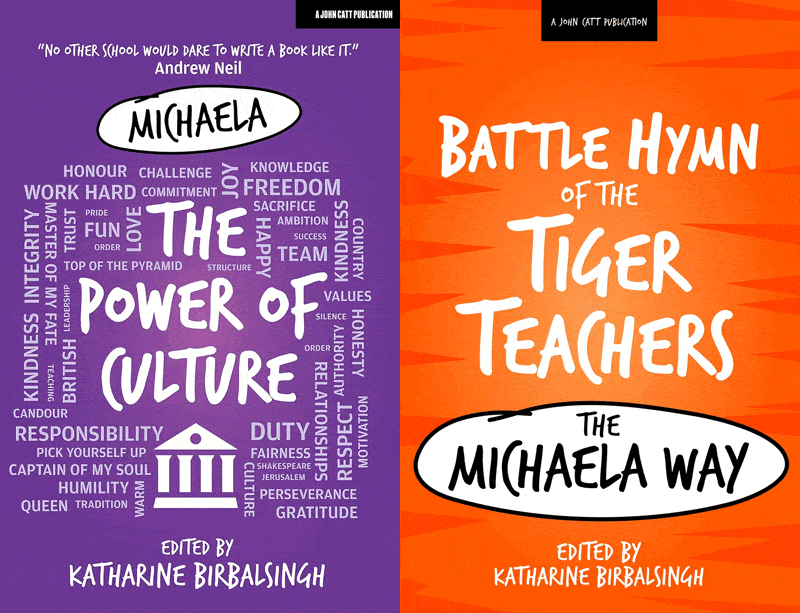
In their recent book, Michaela: The Power of Culture, the faculty and staff of the school focus less on pedagogy and more on the underlying assumptions and espoused values that distinguish Michaela. Contrary to the cultural left and many of those on the right, the Michaela School does not focus on teaching kids how to think. It focuses, rather, on sharing knowledge upon which the children build a foundation for greater understanding.
The school is deliberately resisting the belief that, in order for pluralism and multiculturalism to work, we must foster relativism and a kind of “public nihilism.” For some, cultures can only live and work together if our institutions—not just the government—are utterly indifferent to moral and cultural questions. In practice, this never actually happens. Instead, the prophets of multiculturalism advocate for radical autonomy and identity politics, dividing students into privileged and oppressed, dominant and dominated. Birbalsingh deplores this tendency and rightly blames the U.S. as its primary exporter. But this is just one part of the problem, as Birbalsingh explains:
I now think that victimhood culture, lack of family support, inappropriate music choice and friend choice, refusal to take personal responsibility, inability to embrace one’s duty, inability to be grateful for what one has (however little it is), and peer pressure to conform to the ways ‘of the street’ over academic pursuit are devastating obstacles in children’s lives.
Put another way, the prevailing belief is that children are born innocent and good and if left to themselves, they may find their way to happiness and success. Failure to do so is often not their fault, however. Instead, they come up short because a particular tradition or some group of individuals has deliberately rigged the “game of life” against them. The child, then, is not a person who needs to be developed and deepened, but an autonomous and highly advanced primate longing for freedom. On their journey to realize that freedom, they are owed all manner of excuses and therapeutic escapes.
To be sure, neither I nor the Michaela School teachers deny the existence of victims and corrupt, oppressive systems; nor do we dismiss the reality that many children face profound obstacles. But if educators begin from the premise that each child is an innately good individual waiting to be set free from all external constraints, then we are, paradoxically, cultivating both slaves and rebels. A student brought up in a victimhood culture never knows who to trust or believe, and they are not likely to have much hope for themselves or their work. They can “fight the power” or simply give in, never really knowing why either would be preferable. And they are often driven to the isolation and alienation so characteristic of our current moment.
The Michaela School’s “small-c conservative values” emphasize a different view of the human person. For Birbalsingh and her teachers, the student is of infinite worth and dignity, but they need direction, guidance, and affection. They need to grab hold of a tradition and purpose larger than themselves. The Michaela School especially emphasizes respect, trust, accountability, affection, gratitude, and humility. The book surveys how each area of the school’s curriculum and governance views itself as responsible for maintaining this culture. Indeed, what is immediately clear from the collection is just how successful the Michaela School has been at cultivating a shared central vision and purpose.
This gives rise to an element of Michaela’s design that is critical to understanding its success: the cultivation of authority. In the Western world, authority is viewed as inherently oppressive and inimical to creativity. But the lack of authority and order simply leads to the loudest and strongest overpowering others because, “like energy, we cannot remove authority; we can only move it elsewhere.” And in a school lacking authority, it inevitably moves to the bullies and the pressure of majorities – real or perceived. But teachers are often loath to assert authority because they are unsure whether their superiors or students’ families will back them up. Shutting down a student in class for offensive remarks or calling for some disciplinary action might provoke the ire of one’s colleagues, educational bureaucracy, social media, and student mobs.
Michaela, however, has cultivated a culture in which the assertion of authority and discipline is tied directly to its principles of gratitude and affection. The rules, expectations, and consequences are clearly stated and communicated. Students know who is in charge, and it is not them. They see, rather, that authority rests in the hands of people who care about them. The result has been a very low number of behavioral problems, class disruptions, violence, student anxiety, and exclusion.
It needs to be said, however, that there are blind spots in models such as that at the Michaela School and among my friends in classical education: there is not enough attention paid to genuine learning disabilities and special needs. To be sure, I do not think the standard responses of public education to these same concerns are working and I do not have an answer myself. For my family, we meet these challenges through homeschooling. That may be the only way to do it, since the schools necessarily rely on models and curricula. Too much flexibility would undermine what they’re doing, though insufficient flexibility may stifle creativity and resilience. While many learning disabilities and behavioral disorders are clearly over-diagnosed, they are real. There is a massive need for greater research in how classical and traditional educational models might respond more proactively to special needs students. In some cases, I suspect the traditional model is actually very beneficial, in other contexts it may have diminishing returns.
Second, I question the sustainability of a model untethered from a unifying faith tradition. In the chapter on religious education, Sarah James, explains how Michaela wants its students to appreciate the rich tapestry of belief in hope that this knowledge will strengthen understanding and cooperation amidst religious diversity. But it’s also to resist a disturbing amount of religious illiteracy. As James summarizes, “A survey report by the Bible Society showed that 27% of the British population believed Superman was or could be a biblical story. Included among these ‘biblical stories’ were the Hunger Games and Harry Potter.” Christianity at Michaela is given the greatest amount of attention due to its long history in Britain. Ignorance of basic Christian beliefs and Biblical teachings is not a badge of honor, but the mark of an unserious intellect.
There is much to recommend in Michaela’s efforts to take all faiths seriously and respectfully. But without committing to a specific faith tradition, it risks leaving a void similar to that left by a lack of authority. To be sure, Michaela cannot function otherwise given its status as a state institution. But on the deepest and biggest questions which faith responds to, the students remain vulnerable to peer pressure and majorities unlikely to lead them toward truth. A school that commits exclusively to one faith tradition can do everything that Michaela does, but with more robust roots culturally and historically. An exclusive faith commitment also contextualizes the faculty’s authority in a source beyond the confines of a particular time and place.
A common faith tradition also helps hold together the entirety of the students’ experience and learning. For Christians, the truths of the Bible are the great backdrop on which the entire drama of reality plays out. It is not merely one set of beliefs that helps us act ethically and make sense of the world. It is the truth on which we ground all our existence, our relationships, and purpose. While I am firmly in agreement with the American Framers on the First Amendment, an education that remains neutral on its religious commitments leaves a back door open to forces at odds with the entire project.
Still, in a world bent on escaping reality and authority at all costs, the Michaela Community School’s existence and success is encouraging. It is the kind of institution I would send my own children to, and it is a model worth emulating across the world.
Josh Bowman is the Executive Director of the Ciceronian Society.