

The image of the individual suffuses the American imagination. Every aspect of the American constitutional order is described in terms of individualism, and American liberty in terms of individual rights. The images we conjure when we hear the Declaration’s promise to secure the rights of life, liberty, and the pursuit of happiness is that of the necessity of legal protection for each individual to preserve his own life and live free as he sees fit in a manner that achieves his own happiness as he subjectively understands it. When the Constitution promises to “secure the blessings of liberty to ourselves and our posterity,” we assume it means each individual, now and forever, is secure in his own individual liberty to do what he likes.
A similar image results when we hear “We the People,” the entity in the Preamble that ordains and establishes the Constitution. It conjures a republican version of the cover image for Thomas Hobbes’ Leviathan: a sovereign with sword and scepter composed of a sea of individuals distinguishable only by their miniscule individuality, but otherwise having no defining features. When we describe “the people of the United States” ratifying the Constitution, we describe it in individualist terms, as if ratification was a vast referendum through which all individuals, or at least a majority of them, assented. Even those who recognize that the ratification process took place by state fail to account for the actual process at the state conventions. I get the sense they still imagine a referendum of all individuals at the state rather than national level—a point to which I will return.
When we think about exercise of the rights secured in the Bill of Rights, what do we see? I suspect most imagine an individual praying alone; an individual speaking from a soapbox; an individual keeping and bearing a gun; and an individual living alone on his property, secure in his person, house, papers, and effects from unreasonable searches and seizures.
No matter how we approach the American political order, through liberal rights or republican government, the image of individualism is ascendant.
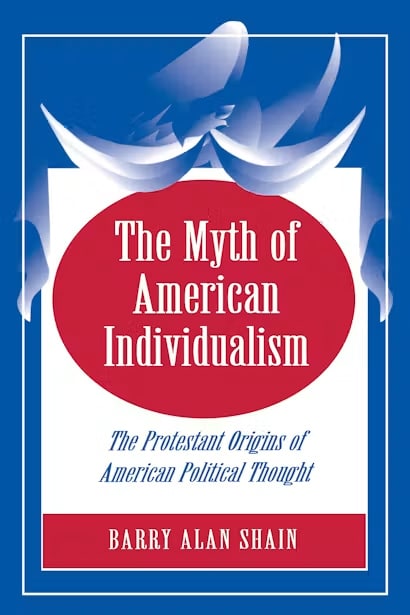
Barry Alan Shain’s The Myth of American Individualism denies the legitimacy of these images. American liberty is not primarily individual liberty; it is corporate and spiritual. Americans at the Founding were embedded in Protestant covenantal theology. They spoke of liberty, but the liberty achieved was freedom from sin, freedom to live rightly. The primary way to achieve that type of freedom is through community with others under legitimate earthly authorities, both spiritual and social. Shain writes, “From the moment of settlement, in an almost reactionary stance, the village, township, or county community sought to be the center of Americans’ self-directing communal lives.” Theologically, Americans believed the individual was sinful, in need of correction. Such local communities, composed of not only the towns but also families and churches, “must play a prominent and intrusive role in defining the ethical life of individuals by placing limits on individual autonomy. Without such barriers, a well-lived life was believed impossible.”
The implication of Shain’s remarkable thesis profoundly reshapes our understanding of the republican and liberal nature of the American constitutional system. What follows is an outline of what it might mean to take Shain’s claim seriously when reading the Bill of Rights.
The first eight amendments, purportedly a grand covenant among that aggregate of individuals composing the American people to secure their individual rights from their government, are really something more than that. If we read them with Shain’s insights in mind, we come to realize an extension of our understanding of what these rights mean. Rather than seeing the individual’s realm of autonomy contracting, we find that it expands.
Some rights we find there are rightly individual, and it would be a great political and moral sin to treat them otherwise. Consider the rights of the Fifth, Sixth, Seventh, and Eighth Amendments, each protecting criminal defendants vulnerable in their isolation before the overwhelming power and aggression of the state. Surely these rights should attach to the individual person, and rightly do we dub them individual rights. An individual and no one else is responsible for his behavior, for whether he follows the law, and legal protections in criminal law recognize this fact. Few things are worse than imputing the guilt of one person upon another.
What of the First, Second, Third, and Fourth Amendments?
Consider the First Amendment’s protection for religious liberty, free speech, free press, free assembly, and the right to petition for a redress of grievances. Individual conscience surely plays a role in the free exercise clause, but the very use of the term invites inquiry into how we primarily exercise our religion. The answer is through religious institutions. The clause invites an institutional reading. To exercise religion, an individual requires a religious community holding services wherein the individual can then participate. To be such, a religious community must be immune from political intrusion to hold services, hire clergy, and discipline members according to the dictates of institutional teaching, the collective conscience of the religious community.
Free speech and free press, our vaunted expressive freedoms, are perhaps most prone to description in individualist terms. The individual may express his views through the spoken and the written word, and the government may not punish such expression. But is this how the exercise of free speech and free press happens most of the time? Unless we speak into the void, free speech requires at least two interlocutors. Most saliently, as the Supreme Court has recognized in a variety of cases, free speech must include the right to form expressive associations, those institutions through which we join with others to advance our views and, more importantly, through which our views are shaped. These associations have the authority to expel those who would hamper the expressive purpose of the group. Sure, the soapbox speaker may speak, but is that how we primarily experience this essential freedom? Or is it through the authoritative actions of our expressive associations?
Freedom of the press is seldom detached from institutions and, in practice, generally features multiple individuals in various roles (such as writing, editing, and publishing) working together to produce the press. In short, this right generally involves institutions. Look no further than the names of the famous free press cases. We find titles like New York Times Co. v. Sullivan, New York Times v. United States, United States v. Washington Post Co., Department of State v. Washington Post Co., and the like. Even the famous 1735 John Peter Zenger case named an individual, but he was responsible for printing articles written by others. The case involved expression, but the facts immediately demonstrate that Zenger did not work alone. As a publisher, he worked in conjunction with others to bring their criticisms of government authority to the fore.
Freedom of assembly most obviously conveys my point. As First Amendment scholar John Inazu has argued in Liberty’s Refuge: The Forgotten Freedom of Assembly, the right of assembly is inherently relational. If you are alone, by definition, you are not assembling. The assembly clause hasn’t been treated in a major Supreme Court case in over forty years. The likely reason is the emphasis upon First Amendment rights as individual rights. The individualist lens obscures the relational implications of the right of assembly, and our First Amendment jurisprudence is poorer for it.
Finally, the right to petition the government for a redress of grievances is an ancient privilege, dating from the latter half of the tenth century. It plays a prominent role in the Magna Carta, where it serves as the enforcement mechanism against the king, but it required a group of barons petitioning the king together to redress their grievances and right the wrongs done by his court and ministers. Similarly, throughout the subsequent centuries on both sides of the Atlantic, petitioning for a redress of grievances nearly always involved a class of people with a grievance, whether it was the seven bishops petitioning for exemption from King James II’s mandates in seventeenth-century England or abolitionists petitioning to end slavery in nineteenth-century antebellum America.
Other amendments invite a similar analysis. The Second Amendment protects the right to keep and bear arms, surely an individual right, although it is asserted in the context of militias, creatures of the local community. In District of Columbia v. Heller, the justices on the Supreme Court debated where to locate the right, whether in the ability of the community to summon the militia or in the individual to bear arms, but the answer surely is both. The individual may defend himself, and so may the local community, and we really can only understand the individual’s ability to defend himself in light of the community’s ability to do the same.
The Third and Fourth Amendments protect against the quartering of soldiers and unreasonable searches and seizures, respectively. Property rights are the subject of both, and both implicate a particular type of property: the home. If one reads these amendments through the individualist lens, this appears to be protection for the individual’s property. If we adopt the relational lens, we are reminded that the home is where families are raised. Protection against quartering of troops is protection of the historic use of property, which is to sustain a family. Similarly, protection against searches and seizures is protection against the government, in the words of “A Son of Liberty,” terrifying “the most delicate part of our families.” Protection against intrusions into our houses implicates more than the individual’s legal right to property, but the very purposes to which property is put: the sustenance and protection of family.
As discussed throughout, individual rights are not discounted by adopting Shain’s perspective. The individual conscience and reason play ineradicable roles in the rights discussed here. However, individual conscience and reason mean little without the presence of substantive communal investment and opportunity for practice.
Shain’s perspective further sheds light on the republican nature of our system. We claim “the people” as the legitimizing force for our constitutional order. If the people are merely an aggregate of individuals, it is difficult to see how this is true. What is it that we all do together? From the beginning, from the very ratification of the Constitution, the answer is, “Nothing.”
Returning to the state ratifying conventions, votes were cast by delegates of towns and counties. The decision by “the people” to ratify the Constitution was the decision of a majority of localities—not, strictly speaking, a majority of individuals—within each state. These localities operated as communities, as unities, who chose their own delegates and had the option of binding their delegate’s vote. The ratification process would indicate that “the people” of the United States who established the Constitution were really the people of the towns and counties, each with its own vote.
All this to say that if Shain is right in his fundamental argument, the general right of association, the right of community, is not a derivative right, one that logically follows from the individual rights we find in the Bill of Rights. Rather, the right of community is the essential right of which all the others are various manifestations. Communities of civil society are essential beneficiaries of our constitutional system of rights and liberties—and the individual is better for it.
Luke C. Sheahan (Ph.D., The Catholic University of America) is associate professor of political science at Duquesne University, a senior affiliate in the Program for Research on Religion and Urban Civil Society (PRRUCS) at the University of Pennsylvania, and editor of The University Bookman. He is author of Why Associations Matter: The Case for First Amendment Pluralism (2020) and editor or coeditor of three books on freedom of speech and freedom of association.