
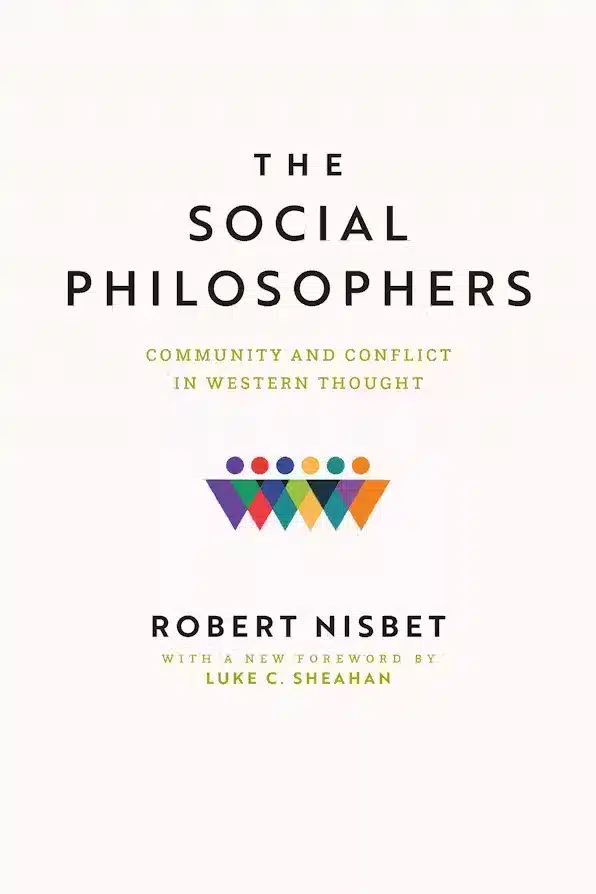
In 1953, Robert L. Heilbroner published The Worldly Philosophers, now in its seventh edition, and spoke to a popular audience about the role of economic thinkers and economic thinking in our understanding of the world. What Heilbroner did for economic thought three quarters of a century ago, Nisbet did for social philosophy in The Social Philosophers a half century ago. Here he lays out the ways in which the quest for community has dominated not only the history of the human race but also our thinking since man’s earliest attempts to explain our place in the world through philosophy. Answers have varied, as this book explains, but the quest continues to this day.
Nisbet defines community as the “relationships among individuals that are characterized by a high degree of personal intimacy, of social cohesion or moral commitment, and of continuity in time.” The basis of those communal relationships includes war, politics, religion, revolution, withdrawal, and plurality. Nisbet admits that his list is not exhaustive. His fundamental premise is that the central goal of social philosophy for millennia is to determine which of these sources is the best and most perfect form of community. Nisbet writes:
From Plato’s lasting portrait of the political community, written amid scenes of perceived breakdown and of alienation, through Augustine’s masterful detailing of religious community in his City of God through the vital and influential works of Sir Thomas More, Hobbes, Locke, Althusius, Rousseau, and many others, down to Marx’s brilliant vision of socialism, to Tocqueville’s premonitions of mass society, and to Kropotkin’s memorable essays on mutual aid and anarchism, the overarching quest of these social philosophers has been, I suggest, the quest for community.
The reforms of Cleisthenes destroyed the tribal organization of ancient Athenian society and made way for the Athenian polis, the essential political context for one of the great ages of philosophy and arts. It was precisely the collapse of the kinship community and the rise of the political community that would orient philosophy toward the quest for the true community. Without the primal communal cohesion of tribe and clan, human beings sought sources of community beyond kinship. In due time, Nisbet argues, three major types of community emerge as alternatives to kinship: war, politics, and religion. Like primordial kinship, each is monist in that it insists upon absolute unity under the absolute supremacy of its own communal purpose: War for reasons of war-time exigencies, politics for reasons of order, and religion for reasons of eternal salvation. All other forms of community, including kinship, are perceived as threats to each of these purposes.
The collapse of kinship arises in the context of war, as the community under the general competes with kinship under the patriarch and matriarch for the loyalty of individuals. Historically, Nisbet traces this pattern from ancient Greece and Rome to feudal and early modern Europe to the French Revolution and beyond. Throughout, the language of war undergirds the understanding of community.
In due time, the war community becomes the political community but maintains several of the farmer’s essential ingredients. Just as in war authority is centralized under the warlord, so in political society authority is centralized under the sovereign, whoever and whatever it may be. The great theorists of the war community, such as Karl von Clausewitz, understood this fundamental relationship between war and the political community. Nisbet writes:
[H]istorically and sociologically there is the closest relation between war and the state. There is no known historical instance of a political state not founded in the circumstances of war, not rooted in the distinctive disciplines of the war-making apparatus; its earliest function everywhere is exclusively military; its earliest rulers, generals and war lords. Only much later begins the work of transferring to the political arm functions previously resident in other institutions; family, religion, and voluntary association of one kind or another. Only later too, when philosophy becomes one of the creations of the human mind, begins the work of seeking other than military justifications for the institution of the state.
That work begins in Plato, who conceived of the political community as the highest community, not only for the function of establishing order, but for the function of securing justice and true community. Similarly, Thomas Hobbes understood the political community in terms of salvation from social disorder. Jean Jacques Rousseau, more than any other, conceived of the political community as the absolute community, absolute in its all-encompassing sense of justice and morality, subsuming the partial communities of family, religion, and locality.
Although history first birthed communities around war and politics, with the emergence of Christianity, religion laid claim to the mantle of the true community. Whatever the City of Man might do and whatever it might be, it was in Augustine’s City of God that persons found their true rest, their highest form of community, one that eclipsed in claim all others beneath it. Membership in the family and citizenship in the city are secondary to citizenship in the City of God.
War, politics, and religion, Nisbet tells us, are the primary enduring bases in the human quest for community. Read a headline today and tell me he is wrong.
Against this dominant communal trifecta, alternatives emerge. Nisbet only tells us of three. The first two are responses to a failure of war, politics, and religion to provide meaningful community. In the case of such threefold failure, the quest for community leads one to either revolution or withdrawal. The revolutionary community requires an overturning of the present order, tending to incorporate aspects of war, politics, and religion into its sense of community. The ecological community, as Nisbet calls it, is driven by the need for withdrawal from the conflicts and crises of war, politics, and religion to live in harmony, separate from the corruption of the world around.
Finally, there is a strain of social philosophy that has rejected the monistic assumptions at the heart of the communities oriented around war, politics, religion, and revolution. This type of community accepts the legitimacy of each community as well as the limits of each. The plural community begins with the assumption of plurality, that there is an irreducible variety of communities, each making differing but overlapping claims on persons, and those claims will be limited to the core functions of the community itself. Rather than trying to solve conflict between communities, it instantiates such conflict in its very structure. Nisbet calls this community “the plural community.” It is for him perhaps “man’s last best hope,” a way in which the functional needs of war, politics, and religion can be reconciled with each other and given their due, while constrained from taking over the whole.
Nisbet’s discussions of each type of community combine historical and philosophical analysis, demonstrating the theoretical underpinnings of each type of community, the major thinkers who worked within that general motif, and the main instantiations each type of community has taken in history. His writing and analysis are accessible to the undergraduate with professional guidance, but they yield dividends to the scholar and thinker as well. The organization of the material provides a unique perspective that demonstrates continuities between thinkers across great spans of time and space in a way obscured by strict chronological accounts of social philosophy.
All this to say that The Social Philosophers is, in short, an essential enchiridion on social philosophy and one that, I hope, will now take its proper place as a primary guide to the subject.
Luke C. Sheahan (PhD, Catholic University of America) is associate professor of political science at Duquesne University and a non-resident scholar at the Program for Research on Religion and Urban Civil Society at the University of Pennsylvania. He also serves as editor of The University Bookman.
This essay is excerpted from Luke Sheahan’s foreword to The Social Philosophers. Read more here.