

Why in America?
In December 1815, Hezekiah Niles reflected on the impressive pace of American economic development in the Baltimore magazine Weekly Register. Although population in the young republic had rapidly increased, wealth had increased more, defying the logic of Thomas Robert Malthus’s 1798 Essay on the Principle of Population.
What accounted for this remarkable prosperity? Niles pointed to three interrelated factors. He first drew attention to “facilities afforded” or resource endowments: “The climate is healthy, land is plenty, [and] the soil is bountiful.” He turned to the wisdom of American laws: “industry is rewarded and enterprise walks forth unrestrained—and the people are free.” He concluded with a less tangible but no less important ingredient. Americans, on his account, seemed to be uniquely possessed with “an almost universal ambition to get forward.” Niles perceived a spirit of improvement and progress animating the bustle of American commercial life.
Niles was not alone in this perception. In 1835, Alexis de Tocqueville catalogued something similar in Democracy in America. He speculated that the American merchant-adventurer dominated his foreign counterpart not because of his superior resources, but because of his rigorous and disciplined spirit. “The Americans affect a sort of heroism in their manner of trading.” The American “follows not only a calculation of his gain, but an impulse of his nature.” Elsewhere, Tocqueville complemented these observations with some broader comments on American attitudes towards work. He explained that in America, “professions are more or less laborious, more or less profitable; but they are never either high or low: every honest calling is honorable.”
The commercial spirit noted by Niles and Tocqueville in America grew out of a revaluation of for-profit commercial enterprise in the early modern period. For-profit commerce had long been denigrated in the Western world. The sixth-century Christian statesman Cassiodorus reflected a common sentiment when he declared merchants to be “an abomination because they neglect the righteousness of God for an inordinate desire for money.” Such views had been and remained commonplace for many centuries to come. By the beginning of the eighteenth century, however, moral evaluations of commercial life had begun to change.
British playwright and author Richard Steele struck a chord with popular opinion when he proclaimed the merchant—far from an abomination—to be “the greatest benefactor of the English nation.” The great evangelical reformer John Wesley was preaching to the choir when he exhorted the faithful to pursue maximum profits through honest industry. The Presbyterian minister John Witherspoon proclaimed a common trans-Atlantic sentiment when he declared, in one of the most significant sermons of the American Revolution, that “industry … is a moral duty of the greatest moment, absolutely necessary to national prosperity, and the sure way of obtaining the blessing of God.”
These men, along with many of their contemporaries, had come to see for-profit commerce as a presumptive social good. They believed one could do good, in ethical terms, while doing well materially. They understood commerce to be a mode of cooperating with God in promoting the benefits of neighbor, community, and nation. The conviction that doing well facilitates doing good, in conjunction with an increasingly expansive horizon of opportunities, contributed to the pervasive commercial spirit of the age, not least in the fledgling American republic. But what drove the revaluation of for-profit commercial enterprise to begin with?
For the Love of Neighbor
In explaining the rise of modern commercial spirit in The Protestant Ethic and the Spirit of Capitalism, Max Weber foregrounded theological developments emphasizing the importance of pursuing and flourishing in an earthly calling—a vocation. Such theological developments, which grew out of a complex of humanist and Reformed teachings, surely mattered a great deal (although not, in my view, in the precise way that Weber thought). But while they may have been necessary, they were not sufficient. To proclaim that one ought to pursue an honest calling in this life for the glory of God and the good of neighbor begs two questions: What kinds of callings are honest, and how, exactly, do they glorify God and serve our neighbors? Answering these questions calls for theological reflection. But theology requires partner disciplines to corroborate and further elaborate its conclusions: jurisprudence, ethics, politics, and, of course, economics.
The discipline of economics grew up in the early modern period alongside an array of philosophical and theological efforts to answer, in an age of increasing commercial complexity and financial sophistication, the question: Who are my neighbors, and how do I make my love for them effective in practice? In the young discipline of economics, which deployed theoretical and empirical methods to study the production, distribution, and consumption of material wealth, moral philosophers and theologians found fresh resources to assist them in their inquiries. Economics—or “political economy,” as it first came to be called—was embraced by many not as a dismal, mechanical science but as a way of understanding how to organize and improve society given the Christian imperative to love our neighbors.
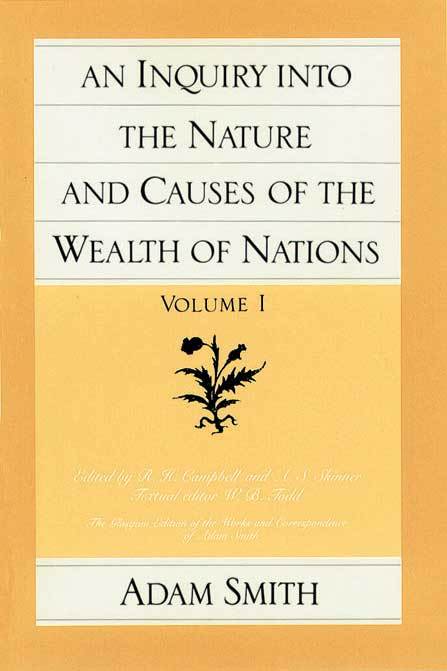
Many early political economists gave support to the basic proposition that the profit of the one need not be seen as a threat to the profit of the many. The material betterment of a neighboring family, a neighboring community, a neighboring nation does not detract from but adds to the potential to better our families, our communities, and our nations. The realization of these mutual benefits does not require much in the way of state supervision. Flourishing social and economic orders are not fundamentally a product of conscious human design, but an emergent outflow of humans living their lives and pursuing their ordinary interests within the boundaries of the natural moral law. In the final decades of the eighteenth century, these perspectives came increasingly to be associated with one name and one book: Adam Smith and An Inquiry into the Nature and Causes of the Wealth of Nations.
Why Smith?
Joseph Schumpeter was partly correct when he asserted in 1954 that Smith’s great book did not “contain a single analytic idea, principle, or method that was entirely new in 1776.” Many of the ideas for which Smith is now famous can be found in earlier writers, including in the work of Smith’s teachers and his closest friend David Hume. But this does not detract from the originality and significance of Smith’s work. The Wealth of Nations was by far the most systematic and ambitious treatment of political economy in history at the time of its publication. It provided a great synthesis of existing economic insights, placed alongside a set of policy recommendations. Perhaps most importantly, it offered, especially when paired with Smith’s earlier work, The Theory of Moral Sentiments, a penetrating ethical assessment of the virtues and vices, the promises and pitfalls, of modern commercial society. Smith’s works together give us not merely an inquiry into the nature and causes of wealth and a theory of moral psychology, but a wider inquiry into the soul of commercial society.
The wider arc of Smith’s inquiry resonated in the eighteenth century, reinforcing and invigorating the dawning commercial spirit of the age. In his work Religion and the Rise of Capitalism, R. H. Tawney wrote that the progress of seventeenth-century economic thought “fortified the mood … which glorified the economic virtues” of Puritanism. Something similar can be said about the progress of eighteenth-century economic thought generally and Smith’s Wealth of Nations in particular. The Wealth of Nations illustrated the logic of mutual benefits in more concrete terms and at greater length than any previous work. The book presented an authoritative demonstration of how individuals often serve the good of others by doing well, even if serving others forms no part of their intentions. Smith’s writing valorized a life of commerce as not merely useful but ethically meaningful.
To rehearse but one of Smith’s famous arguments, the butcher, the brewer, and the baker meet our needs because we meet theirs; together we promote the good of still others about whom we are unaware. Our exchange patterns promote specialization and an extension of the division of labor. The division of labor enhances productivity; it encourages innovation and capital accumulation; it simultaneously pushes wages up and prices down; it brings forth material abundance and convenience. As the size of the exchange nexus expands, even spreading across national borders, productive returns increase and wealth grows. Smith wrote in the final edition of The Theory of Moral Sentiments—the last thing he wrote—that each nation “ought not only to endeavour itself to excel, but from the love of mankind, to promote instead of obstructing the excellence of its neighbours.”
Smith never condoned avarice. Nor did he smile upon lavish self-indulgence—his thought has more than a touch of Weber’s “this-worldly asceticism.” But he recognized that even avarice and self-indulgence have some beneficial social tendencies, so long as they are bound by laws and moral norms in service of liberty, equality, and justice. He illustrated, for example, how price speculation in grain markets—feared as much as witchcraft, he said—promotes abundance in large, well-integrated economies. When a speculator anticipates future price increases, perhaps due to a coming dearth, he withholds current supply. If his anticipations are correct, he sells in the future at a premium. This might smack of injustice to observers; but the speculator’s desire for gain has in fact, Smith explained, effectively moved resources across time from a moment of plenty to a moment of need. Not even financial speculators can escape the guidance of the invisible hand.
The meaning of the famous “invisible hand” metaphor and the role of theology generally in Smith’s economics is a subject of ongoing debate. But Smith’s political economy was clearly interpreted in theological terms by many of his Christian contemporaries and close followers, including the clerics Thomas Robert Malthus, Thomas Chalmers, and Richard Whatley. Whately summarized what he took to be a central Smithian proposition: “Man is, in the same act, doing one thing by choice, for his own benefit, and another, undesignedly, under the care of Providence, for the service of the community.” This proposition was of course not unique to Smith. It found expression prior to Smith in the works, for example, of Richard Baxter, Pierre Nicole, John Locke, Francis Hutcheson, Joseph Butler, and Josiah Tucker. In some broader sense, as an essentially Christian proposition about God’s providence and nature and totality of divine sovereignty, the idea reaches straight back to the Old Testament. But Smith recast the proposition anew. He provided compelling evidence for its truth with the language and tools of economic analysis.
Smith and America
Although by no means solely responsible for the American spirit of capitalism, Smith’s work was of a piece with the nascent American economic mind of the eighteenth century. It is true that “the [American] Revolution,” as John Adams wrote to Thomas Jefferson in 1815, “was in the minds of the people, and … was effected, from 1760 to 1775,” before the outbreak of war. But the ideas presented in The Wealth of Nations, published March 9, 1776, complemented the emerging American mindset, both for the ethical defense it presented of ordinary commercial striving—what Jefferson called “the pursuit of happiness”—and for its implicit support for American independence.
John Witherspoon, in an address published in early 1777, summarized the main arguments about the American colonies from The Wealth of Nations (although he did not mention Smith by name). The colonies, Witherspoon argued, were too expensive for Britain to profitably maintain. The much-vaunted exclusive access that Britain enjoyed to the American market under the Acts of Navigation was much less advantageous than it seemed. As Smith had pointed out, this exclusive access distorted British trade patterns, making them overly dependent on a single channel of exchange. Witherspoon continued that since trade is “founded upon interest,” America will be “as open [to the British] as ever after peace is settled.” The prospering of an independent America need not be taken as a threat to the British Empire; indeed, “the success and increase of one nation is, or may be, a benefit to every other.”
In addition to Witherspoon, arguments from The Wealth of Nations were adopted and adapted in America after 1776 by James Madison, who likely drew inspiration from Smith in his own subtle commentary on factions in Federalist no. 10; by Alexander Hamilton, who parted ways with Smith in his own Report on Manufactures, but who nonetheless showed himself to be a close student of Smith’s ideas; and by James Wilson, who used Smith across several works, notably in a long speech on banking delivered in 1783. Wealth of Nations quickly found its way into American college libraries and curricula, and by the nineteenth century its main ideas had been explicitly incorporated into leading textbooks in political economy. One of these was the Elements of Political Economy, by the Baptist president of Brown University, Francis Wayland. Wayland taught his students, in a thoroughly Smithian vein, that “every benefit is mutual; and we cannot, in the one case, any more than the other, really do good to ourselves, without doing good to others; nor do good to others, without also doing good to ourselves.” Smith inspired a movement of nineteenth-century American political economists, including Wayland, that Henry May aptly dubbed the “clerical laissez faire.”
Outside of the classroom, Smith had been cited occasionally in debates surrounding the constitution in the late 1780s. Smith’s name had begun to appear more frequently in congressional policy debates about trade policy in the nineteenth century. In the controversy surrounding Henry Clay’s “American System” in the 1820s, both free traders and protectionists claimed the name Smith to support their positions. Free traders pointed to the thrust of what Smith himself described as an “attack” on the protective measures and regulations of the British mercantile system; protectionists supporting the American System latched on to the several pragmatic exceptions Smith made to free trade, deploying an “even Adam Smith”-style rhetoric that remains common to this day. Whether the protectionists or free traders had the more compelling case is beside the point here. What is important to see is that Smith had, by the nineteenth century, become something more than an academic figure. He had become a moral authority—an icon even—which he remains to this day.
Harmonizing Sentiments
Although he was Scottish, Smith’s ideas had and continue to have a strong resonance in America. This is not coincidental, for Smith’s moral vision and that of the American founders were essentially cut from the same cloth.
In mounting his case for American independence, John Witherspoon claimed to be reasoning from “rational and liberal” principles. Elsewhere in his writing, he elaborated a “liberal way of thinking” characterized by a view of the mutually beneficial potentials of economic life. Witherspoon’s use of “liberal” maps almost directly on to the way Smith used the term to articulate the heart of his political economy: “the liberal plan of equality, liberty, and justice” in which each is free to pursue “his interest his own way.”
To be liberal for Smith is to hold that all individuals, from street porters, to politicians, to philosophers, are moral and spiritual equals. It is to hold that the purpose of the state is simply to enable the peaceable, voluntary pursuits of individual goals by protecting liberty and property. It is to hold a generous vision of the potentials of voluntary society, including the market, and to maintain that social order is not fundamentally a product of political mediation.
Smith did not much use the language of rights in his political analysis. But his liberalism is nonetheless parallel with that of our founders, who proposed that all are created equal and endowed with inalienable rights to life, liberty, and the pursuit of happiness. The visions articulated in The Wealth of Nations and the Declaration of Independence 250 years ago drew from and reinvigorated what Jefferson described as the “harmonizing sentiments” of age—sentiments that gave rise to the shape and spirit not only of American capitalism but American civilization more broadly.
Erik W. Matson (Ph.D., George Mason University) is the Gibbons Fellow in Economics at the Catholic University of America, a senior research fellow at the Mercatus Center, and deputy director of the Adam Smith Program in the Department of Economics at George Mason University.