
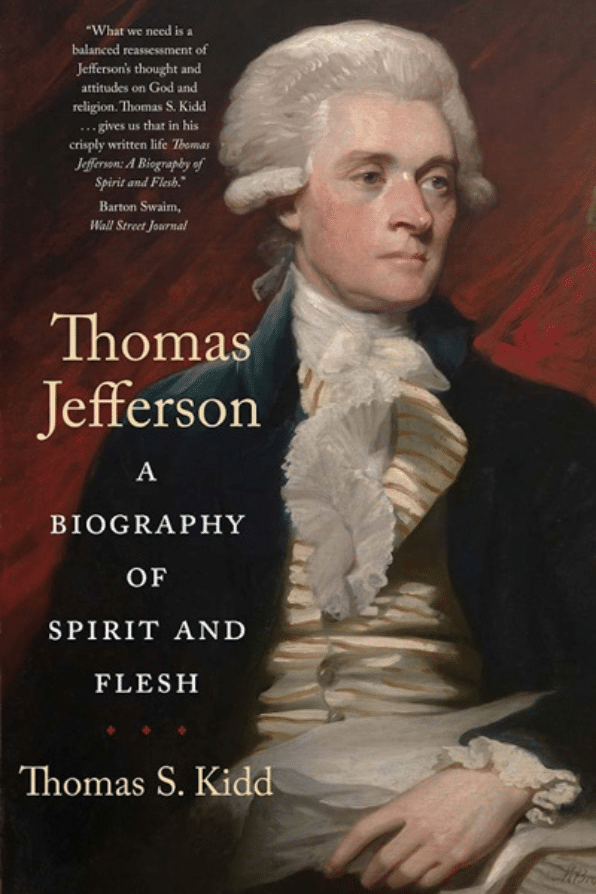
Thomas Jefferson believed in God. This much is abundantly clear from his writings, including the Declaration of Independence’s invocation of natural rights as an endowment from our Creator, Notes on the State of Virginia’s expression of fear at God’s righteous judgment on the institution of slavery, and his letters and writings extolling Jesus’s moral teaching. As Thomas Kidd describes in Thomas Jefferson: A Biography of Spirit and Flesh, Jefferson grew up in an Anglican milieu infused with the Bible and the Book of Common Prayer, and he arrived with other important Founders (like his friend John Adams) at Unitarianism, a supposedly rationalist interpretation of Christianity.
Kidd’s thoroughly researched yet readable biography illuminates the moral, religious, and spiritual life of this most enigmatic of American founders. Kidd shows how Jefferson’s beliefs about God, morality, and salvation intertwined with his convictions about the good life, politics, and liberty—convictions that sat uneasily with many of his choices. Kidd argues that a fundamental dissonance between many of Jefferson’s considered beliefs and his behavior shaped his life; that dissonance goes beyond hypocrisy and evinces a deliberate, thoroughgoing inability or refusal to translate theory into practice. Some of the dissonances and tensions in Jefferson’s convictions and actions can be softened and contextualized. But the greatest dissonance of Jefferson’s life is that he insisted on salvation by moral conduct, yet he failed to exhibit the conduct he saw as necessary for salvation. Jefferson believed in a righteous God, but he did not believe in his—or anyone else’s—need for faith or grace.
Spending and the Good Life
Jefferson continually overspent and mismanaged his finances, accumulating large amounts of debt in his acquisition of lavish properties and slaves. He continually bought staggering amounts of books and wine, along with lavish furniture and art. He built and rebuilt mansions at Monticello and nearby properties. Though he professedly hated debt and embraced aspects of Epicurean philosophy, which counseled building a life allowing for tranquility and enjoyment, Kidd notes that financial mismanagement vexed him and left problems for family members and slaves after his death.
Jefferson justified “conspicuous consumption” as necessary to serve in the variety of capacities in government and society he played, from the ambassador to France, to the secretary of state, to the president of the United States. Yet Kidd suggests that an underlying, deeper conviction about the good life might underlie Jefferson’s overspending and financial mismanagement: Jefferson’s most entrenched, if not consciously pursued, conviction related to the concept of gentility, sociability, independence, and status he absorbed during his formative years in the milieu of Virginia plantations. Jefferson was nothing if not genteel, even if his gentility masked a passionate and ambitious heart, as his friend and sometime political opponent John Adams commented regarding his retirement from his office as secretary of state.
Slavery and Republicanism
Jefferson’s greatest passion, the religion to which he was most ardently devoted, was republican liberty. He adopted Benjamin Franklin’s phrase, “Rebellion to Tyrants is Obedience to God,” as a personal motto. For Jefferson, tyranny was the great evil, and any political opinion smacking of it was a heresy, a violation of the republican faith.
Kidd treats Jefferson’s republican faith, hatred of tyranny, and seemingly incongruous unwillingness to confront American slavery, which he condemned but tacitly accepted, with great finesse. Jefferson appears to have been genuine in his profession of faith that natural rights are endowed by our Creator, a belief expressed in his Summary of the Rights of British America, the Declaration of Independence, and Notes on the State of Virginia. Moreover, in these documents, Jefferson wrote that God gave natural rights to all men and condemned the institution of slavery as a departure from republicanism, damaging to enslavers and enslaved. Jefferson worried in Notes about God’s judgment on America for slavery. Yet, after expressing some support for gradual emancipation if certain conditions were met—namely, the possibility of recolonizing former slaves—and supporting a failed 1784 regulation that would have prohibited slavery in new territories after 1800 as a member of the Congress under the Articles of Confederation, Jefferson took little action to work toward emancipation or abolition.
As Kidd discusses with forthrightness, Jefferson carried on a longstanding intimate relationship with the enslaved woman Sally Hemings, the nature of which is not entirely clear, after his only wife Martha died. He eventually emancipated James Hemings, Sally’s brother, and the children born to her, almost certainly as a result of their relationship.
A careful historian, Kidd evaluates Jefferson by the standards of his own thought and time; Kidd still finds notable distance between conviction and action. Others, like republican lawyer James Otis, saw more clearly that slavery violated the equality and natural rights Jefferson trumpeted. Kidd also recounts a fascinating epistolary exchange between Jefferson and Benjamin Banneker, a free black man who was a kindred spirit in many ways. Banneker appealed to Jefferson’s own rhetoric and asked him to work against anti-black discrimination. Later in his life, Jefferson’s friends, colleagues, and political supporters sought his support for the burgeoning abolitionist cause. Jefferson demurred.
Some of the inconsistencies and apparent tensions on this score dissolve if we accept Roger B. Taney’s understanding of the Declaration of Independence and its invocation of the “self-evident” truth that “all men are created equal.” As the Chief Justice of the Supreme Court, Taney authored the majority opinion in Dred Scott v. Sanford (1857), arguing that the American Founders, not stupid men, understood that race-based slavery existed in the American colonies. Such an institution clearly violated a straightforward reading of the Declaration’s Preamble. Taney concluded that they did not mean to include black Americans in the civic fold of the new nation. There is truth to this position; Jefferson’s primary aim in the Declaration and related writings was to base the rights of white colonists and their justification for seeking independence from Great Britain on as firm and wide a ground as possible.
Yet, Jefferson and other Founders made no effort to limit their language to white colonists and sometimes even rejected limiting language. The appeal to a broader claim of equality grounded in God’s creation, echoing the imago Dei, laid groundwork for future efforts to reform American institutions and practices. One of the two dissenters in Dred Scott, Justice Benjamin Curtis, wrote as an aside in his opinion that he thought the Founders had no intention of restricting their republican ideals or the “great truths” asserted in the Declaration to white men; they saw slavery as inconsistent with those ideals and truths, but they had due regard for circumstances and awaited the proper time for emancipation and abolition. There is also truth to Curtis’s assessment, though it is perhaps a tad charitable. Both Jefferson and one of his major rivals in Virginia politics, Patrick Henry, purported to believe slavery was an evil, a violation of the republican faith and divine justice. Yet neither abandoned it in personal life nor vigorously opposed it, citing political and personal circumstances.
Another element of Jefferson’s thought might alleviate the tension and incongruity between his convictions about republican liberty and equality and his personal acceptance of slavery as an institution: His self-styled image as a patriarch and openness to “natural aristocracy.” While he expressed the belief that slavery violated the republican faith and looked ahead to eventual abolition, his belief that persons of African descent were generally inferior to people of European descent provided a rationale for relations of dependency and subordination of blacks to whites that slavery established. Jefferson’s belief in the inferiority of blacks and his patriarchal vision of the household softened, without eliminating, the incongruity between his republican faith and life in antebellum Virginian society, allowing him to make an uneasy peace with the tyranny of master over slave. This belief in de facto inequality, combined with the fear of anti-white backlash, helps explain Jefferson’s refusal to contribute to the anti-slavery cause.
Salvation and Morality
One of the most interesting threads Kidd weaves in the book is Jefferson’s spiritual journey, which he undertook with seriousness in tandem with his political career. One of the book’s main contributions is to complicate the picture of Jefferson: He was not simply a secularist, much less a Christian Founder. He grew up, lived, and worked in a religious, biblically infused, Christian milieu and took an active interest in it. He gave attention to biblical study and the writings of the church fathers; he wrestled with and thought about doctrines like the Trinity, creation, and the infallibility of scripture. He finalized his personal creed with interlocutors like the English Unitarian Joseph Priestley and the American doctor and Declaration-signer Benjamin Rush during his first term as president, finishing the first version of his famed “Jefferson Bible” in 1804. Jefferson’s rationalist version of Christianity focused on Jesus’s moral teaching, abjuring reference to doctrines about his miracles, divinity, or his sacrificial death for human sin.
Kidd expertly draws out the connection between Jefferson’s personal religious creed and his republican faith. Jefferson treated religious orthodoxy as a potential tyranny over the mind. Kidd includes a revealing passage from a letter to Francis Hopkinson in which Jefferson explains his aversion to submitting his opinions wholly to “the creed of any party of men whatever in religion, in philosophy, in politics, or in any thing else where I was capable of thinking for myself.” He continues to declare, “If I could not go to heaven but with a party, I would not go there at all.”
Religious liberty was a major preoccupation throughout Jefferson’s career, which brought him into cooperation with James Madison, but also Baptists and other Evangelical dissenters from Puritan Congregationalism and Anglicanism. In Jefferson’s notes for a speech probably delivered to the Virginia Assembly amidst the debate on religious assessments in the mid-1780s, pitting Jefferson and Madison against Patrick Henry, Jefferson appealed to Jesus’s words in Matthew 16:18 (“Upon this rock I will build my church; and the gates of hell shall not prevail against it”) to argue that Christianity had no need of state support. Kidd might also have discussed Jefferson’s probable reference in Notes to the North African church father Tertullian’s defense of religious liberty, discussed in Robert Louis Wilken’s Liberty in the Things of God.
Kidd brings nuance to Jefferson’s beliefs and actions about religious liberty and the question of disestablishment, noting that Jefferson understood the First Amendment to limit the powers and responsibilities of the national government vis-à-vis religion much more than a state’s government. As a legislator and governor of Virginia, he supported prayer and fasting resolutions and proclamations; he declined to do so as president. He explained that position in his much-discussed Letter to the Danbury Baptists, where he evoked the “wall of separation between Church and State” the First Amendment supposedly erected. As Kidd explains, “Jefferson did little to manifest what today we would call a ‘strict separationist’ approach to church-state relations.”
Jefferson expressly rejected the idea of salvation by grace through faith, instead expressing a belief in salvation on the basis of moral behavior. He believed Jesus was the greatest expounder of the moral behavior God required for salvation. Interestingly, just as interlocutors sought to enlist Jefferson in the anti-slavery cause, friends and interlocutors entreated him to accept Christ not only as a moral teacher, but as Savior and Lord through faith. As in the case of slavery, he demurred.
Conclusion
Jefferson styled himself as an anti-Calvinist; perhaps he is more accurately described as the anti-Luther. Incorrigibly scrupulous, Luther famously sought inner peace in vain, finding it only in his ultimate embrace of salvation by grace through faith. Jefferson, seemingly unbothered by violations of his own republican faith and Jesus’s moral teachings—though troubled by his failure to control his spending and achieve tranquility—nevertheless insisted on salvation by works alone (sola operibus). How Jefferson’s anti-Protestant—indeed, anti-Christian, though not atheistic—beliefs have shaped the “American mind” he gave such powerful expression to in the Declaration, and how they relate to the Puritan and broadly Protestant Christian heritage of the nation, is a subject for further inquiry.
We have only scratched the surface of Kidd’s detailed yet accessible exploration of the moral, spiritual, and religious life of Thomas Jefferson. Offering a wealth of detail and reflection about Jefferson’s convictions and choices, Spirit and Flesh is essential reading for anyone interested in the moral, religious, and spiritual life of the American Founders.
Ben Peterson (Ph.D., Texas A&M University) is an assistant professor in the department of government and criminal justice at Abilene Christian University. He is the author of Community, Character, and the Governance of the Social Commons: Sanctuaries of Order and has written for Comment, Law & Liberty, Public Discourse, National Affairs, The New Atlantis, and other outlets.