

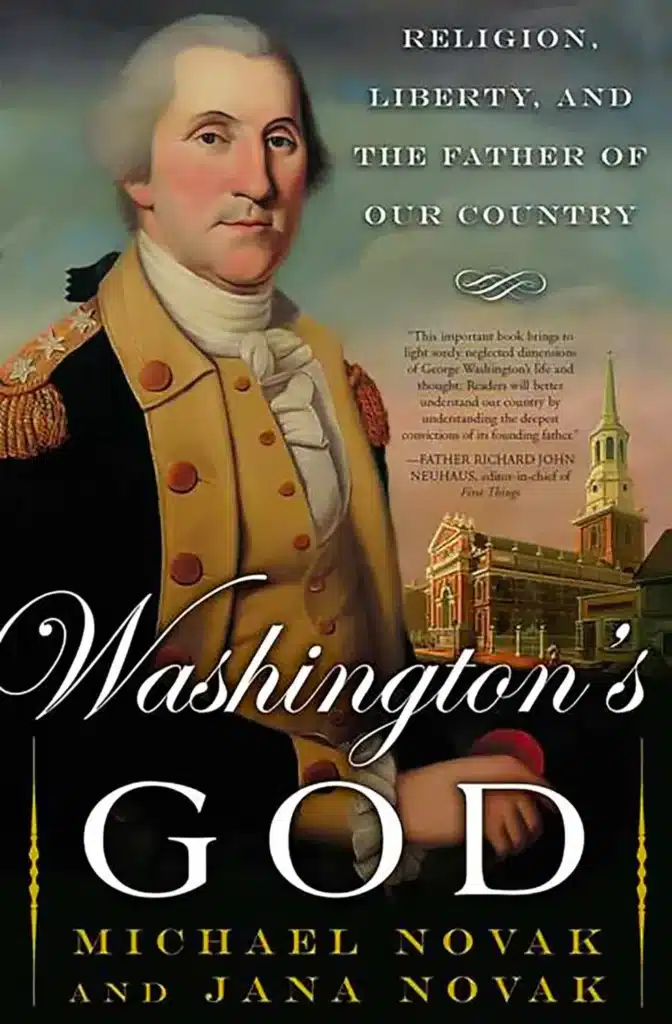
No toy this God. Not an emblem to be waved in social and political expression. Not a bludgeon to submit adversaries. And not an ornament to festoon social interactions. No. This God is a real something, whose reality constitutes the subject of the Novaks’ fulsome account of George Washington’s religious expression (and implicitly his understanding of God). Their work supplanted the now sixty-year-old work of Paul Boller Jr., which was greatly inadequate in the sense that it failed utterly to penetrate the surface of Washington’s faith.
We understand best Washington’s God when we first remind ourselves just what the subject is. When we say “No toy this God,” we mean precisely that the question of God is entirely a question of the personal encounter with the reality, the thingness, of God. I do not speak here of the conversion experience (that “transformation of the mind” conveyed in Romans 12:2), but of the far more fundamental creation imperative. We can approach an understanding if we begin with the maxim that Washington rehearsed as a boy and to which he sustained a commitment through his life: “Labour to keep alive in your Breast that Little Spark of Ce[les]tial fire Called Conscience.” One must pay attention to every word of this maxim to appreciate its dynamic force.
The first word, “labor” is active and denotes exertion toward the exercise of conscience. Thus, conscience is not an autonomous function. However, it is also immaterial, resident in no organ or function of the body. I have written at considerable length about that heretofore. Here we find the key to that reality in the formulation that identifies labor as needed to sustain it (“keep alive”) in a person’s breast.
But what is it exactly: a “little spark of celestial fire”? It is the bright center of spirit, the “breath of life.” The celestial or heavenly fire is of divine origin, originating in the creation itself. Conscience, accordingly, represents God’s first interposition in human affairs independent of the creation itself. In that, it distinguishes humans from other living things in a manner far more profound than the distinction of reason. Reason has a role to play in conscience but does not originate it. The labor required to sustain it must flow from judgment, which requires the operation of reason (a distinction conveyed by the legal evaluation of compos mentis).
The significance of the foregoing observations is that they invoke the very personal relation with the thingness of God intrinsic to each human independently of any performative criteria associated with congregations of the faithful. That relationship is not subject to intersubjective transmission, however; evidence for it may be noted in the character and usages of those who are indeed cognizant of it. We shall shortly see why that is the touchstone of the Novaks’ work. For now, we may summarize by emphasizing that the reality of God is present to humans as such, independently of professions of faith. The reason for that, as James Madison observed, is that humans have obligations to God as humans, whether they believe or not. For the same reason, the freedom of conscience is required for all, whether they believe or not. The atheist, the deist, cannot explain why he or she has a conscience but will unfailingly lay claim to a right of conscience. When Washington declared in a letter to the Reformed German Congregation at New York in November 1783 that “the establishment of Civil and Religious Liberty was the Motive which induced me to the Field,” he meant liberty of conscience (as he explained to many congregations of varying faith on numerous occasions). He wrote:
Disposed, at every suitable opportunity to acknowledge publicly our infinite obligations to the Supreme Ruler of the Universe for rescuing our Country from the brink of destruction; I cannot fail at this time to ascribe all the honor of our late successes to the same glorious Being. And if my humble exertions have been made in any degree subservient to the execution of the divine purposes, a contemplation of the benediction of Heaven on our righteous Cause, the approbation of my virtuous Countrymen, and the testimony of my own Conscience, will be a sufficient reward and augment my felicity beyond anything which the world can bestow. (Emphasis added)
These remarks highlight that Washington did not merely credit the general providence of God through the design of nature, but the special providence that interposes in human affairs according to God’s will. But his own “humble exertions” bear significant weight, inasmuch as they underscore the foundation of free will in the relation between judgment and conscience. Because God created that relation and witnessed the failure of humans at the outset, the first (Abrahamic) revelation had to be superseded by the second Christic revelation that provided the Paraclete (Holy Spirit) as a heuristic to improve the odds of honoring the testimony of conscience. Free will was not thereby impaired; rather it was most certainly bolstered. What is important is to observe that conscience was not newly created by Christ and remained, as it originally was, the contact with reality for all persons no matter what faith or belief they practice.
This universal function is far more certain than the universalism derivable from observations of nature. Moreover, it figures directly in answering the question, quid sit deus, “What is God?” Any particular individual’s response to that question is a mere verbal formula, until it is seconded by such signs of character and habitual expression as to give assurance that an observer well understands what a witness intends by “God.”
It is at this point that Washington’s God provides a sure-footed evaluation of what God meant to George Washington. The Novaks succeed in freeing him from the imputation of deism (derived almost exclusively from his reticence publicly to elaborate on his faith) and—what is worse—hypocrisy (the supposition that he used religious language only for civil or political purposes).
George Washington’s religious usage and moral character constitute the lynchpins of the analysis. Indeed, the work even includes an appendix enumerating the 102 locutions Washington deployed. Most convey a distinct Old Testament resonance, and many plainly indicate Jesus as medium of divine providence. In fact, one locution above all is decisive in revealing Washington’s understanding, and that is the closing prayer of his 1783 “Circular Address” to the governors and citizens of the thirteen states:
I now make it my earnest prayer, that God would have you, and the State over which you preside, in his holy protection, that he would incline the hearts of the Citizens to cultivate a spirit of subordination and obedience to Government, to entertain a brotherly affection and love for one another, for their fellow Citizens of the United States at large, and particularly for their brethren who have served in the Field, and finally, that he would most graciously be pleased to dispose us all, to do Justice, to love mercy, and to demean ourselves with that Charity, humility and pacific temper of mind, which were the Characteristicks of the Divine Author of our blessed Religion, and without an humble imitation of whose example in these things, we can never hope to be a happy Nation. (June 14, 1783)
Here Washington called for the “humble imitation” of the “divine author of our blessed religion,” after describing the character of that “divine author” in terms that expressly refer to Christ, who acted with “charity, humility, and a pacific temper of mind.” This passage has always been under-interpreted, rightly identifying Jesus as the subject but failing to note the embrace of the Incarnation. To identify Jesus as “divine” incorporates the Old Testament references to him that underlie the Incarnation, even if this does not connote a full embrace of the trinitarian view. It would be impossible for any intelligence to embrace this understanding without a firm, Christian belief.
Moreover, Washington’s own conduct and character were fully consistent with this view, inasmuch as he consistently manifested a conscientious standard in his conduct and an even temperament in his dealing with others (preserving the respect for others signaled as the foundation of the “Rules of Civility”). To be sure, historians—the Novaks included—have attributed an explosive temper to him in situations in which he was outraged by the conduct of others (think of the failure of Gen. Charles Lee to follow instructions in battle!). Nevertheless, it was always more remarkable that his strong reactions in such moments were consistently kept well within bounds and never resulted in intemperate judgments or decisions. It would be difficult to imagine a more even-tempered character.
This appraisal was conveyed indirectly by the Novaks when they wrote:
Washington imagined the world around him as a “concatenation” of causes and events, events caused by earlier causes and, in turn, setting off other chains of events. This loose network of many competing bundles of causation, full of incalculable probabilities and outside chances, represents his experience of the actual hazards of life. He himself addressed patterns of seeming inevitability yielding to totally serendipitous surprises. At one extreme, he did not concede that there is pure chaos. At the other extreme, he did not envisage blind, dumb fate, inexorable and unavoidable. He discerned progress and some degree of direction… He perceived open opportunities for affecting the destiny of the nation and his own destiny. He perceived ways of shaping and determining human character—within certain limits—either this way or that, and he encouraged himself and his men constantly to become better men, and even better Christians.
What the Novaks represent here is not so much an attitude as a character. For that reason, they went to great length at the outset of this work to delineate Washington’s character, the crux of which was conveyed in this: “Better than to gain success, [Washington] learned, is to live so as to deserve it, win or lose. To think otherwise is to deny the sovereignty of God.”
Reasonings of this character lead the Novaks, in conclusion, to respond directly to the problem raised at the outset: Did Washington believe in the reality of God?
[W]as Washington a deist? Although we recognize the term deism covers a broad continuum, from breakaway nonbeliever to philosophically minded bishops and Christian laity, the evidence seems to us overwhelming that Washington was not a deist, certainly not at the extremist end of the spectrum. He held as a matter of daily practice and frequent prayer the Jewish and Christian view of God, that is, that God interposes in the affairs of history and all through the daily governance of the universe, not by disrupting the laws of nature but by deftly and artistically using the openings discernible in the dazzling array of life’s daily contingencies…
Washington instructed his men—and later the whole nation—to pray for God’s continuing interventions on behalf of the preservation and the prospering of freedom on earth…
Washington spoke too much of Providence and the interpositions of God’s actions in contingent human affairs to count as a deist in the intended ‘scientific’ sense. He had no use for a watchmaker god indifferent to the affairs of humans.
We may say more. Not only did Washington have no use for a “blind watchmaker,” he was not subject to any of the three forms of atheism identified in the concluding book of Plato’s Laws: denial that God exists; asserting the existence of gods but their indifference to human affairs; and the belief that gods can be bribed. Washington was too intelligent to seize upon such errors. His prayers and solicitations reflected that personal relation with God. Washington was fabled for disclaiming any intelligence; he did so convincingly enough to elicit “amens” from John Adams and Thomas Jefferson. In retrospect, however, it becomes clear that Washington stood on far more solid ground than those who claimed much but knew little. For Washington could say, philosophically speaking, that the only thing he knew was God. All else is seeming toys, whether adapted or fabricated.
Finally, let us recall Washington’s retrospective view of his endeavors, delivered at the close of his “Farewell Address” of 1796—namely that he labored for 45 years. He never looked back; he never hesitated. This reflects both his confidence in his ability and his conviction as to the end. That conviction was doubtless founded in his knowledge of God.
William B. Allen (Ph.D., Claremont Graduate University) is emeritus professor of political philosophy and former dean of James Madison College at Michigan State University. His significant record of nonprofit board and public service includes serving as chair of the United States Commission on Civil Rights. A noted scholar and author on political philosophy and American political thought, his books include George Washington: America’s First Progressive and George Washington: A Collection.