

Long ago, the great world religions governed the human race. Their power was limited only by one another. Hinduism, Confucianism, Buddhism, Taoism, Zoroastrianism (we mustn’t forget the Zoroastrians), Judaism, Christianity, and Islam created great civilizations that infused human lives with sacredness and meaning. The great faiths shaped our laws, our morals, and our cultures. They crafted our art, architecture, and clothes; our homes, our weapons, our food; our language—even our thoughts.
These doctrinal faiths arose from a universal human tendency to religious belief. The great evolutionary psychologist Robin Dunbar writes, “For as long as history has been with us, religion has been a feature of human life. There is no known culture for which we have an ethnographic or an archeological record that does not have some religion.” Even in today’s secular cultures, many people remain devout. Nations like the United States, which seem to secularize, might instead be in the process of rejecting Christian beliefs for a more eclectic spirituality.
Like religion, politics has been humanity’s constant companion. Like religion, every society has it. How, then, should we expect average humans to approach political life? What are their political aspirations and needs, and how do I hey articulate their political ideas? For the vast majority of human history, religion helped answer these questions, and in many places, religion answered them in full.
Today many see religion as a private affair, but this view is peculiar. If you think your religion is true, it should of course shape political order. Consequently, it is more common for religion to be a purely public matter than a strictly private one. The human default is to form societies that interweave the sacred and the secular. Societies that separate faith and politics are the outliers, so where did these societies come from?
Liberalism, Socialism, and Separation: Rise and Decline
The world began to change 250 years ago, first in Western Europe. Christian infighting and the birth of modern science created secular ideologies. The first we call liberalism. Liberals defend human freedom, human equality, religious toleration, and the fundamental harmony of human interests. They include left-liberals, who stress economic equality, approach religion in politics with skepticism, and stress the importance of using democracy to control the ills of the free market. But other liberals, whom we can call classical or right-liberals, stress economic freedom and de-emphasize social equality. They welcome religious influences in politics and highlight the self-regulating power of markets and the limitations of democracy with regard to improving economic outcomes. Nonetheless, liberals share the same underlying values, even if they express them differently.
The classical liberal tradition arose first, but liberalism gradually moved left in response to challenges from the next major political ideology: socialism. Socialists also preach liberty and equality, but they view society in more conflictual terms. They cast history as a contest between the oppressed and oppressors. Socialists also come in great variety. Some favor parliamentary democracy, while others insist that parliamentary democracy is a smoke screen for capitalist domination. Some favor change through reform, while others insist on social revolution. Yet they often share hostility toward religion. Consequently, democratic socialists approach religion in politics as liberals do, but Marxist socialists usually seek religion’s annihilation.
Liberalism and socialism have fought established churches. Many have sought to privatize religion, and some have attempted to uproot it altogether. Liberals and socialists have often been religious themselves. But overall, they have sought to limit the role of religion in public life.
In the nineteenth century, liberalism and socialism colonized European elites. In the twentieth century, they divided the world between them and crushed the political power of the great world religions. Often socialists hunted religion to extinction. Liberals were gentler: they usually settled for a domesticated faith that prioritizes liberal values.
If religion is a human universal that invariably shapes politics, liberal and social victories were, at best, temporary. And this is what we see. Now that socialism has evaporated, the great religions recover their political expression.
Do not let the United States and Western Europe occlude your vision. Take a global perspective. You may know that many in Poland and Hungary trade liberal democracy for illiberal Christian politics. The Soviet Union was once the world’s leading atheist federation. Today, Russia returns to Orthodox Christianity.
China contains a plurality of the world’s atheists. But Xi Jinping has had to adopt Maoist methods to control popular religion. He has had to supplement lagging Marxism with Confucianism. The twenty-first century has seen a dramatic revival of Confucian thought.
Muslims have fought secularizing forces for decades, often with stunning success. Afghanistan and Iran are striking examples. Western liberal hopes for a “modern” Islam remain unfulfilled. Indeed, some Muslim regimes de-secularize. Turkey illustrates.
India shocks me. Its elite face a robust challenge from the Hindutva, the Hindu nationalist movement. One of the world’s most ancient civilizations had adopted a mix of socialism and liberalism. India proved that Western political ideas had universal appeal. But today, it returns to ancient political form.
Human religiosity persists, and the many adherents of the great faiths have renewed their political ambitions. Liberalism alone prevents them from reconquering politics. A central question for twenty-first-century humanity is whether liberalism can succeed. Another question is whether it deserves to.
Liberalism in the Twenty-First Century
Today liberalism has become associated with abstract academic theorizing. Liberals obsess over esoteric debates about sex and gender that make no sense to most humans. The authoritarian leaders of the world have noticed, eagerly pointing out liberal insularity. Consider the bizarre spectacle of Russian president Vladimir Putin complaining that transgender activists have mistreated famed children’s book author J. K. Rowling. Why does Putin care? He doesn’t. He wants to delegitimize liberal order by drawing attention to its flaws.
The authoritarians of the world are on offense. They smell liberal weakness. But they must grapple with liberalism’s historic achievements.
In most places, liberalism was a practical program of reform. Liberals sought to protect human liberty from concentrated and arbitrary power. Liberals promulgated religious toleration, challenged state absolutism, helped abolish slavery, and pioneered the liberation of women. Liberalism defeated fascism and communism, created the post-World War II human rights regime, and led late-twentieth-century fights against racism and sexism. Liberals helped lift billions out of grinding poverty by defending the market economy. Today’s anti-liberals cannot say one nice thing about liberal order. But liberalism delivers.
Of course, we must not whitewash liberal history. Beyond their frequent intolerance of religion, liberals have taken up unjust causes—imperialism, colonialism, eugenics, and an indifference to the unborn. But in the main, liberals have made humans better off. And yet today, liberals no longer inspire. Fewer and fewer people claim their mantle, and many young people abandon liberalism for other doctrines. This situation is dire. If we lose liberalism, we may lose its achievements, and the rapid expansion of freedom, equality, and prosperity may reverse.
Liberals did not anticipate the challenges that followed the demise of socialism. For centuries many liberals have predicted the end of religion. Or they comforted themselves with the belief that religion would become private. Socialism enabled that illusion to endure. But if, as Dunbar argues, religion is a human universal, liberals face a grave global challenge. They must accept the permanence of religious belief and accommodate those who would give political expression to their faiths. And they must do so while preserving liberalism’s concrete accomplishments.
To do this, liberals must shed their hostility toward religion. Millions of people of faith mistrust liberalism, viewing it as a covert but aggressive secularizing ideology. Liberals must dispel this suspicion or discredit themselves.
Robert Frost once said, “A liberal is a person who can’t take his own side in a quarrel.” Nobody says that anymore. But that was the liberal promise: liberal order should be a diverse and open inquiry into better ways of living together. Liberals should reclaim intellectual humility and curiosity. They must engage those eager for liberalism to follow socialism into oblivion.
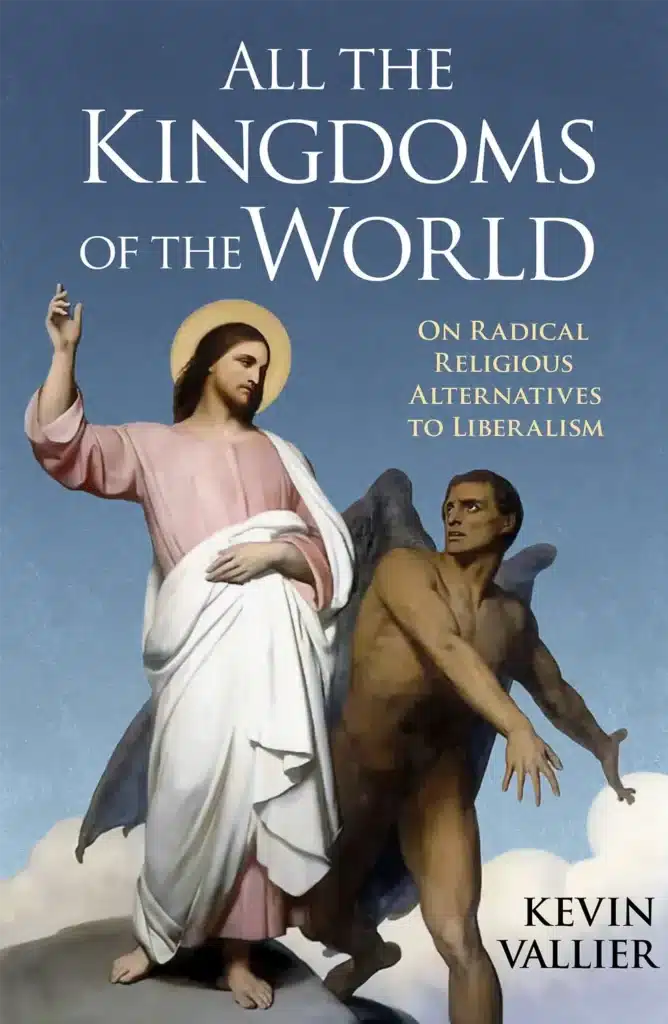
Read more in All the Kingdoms of the World: On Radical Religious Alternatives to Liberalism by Kevin Vallier.
From All the Kingdoms of the World by Kevin Vallier. Copyright © 2023 by Kevin Vallier and published by Oxford University Press. All rights reserved.