

What I propose now is the recovery of premodern interpretation in ways that revive and revitalize the ecclesial shaping of biblical theology. Hermeneutics is not really about procedures anyway but rather is about essential questions of reality. The modern world has been furiously trying to untie the Gordian knot of methodology, without concern for the metaphysical assumptions that various methodologies harbor. But now, biblical interpretation must learn to think holistically, to walk outside the room and see how the whole project of biblical theology participates in a Christian culture.
Our dialogue partner for this journey is the early Christian community that models an ecclesial biblical theology. I recognize that the church fathers do not use the term biblical theology, but they do say meaningful things about the unity of Scripture. I continue to use the term to capture how their reading of Scripture unifies their ecclesial culture, and I bring their voice to bear on the current conversation. The fathers show us that the unity of Scripture makes sense only to those who participate in it. Ancient Christians do not merely theorize; they practice their biblical theology. They read Scripture as a sacramental guide on the journey of salvation. The Scriptures guide their attunements and perceptions, refracting all things through the telos of the storyline of Scripture, demonstrating “the inseparability of theology, exegesis of Scripture and spirituality, an integration by no means apparent in the modern world.” Their liturgies, readings, postures, and prayers are filtered through the Scriptures, creating patterns of life from the culture-forming nature of the church’s biblical interpretation.
Understanding how the fathers approach Scripture is like entering a different world. The early church works with a different view of reality, or what philosopher Charles Taylor has called a “social imaginary,” which explains the ways people “imagine their social existence.” As we will see, the early church was born into a world that did not share its first principles. They had to learn—and learn quickly—how to live their faith and reimagine their social existence in light of it.
By way of illustration, my first teaching position was in a seminary degree program in a Texas prison. I was slated to teach a regular diet of Bible courses covering both the Old and New Testaments. Entering the world of incarceration was like stepping into a foreign land, with its own governance, bartering system, and natural hierarchies. As I began teaching, I realized quickly that all my lectures and illustrations were framed for people living in the “free world,” a world these offenders left far behind. By contrast, they were embedded in a different world with its own mores and patterns. I knew that if I was going to connect with them, I needed to see things from their vantage point. So I sat down with one of them and asked him to walk me through their daily lives. For a long time, he explained the process of arrest and conviction, followed by sentencing and the slow, steady acclimation to prison life. We discussed living conditions, meals, free time, and cellmates. I came to understand the rhythms of the day, the small joys, and the many struggles.
Understanding ecclesial biblical theology requires something similar. We must step into the early Christian social imaginary and conceive of the world from that vantage point. “It is senseless,” theologian Fred Sanders argues, “to try to retain the result of the early church’s holistic interpretation of Scripture—the perception of the biblical doctrine of the Trinity—without cultivating, in a way appropriate for our own time, the interpretive practice that produced that result.” We need to think about the whole culture of theology, the ways and patterns that unite Scripture in a drama of salvation under the provision and direction of the one true God. This does not happen by picking up the scattered procedures of exegesis used here or there; rather, it happens by conceiving of the whole.
The early church is a good case study for our age, because the religious and philosophical diversity of their age demanded that they debate first principles. Planted in a Greco-Roman world with all its mores and rituals, these premodern readers knew that they could not come to the Bible with their inherited cultural assumptions—Greek and Roman assumptions that were frequently at odds with basic theological claims in the Bible. They recognized implicitly that “biblical texts can only be interpreted in relation to something else: a concept, a question, a belief, a historical reality.” So they had to read the Bible in a way that shaped their culture, not the other way around. Through their totalizing reading of Scripture, the early church called for “a radical revision of the first principles,” which challenged the very foundations of classical culture. Their reading involved a different conception of reality, with unique metaphysical, epistemological, and ethical assumptions that expressed themselves in different patterns of religious life and social mores. The church forged a vision of salvation history that brought them into constant struggle with their intellectual and social environment. Christians never fully felt at home in the Roman world, and ultimately, the two could not coexist in peace. Eventually, by the fourth century, the church gained enough ground to influence the institutions of the ancient world and begin to build Christendom. At that point, the synergy between the Bible and culture took on a more intimate relationship that began shaping the culture in new ways.
But now in the modern world, Christian cultural hegemony is vanishing at a rapid pace, and a new kind of secular age is emerging—a society in which, as Taylor describes, belief in God is “one option among others, and frequently not the easiest to embrace.” The competition of social imaginaries today mirrors the ancient world and makes a patristic ecclesial biblical theology as relevant as ever. Like the ancient Christians, I pray that we run to the church, forming a community that never forgets that we are “a chosen race, a royal priesthood, a holy nation, a people for his own possession” (1 Pet. 2:9), united like a great cloud of witnesses and living the story of God.
Stephen O. Presley (Ph.D., University of St. Andrews) is senior fellow for religion & public life at the CRCD and associate professor of church history at The Southern Baptist Theological Seminary in Louisville, Kentucky. His previous books include Cultural Sanctification: Engaging the World like the Early Church.
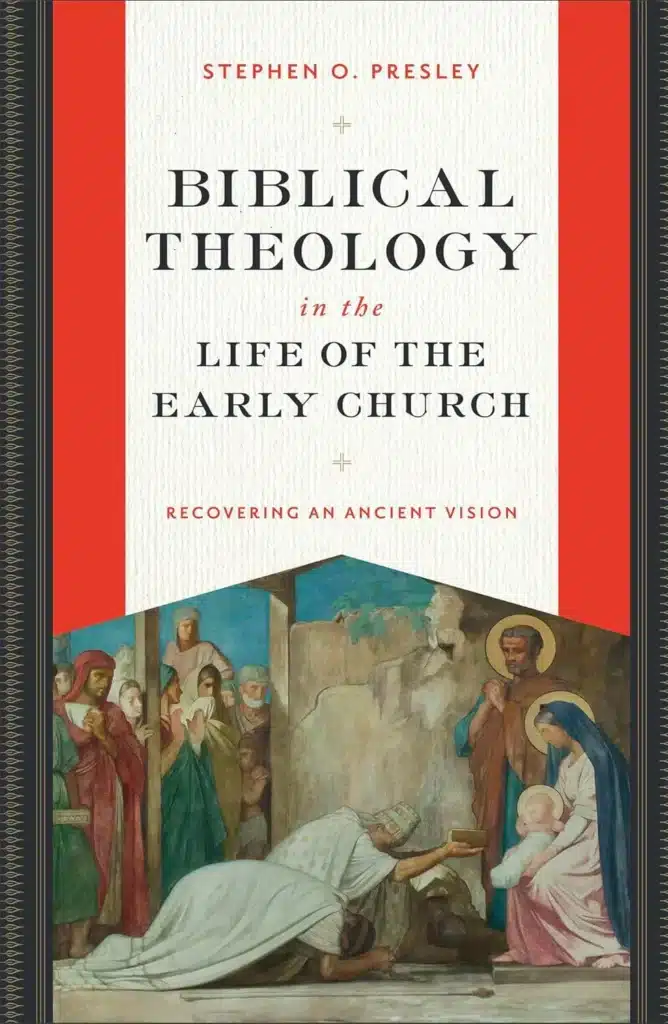
Read more in Biblical Theology in the Life of the Early Church: Recovering an Ancient Vision (Baker Academic, 2025).