
In 1982, Howard F. Ahmanson Jr. journeyed to Mississippi to learn more about the ministry of John M. Perkins—the African-American Christian leader and activist. Throughout his life John
had struggled, at great cost to his welfare and flesh, to alleviate poverty and bring the gospel and justice to the people in his home state of Mississippi. In return, those he challenged tortured and brutalized him, and murdered his brother.
Howard F. Ahmanson is the reclusive, only son of the man that California Business magazine wrote was the richest man in California. In 1982, he was a supporter of Reconstructionism, usually portrayed as an ultraright Christian movement. Later in life, Time magazine listed him as one of the “25 Most Influential Evangelicals in America,” the Los Angeles Times described him as the one who “Bankrolls the Religious Right’s Agenda,” and Max Blumenthal in Salon labeled him “The Avenging Angel of the Christian Right.”
When he met Howard in 1982, John Perkins spoke of God’s concern for those who were outcast and castigated, and those evangelicals who had forsaken the gospel’s command to work for
the poor and downtrodden. Howard listened carefully and with sympathy because this was a cause close to his heart. He also thought that John had neglected to pay sufficient attention to the negative sides of government programs.
In his shy and stammering manner, Ahmanson challenged some of Perkins’s views. John, with his usual openness to hearing others and to reconciliation, listened to Howard’s concerns. But because of Howard’s frequent pauses and fractured sentences, John didn’t take them that seriously at first. “I didn’t realize that he couldn’t talk as fast as me and I gave him my regular canned answer to the question. But he didn’t give up on me,” he recalled. Howard went out to his car, brought back a book on economics, and gave it to John, saying that he hoped he would read it. ‘”And when I read that book,” John recalls, “I realized that he knew more about the issue than I did.” Also, “I could tell he was trying to be friends.”
Around this time, Howard gave to John’s Voice of Calvary ministry the largest individual gift it had ever received. John wondered who this person was that he had just met in passing and who had become his biggest donor. When John and his wife, Vera Mae, made a trip to Southern California, Howard invited them to visit. John remembers vaguely that Howard drove “a Volkswagen convertible.”
And he—he didn’t act like he was rich … because when he invited us to come down and spend a day with him, he was going to show us around, show us where he grew up. You go to the house on a little island where there were John Wayne’s house and his house. Not many houses on the island. We got there about ten o’clock in the morning … and he asked us to wait until he got everything together because we were going to spend the day together …. And I went out, I looked at a car in the parking lot, see—I knew at this time he was rich …. And I probably was looking for a Mercedes, at least, and I went to get in that car, but instead he went to a Volkswagen to move the gas can out of the front seat.
They spent the day touring Howard’s old haunts and getting to know each other, and despite their deep differences in background, income, and race, these two men began an unlikely and profound lifelong friendship.
Paul Marshall (PhD, York University) is Wilson Professor of Religious Freedom at Baylor University, and senior fellow at the Religious Freedom Institute and Hudson Institute. He has authored over twenty books, including Silenced: How Apostasy and Blasphemy Codes Choke Freedom Worldwide (Oxford University Press, 2011), Blind Spot: When Journalists Don’t Get Religion (Oxford University Press, 2009), Religious Freedom in the World (Rowman and Littlefield, 2008). His work has been translated into twenty languages.
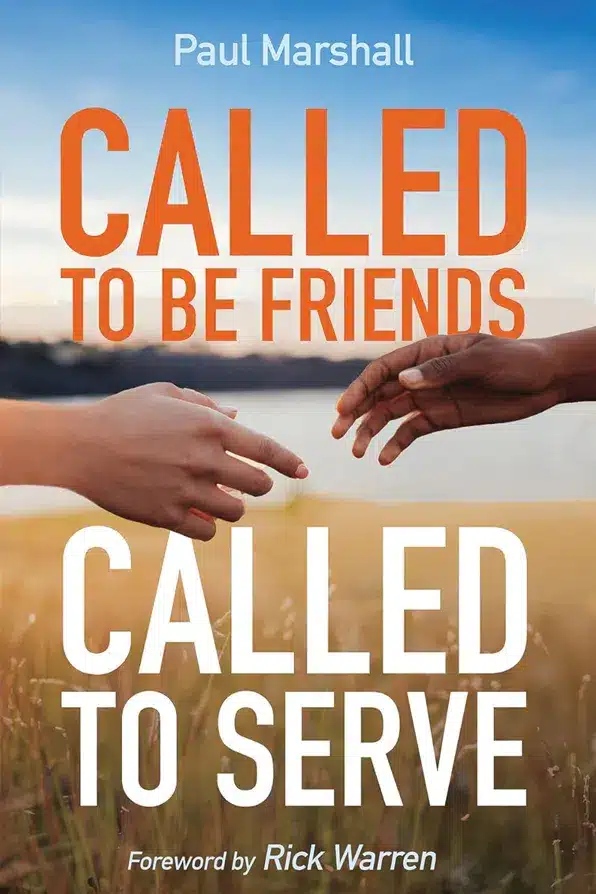
Read more in Called to Be Friends, Called to Serve (Cascade, 2025).