
I have written or edited a dozen academic books, most of which consider in one way or another the relationship between Christianity and politics/law in America’s founding. These books, along with works by like-minded students of America’s founding, have encouraged jurists and academics to reconsider the role of religion in the era, but none of our works have been read widely outside our disciplines.
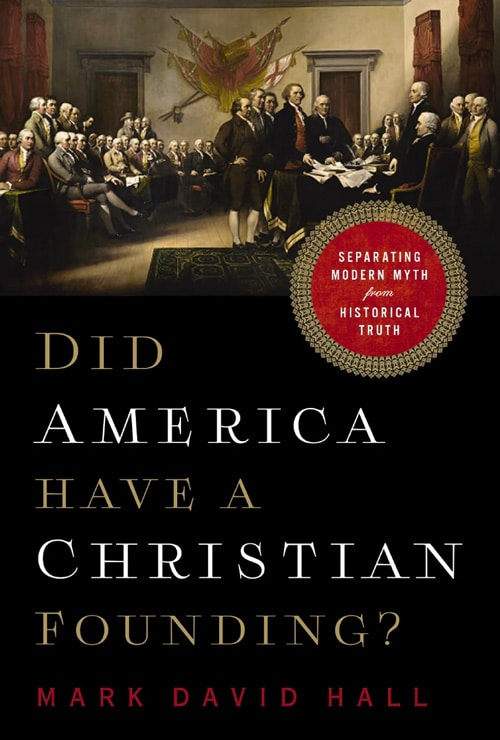
In this book, I distill thirty years of scholarly work on Christianity’s role in the American founding into an accessible resource for nonacademics. I challenge a number of assertions that are found regularly in scholarly and popular books. Simply getting American history right is a worthy goal in its own right, but in this case, it also has immediate implications for law and public policy as political leaders and jurists continue to look to America’s founders for guidance. This is especially true with respect to religious liberty and church-state relations.
In academic books, it is customary to spend a great deal of time engaging the work of other scholars, in part to demonstrate that one is aware of the most important secondary literature and also to show that one’s interpretations are superior to those of other scholars. Other than quoting authors I am criticizing to make it clear that I am not attacking straw men, I spend little time engaging other works about the founding. Instead, in each chapter, I make arguments based on laws, letters, debates, official state papers, and other primary source documents from the founding era. I carefully document quotations from these sources so that interested readers can check to make sure I am using them fairly. I occasionally cite good secondary sources in the endnotes and conclude each chapter by offering suggestions for further reading. These features permit those who would like to dig deeper to do so.
A book like this may appear at first glance to be an exercise in Christian triumphalism. I am a practicing Christian (although my pastor says I need more practice), and I am also a proud American. But I hope it is clear, by the end of the book, that I have provided a fair and balanced account of Christianity’s role in America’s founding. Anyone who desires to understand this critical era simply must grasp the pervasive influence of religion at the time. Similarly, it would be foolhardy to ignore Islam when considering the history and politics of Saudi Arabia.
Practically, and positively, a central argument of this book is that America’s founders drew from their Christian convictions to create a constitutional order that benefits all Americans, not just Christians. Their convictions led them, for example, to carefully limit the national government’s power, value checks and balances, support the rule of law, and protect a robust conception of religious liberty. There were few non-Christians in late eighteenth-century America, but there were some and most of America’s founders were convinced that the right of these non-Christians to believe and act according to the dictates of their consciences must be protected.
Consider, for instance, George Washington’s 1790 letter to the “Hebrew Congregation” in Newport, Rhode Island. He wrote to this tiny religious minority that:
All possess alike liberty of conscience and immunities of citizenship. It is now no more that toleration is spoken of, as if it was by the indulgence of one class of people, that another enjoyed the exercise of their inherent natural rights. For happily the Government of the United States, which gives to bigotry no sanction, to persecution no assistance requires only that they who live under its protection should demean themselves as good citizens, in giving it on all occasions their effectual support.
… May the Children of the Stock of Abraham, who dwell in this land, continue to merit and enjoy the good will of the other Inhabitants; while every one shall sit in safety under his own vine and figtree, and there shall be none to make him afraid. May the father of all mercies scatter light and not darkness in our paths, and make us all in our several vocations useful here, and in his own due time and way everlastingly happy.
This letter, from the era’s one indispensable man, reflects well the founders’ understanding that the religious convictions of all citizens must be respected. Yet it also illustrates the reality that America’s founders did not think religion must be driven from the public square. In their book on Washington’s faith, Peter Lillback and Jerry Newcombe identify nine scriptural references in this letter alone. One of them is Micah 4:4, which reads “But they shall sit every man under his vine and under his fig tree; and none shall make them afraid: for the mouth of the Lord of hosts hath spoken it.” This was one of George Washington’s favorite verses; we have records of him quoting or paraphrasing it at least forty times. Like other founders, Washington’s faith influenced his political beliefs and actions, and all Americans-from Jewish citizens in the eighteenth century to Sikh citizens today-have benefited from this fact.
Read more in Did America Have a Christian Founding? Separating Modern Myth from Historical Truth (Nelson, 2019).