
This book extends a come-as-you-are invitation, and as such, it attempts to be a friendly point of entry for all sorts of readers and students of history, whatever their background. As the best stories show us, simplicity and complexity are not mutually exclusive. Hence this book strives to be, as the ancient sage put it, a river shallow enough for the lamb to go wading but deep enough for the elephant to swim. I hope all those who are new to the subject will be so intrigued that they will want to venture into deeper waters and, eventually, turn to the many outstanding books and authors that can take them much, much further, and deeper, than this book possibly can. But I hope that I have also done some justice to the deeper waters, without sacrificing the book’s accessibility.
For both sorts of readers, I try to keep before us the recognition that history is not just an inert account of indisputable and self-explanatory details. It is a reflective task that calls to the depths of our humanity. It means asking questions, and asking them again and again, and asking fresh questions as the experience of life causes fresh questions to arise. The past does not speak for itself, and it cannot speak to us directly. We must first ask. It may have things to tell us that we have not yet thought to ask about. But it can be induced to address some of our questions, if we learn to ask them rightly. That is one of the many subtle glories of the study of history.
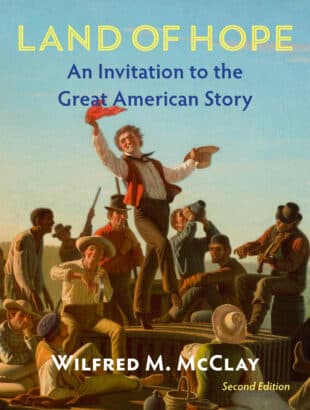
Finally, I’d like to offer a word about the book’s title, which forms one of the guiding and recurrent themes of the book. As the book argues from the very outset, the Western Hemisphere was inhabited by people who had come from elsewhere, unwilling to settle for the conditions into which they were born, and drawn by the prospect of a new beginning, the lure of freedom, and the space to pursue their ambitions in ways their respective Old Worlds did not permit. Hope has both theological and secular meanings, spiritual ones as well as material ones. Both these sets of meanings exist in abundance in America. In fact, nothing about America better defines its distinctive character than the presence of hope, a sense that the way things are initially given to us cannot be the final word about them, that we can never settle for that. Even those who are bitterly critical of America, and find its hopes to be delusions, cannot deny the enduring energy of those hopes and are not immune to their pull.
Of course, hope and opportunity are not synonymous with success. Being a land of hope will also sometimes mean being a land of dashed hopes, of disappointment. That is unavoidable. A nation that professes high ideals makes itself vulnerable to searing criticism when it falls short of them – sometimes far short indeed, as America often has. We should not be surprised by that, however; nor should we be surprised to discover that many of our heroes turn out to be deeply flawed human beings. All human beings are flawed, as are all human enterprises. To believe otherwise is to be naive, and much of what passes for cynicism in our time is little more than naivety in deep disguise.
What we should remember, though, is that the history of the United States, and of the West more generally, includes the activity of searching self-criticism as part of its foundational makeup. There is immense hope implicit in that process, if we go about it in the right way. That means approaching the work of criticism with constructive intentions and a certain generosity that flows from the natural awareness that none of us is perfect and that we should therefore judge others as we would ourselves wish to be judged, blending justice and mercy. One of the worst sins of the present – not just ours but any present – is its tendency to condescend toward the past, which is much easier to do when one doesn’t trouble to know the full context of that past or try to grasp the nature of its challenges as they presented themselves at the time. This book is an effort to counteract that condescension and remind us of how remarkable were the achievements of those who came before us, how much we owe them.
Read more in Land of Hope: An Invitation to the Great American Story, 2nd ed. (Encounter, 2026).