

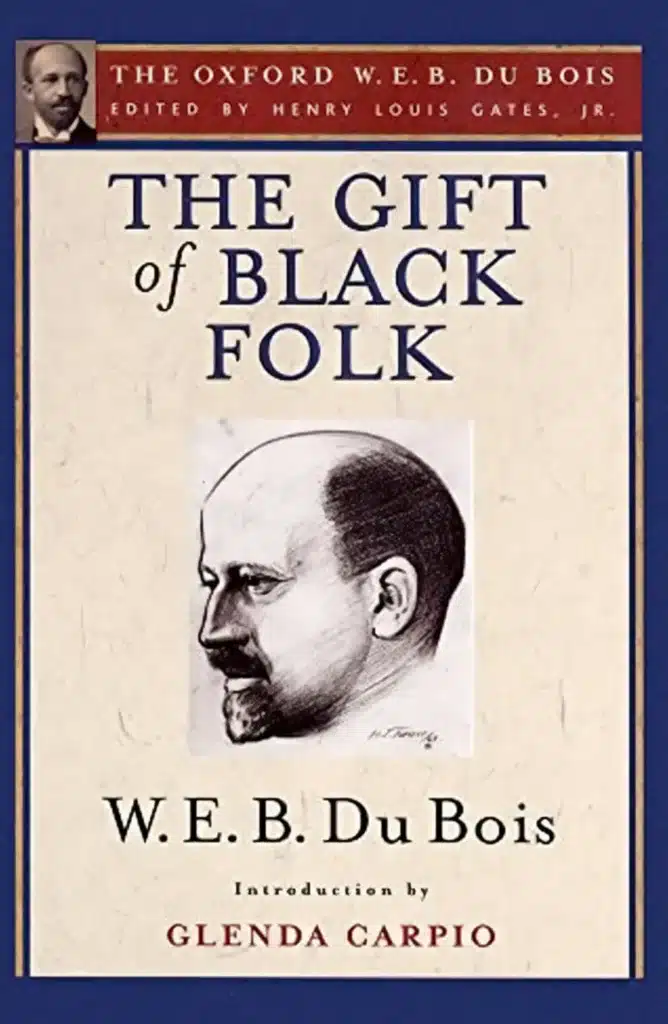
This year marks the centennial anniversary of the publication of W. E. B. Du Bois’ The Gift of Black Folk: The Negroes in the Making of America. The following excerpts highlight important themes, claims, and arguments related to the core foci of the Center for Religion, Culture & Democracy. As the foreword to the book reads, “Modern democracy rests not simply on the striving white men in Europe and America but also on the persistent struggle of the black men in America for two centuries.” Additional features will grapple with this text and its ideas within the broader context of Du Bois’ life and work as well as the ongoing challenges of pluralism, race, colonialism, human dignity, and the faults and promises of this grand American experiment in ordered liberty.
Excerpts from W. E. B. Du Bois, The Gift of Black Folk (1924)
After the discovery of America by Columbus many Negroes came with the early explorers. Many of these early black men were civilized Christians and sprung from the large numbers of Negroes imported into Spain and Portugal during the fifteenth century, where they replaced as laborers the expelled Moors. Afterward came the mass of slaves brought by the direct African slave trade.
From the beginning of the fifteenth century mention of the Negro in America becomes frequent. In 1501 they were permitted to enter the colonies; in 1503 the Governor of Hispaniola sought to prohibit their transportation to America because they fled to the Indians and taught them bad manners. By 1506 they were coming again because the work of one Negro was worth more than that of four Indians. In 1518 the new sugar culture in Spain and the Canary Islands began to be transferred to the West Indies and Negroes were required as laborers. In 1521 Negroes were not to be used on errands because they incited Indians to rebellion and the following year they rose in rebellion on Diego Columbus’ mill. In 1540, in Quivera, Mexico, there was a Negro priest and in 1542 there were at Guamango, Mexico, three Brotherhoods of the True Cross of Spaniards, one of which was of Negroes and one of Indians.
Thus the Negro is seen not only entering as a laborer but becoming a part of the civilization of the New World.
It was black labor that established the modern world commerce which began first as a commerce in the bodies of the slaves themselves and was the primary cause of the prosperity of the first great commercial cities of our day. Then black labor was thrown into the production of four great crops—tobacco, sugar, rice and cotton. These crops were not new but their production on a large cheap scale was new and had a special significance because they catered to the demands of the masses of men and thus made possible an interchange of goods such as the luxury trade of the Middle Ages catering to the rich could not build. Black labor, therefore, beneath these crops became an important part of the Industrial Revolution of the eighteenth and nineteenth centuries.
Moreover the black slave brought into common labor certain new spiritual values not yet fully realized. As a tropical product with a sensuous receptivity to the beauty of the world he was not as easily reduced to be the mechanical draft-horse which the northern European laborer became. He was not easily brought to recognize any ethical sanctions in work as such but tended to work as the results pleased him and refused to work or sought to refuse when he did not find the spiritual returns adequate; thus he was easily accused of laziness and driven as a slave when in truth he brought to modern manual labor a renewed valuation of life.
The Negro worked as farm hand and peasant proprietor, as laborer, artisan and inventor and as servant in the house, and without him, America as we know it, would have been impossible.
Dramatically the Negro is the central thread of American history. The whole story turns on him whether we think of the dark and flying slave ship in the sixteenth century, the expanding plantations of the seventeenth, the swelling commerce of the eighteenth, or the fight for freedom in the nineteenth. It was the black man that raised a vision of democracy in America such as neither Americans nor Europeans conceived in the eighteenth century and such as they have not even accepted in the twentieth century; and yet a conception which every clear sighted man knows is true and inevitable….
Democracy was not planted full grown in America. It was a slow growth beginning in Europe and developing further and more quickly in America. It did not envisage at first the man farthest down as a participant in democratic privilege or even as a possible participant. This was not simply because of the inability of the ignorant and degraded to express themselves and act intelligently and efficiently, but it was a failure to recognize that the mass of men had any rights which the better class were bound to respect. Thus democracy to the world first meant simply the transfer of privilege and opportunity from waning to waxing power, from the well-born to the rich, from the nobility to the merchants. Divine Right of birth yielded the Divine Right of wealth. Growing industry, business and commerce were putting economic and social power into the hands of what we call the middle class. Political opportunity to correspond with this power was the demand of the eighteenth century and this was what the eighteenth century called Democracy. On the other hand, both in Europe and in America, there were classes, and large classes, without power and without consideration whose place in democracy was inconceivable both to Europeans and Americans. Among these were the agricultural serfs and industrial laborers of Europe and the indentured servants and black slaves of America. The white serfs, as they were transplanted in America, began a slow, but in the end, effective agitation for recognition in American democracy. And through them has risen the modern American labor movement. But this movement almost from the first looked for its triumph along the ancient paths of aristocracy and sought to raise the white servant and laborer on the backs of the black servant and slave. If now the black man had been inert, unintelligent, submissive, democracy would have continued to mean in America what it means so widely still in Europe, the admission of the powerful to participation in government and privilege in so far and only in so far as their power becomes irresistible. It would not have meant a recognition of human beings as such and the giving of economic and social power to the powerless.
It is usually assumed in reading American history that whatever the Negro has done for America has been passive and unintelligent, that he accompanied the explorers as a beast of burden and accomplished whatever he did by sheer accident; that he labored because he was driven to labor and fought because he was made to fight. This is not true. On the contrary, it was the rise and growth among the slaves of a determination to be free and an active part of American democracy that forced American democracy continually to look into the depths; that held the faces of American thought to the inescapable fact that as long as there was a slave in America, America could not be a free republic; and more than that: as long as there were people in America, slave or nominally free, who could not participate in government and industry and society as free, intelligent human beings, our democracy had failed of its greatest mission.
This great vision of the black man was, of course, at first the vision of the few, as visions always are, but it was always there; it grew continuously and it developed quickly from wish to active determination. One cannot think then of democracy in America or in the modern world without reference to the American Negro. The democracy established in America in the eighteenth century was not, and was not designed to be, a democracy of the masses of men and it was thus singularly easy for people to fail to see the incongruity of democracy and slavery. It was the Negro himself who forced the consideration of this incongruity, who made emancipation inevitable and made the modern world at least consider if not wholly accept the idea of a democracy including men of all races and colors.
In a peculiar way, then, the Negro in the United States has emancipated democracy, reconstructed the threatened edifice of Freedom and been a sort of eternal test of the sincerity of our democratic ideals. As a Negro minister, J. W. C. Pennington, said in London and Glasgow before the Civil war: “The colored population of the United States has no destiny separate from that of the nation in which they form an integral part. Our destiny is bound up with that of America. Her ship is ours; her pilot is ours; her storms are ours; her calms are ours. If she breaks upon a rock, we break with her. If we, born in America, cannot live upon the same soil upon terms of equality with the descendants of Scotchmen, Englishmen, Irishmen, Frenchmen, Germans, Hungarians, Greeks and Poles, then the fundamental theory of American fails and falls to the ground.”
The Negro is primarily an artist. The usual way of putting this is to speak disdainfully of his “sensuous” nature. This means that the only race which has held at bay the life destroying forces of the tropics, has gained therefrom in some slight compensation a sense of beauty, particularly for sound and color, which characterizes the race. The Negro blood which flowed in the veins of many of the mightiest of the Pharaohs accounts for much of Egyptian art, and indeed Egyptian civilization owes much in its origin to the development of the large strain of Negro blood which manifested itself in every grade of Egyptian society.
One must not forget the Negro orator. While in the white world the human voice as a vehicle of information and persuasion has waned in importance until the average man is somewhat suspicious of “eloquence,” in the Negro world the spoken word is still dominant and Negro orators have wielded great influence upon both white and black from the time of Frederick Douglass and Samuel Ward down to the day of J. C. Price and Booker T. Washington. There is here, undoubtedly, something of unusual gift and personal magnetism.
Above and beyond all that we have mentioned, perhaps least tangible but just as true, is the peculiar spiritual quality which the Negro has injected into American life and civilization. It is hard to define or characterize it—a certain spiritual joyousness; a sensuous, tropical love of life, in vivid contrast to the cool and cautious New England reason; a slow and dreamful conception of the universe, a drawling and slurring of speech, an intense sensitiveness to spiritual values—all these things and others like to them, tell of the imprint of Africa on Europe in America. There is no gainsaying or explaining away this tremendous influence of the contact of the north and south, of black and white, of Anglo Saxon and Negro.
It must not be assumed that this missionary work acted on raw material. Rather it reacted and was itself influenced by a very definite and important body of thought and belief on the part of the Negroes. Religion in the United States was not simply brought to the Negro by the missionaries. To treat it in that way is to miss the essence of the Negro action and reaction upon American religion. We must think of the transplanting of the Negro as transplanting to the United States a certain spiritual entity, and an unbreakable set of world-old beliefs, manners, morals, superstitions and religious observances.
POSTSCRIPT
Listen to the Winds, O God the Reader, that wail across the whip-cords stretched taut on broken human hearts; listen to the Bones, the bare bleached bones of slaves, that line the lanes of Seven Seas and beat eternal tom-toms in the forests of the laboring deep; listen to the Blood, the cold thick blood that spills its filth across the fields and flowers of the Free; listen to the Souls that wing and thrill and weep and scream and sob and sing above it all. What shall these things mean, O God the Reader? You know. You know.