
It appears that, based on lived testimony as well, most 18th-century Americans cannot be accurately characterized as predominantly individualistic or, for that matter, classically republican. The vast majority of Americans lived voluntarily in morally demanding agricultural communities shaped by reformed-Protestant social and moral norms. These communities were defined by overlapping circles of family- and community- assisted self-regulation and even self-denial, rather than by individual autonomy or self-defining political activity. (For those who have lived in America’s small towns, I imagine this is not an altogether surprising finding.)
I have come to believe that the apologists for each of the dominant explanatory models of late 18th-century American political thought, republicanism and individualism, have exaggerated these models’ importance, coherence, hegemony, and institutional strength. Each of these accounts purports to represent too fully late 18th-century American political and social thought. Regrettably, the exaggerated attention shown them by contemporary commentators speaks more to our needs for a usable secular or individualistic past than to the historical needs of a communal, rural, and Protestant people.
In short, the Protestant-inspired character of the primary materials I have consulted and the town and the town histories (written by social historians) I have examined have led me to abandon my hope of showing that 18th-century American political thought was predominantly republican. These same sources, however, have done nothing to weaken my opposition to the claim that individualism, as a body of thought, played an active role in shaping the aspirations of Revolutionary-era Americans. I have become confident that more-powerful influences (though more atavistic and thus less politically useful) on the speech, writing, and practices of the majority of European Americans have been underemphasized. This, I intend to show, is most true of the reformed-Protestant foundation of American social and political thought. As Philip Schaff explained to his distinguished Berlin audience, America was “a land thoroughly Protestant, almost to an extreme, since Protestantism embraces not merely the large majority of the population, but is the source, at the same time, of all its social and political principles.” And the 18th-century Americans I have come to know were indeed preponderantly reformed Protestants (either in practice or attitudinally). They were a varied group of rural farmers, highly educated ministers, and judges who held a strained and eclectic Protestant communal vision of the good that defies facile characterization.
More disconcerting, however, than my realization that we are a people enjoying a limited republican inheritance and a more questionable liberal foundation has been my recognition that we are a people without a past. As a people, we have consistently re-created our past. Apparently, we have collectively wished to avoid the acknowledgment of failure. The Revolution is only one example of what I believe may be a more widespread pattern of cultural prevarication. Eighteenth-century American history is not a story of ordered change, but rather a tale of unmet expectations and unplanned transformation. In other instances, I surmise, Americans as a people have failed to adhere to the particular goals of extrapersonal service they have set for themselves. This is surely the case when the vision is the evolving one of the 17th and 18th centuries of serving God and achieving freedom from sin through Christ, and the more secular but short-lived, late 18th-century, elite Revolutionary vision of moral regeneration through political service to the public. It is likely true also of the 19th-century notion of overcoming oneself and nature through service to family, to work, and to community that has only come to be abandoned by prominent contemporary elites in the second half of the 20th century. IF what I have discovered of the 18th century holds true for the 19th and 20th centuries, political individualism is not a goal toward which Americans intentionally strove in those centuries, but instead is the unintended end product of multiple failures.
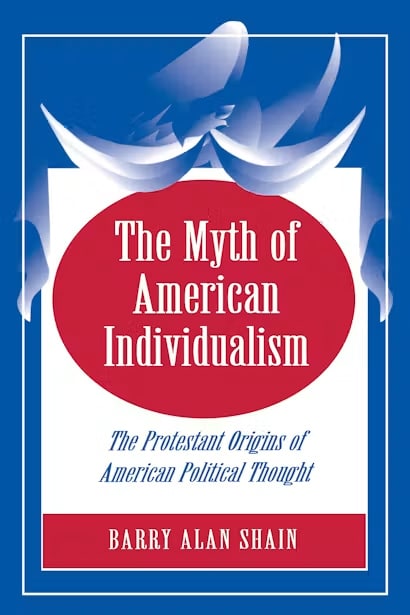
Read more in The Myth of American Individualism: The Protestant Origins of American Political Thought (Princeton, 1994).