
“Critical theory” has in recent years become a major bone of contention in American culture. The term has taken on a life of its own, such that it functions as kind of shibboleth for both conservatives and progressives. Are you for it or against it? That is the blunt either-or test of loyal membership on both sides of the political divide, typically played out at levels of sophistication dictated by the character limits for a Tweet. In particular, critical race theory has become a focal point for Americans eager to litigate the country’s racial divides and the long shadow of slavery and segregation. Rather like those other buzzwords or phrases—cultural Marxism, white privilege, heteronormativity— the vocabulary has taken on a life of its own, and is often wielded with utter conviction in the battles that take place online among those on both sides who have mastered the moralizing rhetoric without ever having reflected upon the theoretical background from which it emerged.
That is where this book will, I hope, prove useful. I am by trade and training an intellectual historian. That means that my primary interest is in how ideas and schools of thought come into being, what their origins are, what claims they make about the world in which we live, and what their significance—cultural, intellectual, historical, ideological—might be. I am not concerned first and foremost with the truth or coherence of the ideas and movements I study so much as with the various aspects of their historical and cultural significance. And so this study is an attempt to expound the critical theoretical ideas of a few chosen thinkers associated with the early development of critical theory in order to help us engage with more clarity on some of the most pressing issues of our own age.
And what are those issues? An immediate response might well point to the use of critical theory in schools, colleges, public policy making, and the media. That certainly covers some of them, but I want to suggest that there is a much deeper issue in our modern world that makes some knowledge of critical theory important in ways that go beyond what we might call these broadly political concerns. It is the issue of anthropology, the understanding of what it means to be human.
The year in which this book was completed—2023—was the eightieth anniversary of C. S. Lewis delivering the lectures that later became the small but important volume, The Abolition of Man.1 In 1943, Lewis astutely identified a deep anthropological crisis facing the West. To put it more
bluntly, the West was losing its ability to define what it means to be a human person. And if that was true in 1943, how much more so is it today, when a basic anthropological question such as “What is a woman?” is proving too complicated for some of the finest public minds to answer with any conviction or clarity?
This is where critical theory becomes important. Once we step back from pressing political concerns, it is clear that the critical theorists, from an early figure such as Theodor Adorno to later figures such as Gail Rubin, are all wrestling with the question of what, if anything, it means to be human? Critical theory is, of course, an umbrella term for a variety of different and even incompatible approaches. The Marxism of an Adorno is not the queer theory of a Rubin. But all share this in common: a basic preoccupation with anthropological questions.
This is not to defuse the contemporary political significance of critical theories. All critical theories—at least, all truly critical theories—are revolutionary. But it is to set them in the context of our times and to see them as one set of responses to that age-old question which has in the flux and volatility of modernity taken on peculiar urgency: What is man? Is he defined by making and producing or by consuming? Are biological relationships important or not? What does the good life look like? How has technology changed our understanding of human nature? Has it liberated us or enslaved us? Is sexual desire part of our core identity? Does the universe have a moral shape? Is there such a thing as “human nature”? Are we free agents or merely functions of broader cultural forces? And, of course, the pointed question so succinctly expressed by Pilate: What is truth? Christians wrestle with these questions, intensely so in our chaotic contemporary world. And critical theorists do so as well. If nothing else, we share with them a set of serious questions about the human condition that demand serious answers.
If the challenge facing Christians—and all members of Western society today—comes down to basic questions such as these, questions that all touch on the deeper issue of how we define human nature, then it behooves us to be aware of the manner in which the discussion is being pursued. This then is the principle which guides the exposition of aspects of critical theory which follow.
Carl R. Trueman (Ph.D., University of Aberdeen) is professor of biblical and religious studies at Grove City College.
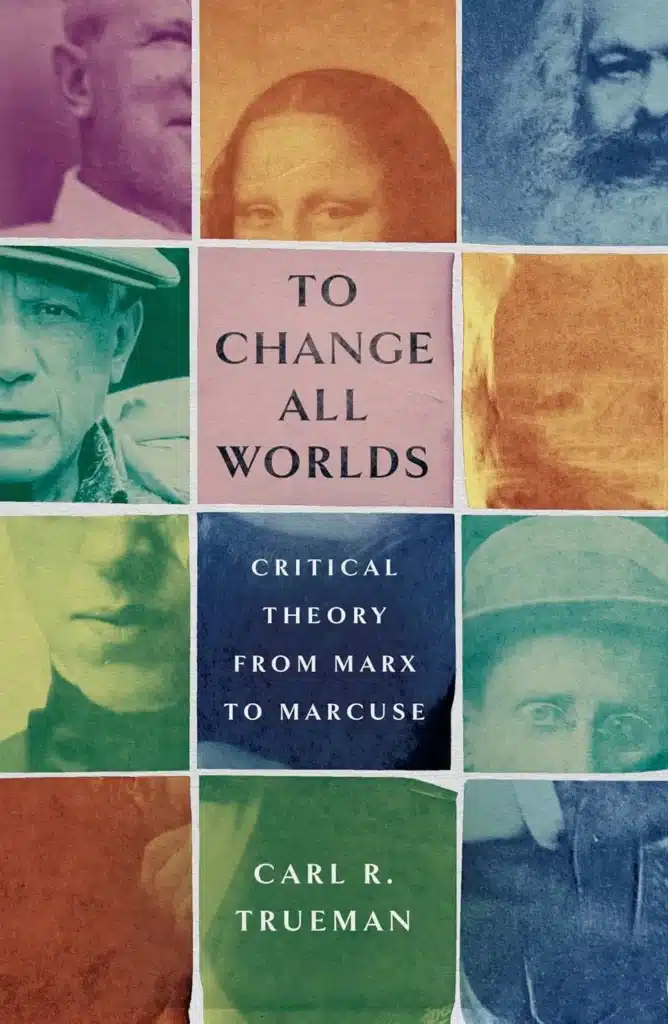
Read more in To Change All Worlds: Critical Theory from Marx to Marcuse (B&H Academic, 2024).