

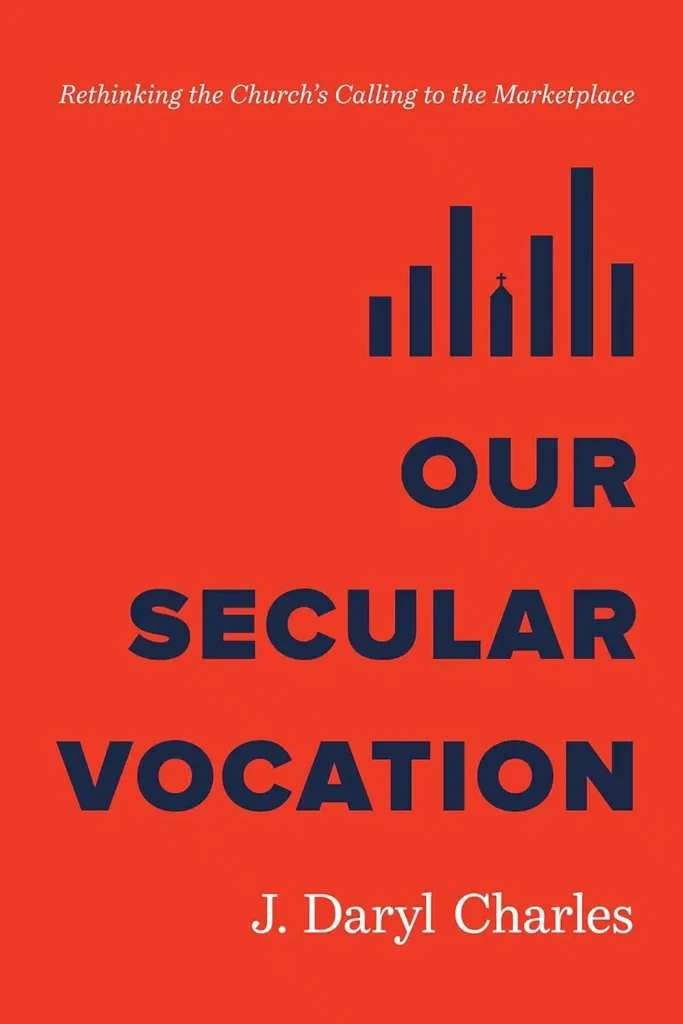
This installment of the Reading Wheel Review features a written dialogue between Dr. J. Daryl Charles, senior fellow at the Center for Religion, Culture & Democracy, and CRCD’s executive director, Dr. Jordan Ballor. Through a discussion of Dr. Charles’ Our Secular Vocation: Rethinking the Church’s Calling to the Marketplace, this conversation addresses misconceptions that cloud the Christian understanding of vocation and explores opportunities for the renewal of an authentically Christian understanding of work.
JJB: What are we to make of the sacred/secular distinction? Your book refers to “secular” vocations, and we often think about secularity involving some kind of antipathy or neutrality toward religion. What makes the majority of Christian vocations “secular,” properly understood?
JDC: I grant that the title of my book—Our Secular Vocation—might raise questions, and this was by design. Briefly stated, in order to collapse the remarkably persistent “sacred-vs.-secular dichotomy” (hereafter SSD), a divide that is insidious yet perennial, we must view the “secular” as sacred. Thus, we may argue that the sacred is secular, or, conversely, that the secular is sacred; based on a proper view of creation, there is no compartmentalization. Here we can benefit from the thinking of Dorothy Sayers, several generations removed, whose wonderfully relevant essay “Why Work?” critiques the remarkably strong centrifugal force that keeps religious faith and work as “separate departments,” a divide that mirrors a decisive theological deficiency. This deficiency, alas, mirrors not only an inadequate understanding of creation and redemption but a deficient ecclesiology, pneumatology, and eschatology as well.
As such the SSD is perennial and has deep roots in ancient culture. Well known are the assumptions that undergirded Greco-Roman attitudes toward work: Manual labor was viewed as inferior, to be performed by servants and slaves, while political life or philosophical reflection was perceived as superior. Historians refer to this contrast in terms of a vita contemplativa-versus-vita activa divide. What is remarkable is the tenacity with which this dichotomy was sustained even in the Christian era, surfacing in the late-patristic period but becoming deeply embedded in medieval life and thinking. Augustine, for example, will write to a friend, Boniface, who is an officer in the Roman Legions, and exhort him to continue in his soldierly duties: “Do not think that it is impossible for anyone to please God while engaged in active military service,” he counsels his friend. In support of this position, he reminds Boniface that no less than John the Baptist, when asked by soldiers what was required of them, did not call them away from their military obligations but rather counseled them to act justly and be content with their wages (Luke 3:14). In its medieval expression, the divide will govern the church’s thinking for well over a millennium, until an Augustinian monk by the name of Martin Luther challenges the church’s basic orientation toward work and vocation. While modernity (and postmodernity) have altered our basic assumptions about community, the church’s authority, and social life (at least in the Western context), it is nevertheless a fact that versions of the SSD persist. This divide, moreover, is to be found among both Catholics and Protestants.
Which is to say, once more, that it is a perennial phenomenon. It arises in every generation, though in varying degrees and in varying contexts, often depending on our theological orientation and our eschatological outlook.
The New Testament, however, knows no such compartmentalization. We have only to look at the “Son of Man” himself. Here is the Creator of all things (John 1:3; Romans 11:36; Colossians 1:16; Hebrews 1:2) who is incarnated as a woodworker—a tradesman—and this for the better part of three decades before his redemptive work begins. And the “apostle to the Gentiles,” while he does not make much of his tradecraft, nonetheless works as a “tent-maker,” in order that he might carry on his apostolic work in furthering the Gospel. He does this, as he will remind the churches, so that no one might accuse him of not “paying his own way” (so, for example, 1 Thessalonians 2:9 and 2 Thessalonians 3:8-11). Jesus and Paul as tradesmen—what might this suggest? At the very least, it suggests the worth and importance of work and works.
One of the most forceful declarations in the New Testament—one on which I have never heard a sermon—is Paul’s statement in his letter to the Christians in Ephesus: “For we are God’s handiwork, created in Christ Jesus to do good works, which God prepared in advance for us to do” (NIV). Do we catch the force of this purpose statement? And notice what immediately precedes: the oft-cited verses about being saved by grace through faith and not by works (2:8-9). Why is it that we never preach or teach on the realities issuing out of verse 10? We are created for nothing less than good works, and this because of the eternal counsel of God.
Further evidence that the New Testament knows nothing of a SSD is the bundle of “all things” texts that are applied to Christ Jesus. All things were created by him, through him and for him (John 1:3; Ephesians 1:10; Colossians 1:15-20 [five times the expression “all things” occurs]; and Hebrews 1:2). Fishermen, we may rest assured, continued to fish in the Sea of Galilee; they did not “leave their nets” in a vocational sense, as some might surmise in our day.
The Lutheran breakthrough of the early sixteenth century as it affected work and vocation cannot be overstated. Here we are witnesses to a revolt by a monk himself against the wider monastic system—a system that was propped up by the theological rationale of a higher or superior vocatio for those called to the priesthood or the monastic ideal. This was essentially a calling away from society. Luther’s response was to emphasize the goodness of all work, when performed in service to one’s neighbor. Undergirding this prophetic response was the theology of the priesthood of all believers. Thereby work and vocation were reconceptualized, with the result that any SSD was countered and believers were called to, rather than away from, society for service.
Modern and contemporary versions of the SSD have inherited, to some degree, the clergy-laity distinction of the medieval era. Perhaps the two most notable features of current church life that tend to encourage this divide are (1) a professionalization of the clergy and related pastor-centric orientation (hence, “faith and work” movements tend to be lay-led) and (2) an understanding of “missions” that focuses almost exclusively on “foreign missions” or “full-time Christian ministry” (which itself is a distortion). Tragically, these tendencies are encouraged rather than altered by the sheer fact of the relative absence of a “theology of work” and “theology of vocation” in our standard seminary or divinity school education core curricula. What’s more, many pastors have never spent a meaningful season of life working in the marketplace and hence either are intimidated by or uninterested in equipping the laity for service in the workforce. What is greatly needed, whether from the pulpit, in our attempts at Christian education and spiritual formation, or in our seminary education, is a vision for three related emphases: (1) the design and intrinsic dignity of work based on our creation in the image of God, (2) the resultant “creation mandate,” by which we recognize the high calling of the marketplace/the Monday-through-Friday and all endeavors to develop the created order, and (3) the centrality of the doctrine of vocation (properly understood) that shapes our direction and serves as our guide.
In eminently practical terms, allow me to suggest the following liturgical addition to standard congregational life—a liturgical addition that would utterly revolutionize congregational life, reflect a healthy theological orientation, and encourage the collapse of any form of SSD present in our churches. I propose, as part of our liturgy in one Sunday worship service a month, having a regular “commissioning” service for the laity (who together comprise 99.9% of every congregation). One month we would commission (and pray for) those called into the business and finance sector; another month we would commission those called into professional medicine and healthcare services; another month, those called into the study or practice of law; another month, those who perform government and political service; another month, those who are first responders; another month, those who are tradesmen such as builders, developers, plumbers, electricians, and so on, etc., etc. The benefits of such liturgical additions would be enormous. Congregational life would mirror healing and health, and our witness to the community, the city, and the world would be magnified. Moreover, this practice would be a demonstration of work as worship—indeed, a significant part thereof. Such liturgical additions would close the gap between Sunday and Monday, giving evidence of an integrated faith-life.
JJB: Is the “faith and work” movement largely a white-collar or middle-class phenomenon? How should we think about callings in different areas of life and how education, from secondary to post-secondary, fits into that understanding?
JDC: Many of those in the movement (though by no means all) come out of the business sector, thereby perhaps giving the impression that it might be viewed as a white-collar phenomenon. However, the great divide is not so much between various strata of the workforce—for example, white-collar versus blue-collar workers—as it is between laity and clergy, both Protestant and Catholic. The reasons for this go back to the previous question and the persistent SSD that is fostered, in our time, by the great divide existing between a professionalized clergy, pastorate, or priesthood and the laity who comprise virtually the entirety of every congregation or parish. This, alas, has been nurtured, as the previous question observed, by the absence in our seminaries and divinity schools of any core component in the curriculum devoted to a theology of work and vocation. Where at the seminary level there does exist a “faith-and-work” element, it is typically adjunct and supplementary in nature. This in itself is highly instructive.
And until theological training—whether at the college or seminary level or at the local congregational level—recognizes (1) the centrality of work’s intrinsic dignity based on creation in the imago Dei, (2) the resultant “creation mandate,” by which we the high calling of the marketplace, the Monday-through-Friday, and our work in the world are affirmed, and (3) the centrality of the doctrine of vocation that serves to guide our personal lives, the SSD will not be addressed sufficiently. To be sure, spiritual revival and reform, viewed historically, have had their origins in lay efforts. At the same time, social, structural, and ecclesial realities that have shaped the church, whether Catholic or Protestant, may serve to impede what the Spirit of God might wish to do.
At the same time, it is imperative that we not diminish the role that families—and not merely educational institutions—play in preparing people for service to Christ and to the world. Christian parents have the great joy—and the supreme responsibility—to guide their children in their growth beginning at a relatively early age and through different stages. An important part of our children’s personal growth and maturation is to develop a consciousness of their particular giftings, talents, and propensities, all of which point toward a vocational calling. This process of guidance need not be relegated primarily to the local church, or the college experience, or the wider Christian community, even when each of these has a role to play in confirming our callings. It begins in the home, regardless of social or economic stratum and cultural location.
JJB: What are some of your favorite scriptural verses or passages about work?
JDC: I find certain Scriptural texts recurring in my own thinking and work on the wider topic of work and vocation. Permit me to identify each of them initially and then offer several related comments.
- Ephesians 2:10 – our purpose
- Genesis 1:26-28 – our design
- Exodus 20:8-11 and Deuteronomy 5:12-15 (Decalogue) – our model
- Colossians 1:15-20 – our range
- Ecclesiastes 9:10 – our motivation
- Ecclesiastes 11:1-6 – our potential
- Matthew 5:15-16 – our effect
- Matthew 25:14-30 – our reward and our responsibility
As I noted in the last question, we are created for work; it is part of our design, based on our creation in the image of God as recorded in Genesis. While it is true that work is not our full identity, it is still part of our identity. Thus, the well-intended exhortation of one Christian commentator—that “we are not made for work but for rest and worship,” and that “we are not made for the sixth day, but for the seventh”—is both true and false and thus needs adjustment. We are made for both work as well as rest and worship. Moreover, such a statement pits work against worship, falsely assuming that the two have different identities. Indeed, work is a significant part of our worship; a biblically faithful theology must argue for work as worship.
Our model here, based on human creation in the image and likeness of God, is the Lord God himself, who worked, whose creation was “good” (indeed “very good”), and who then rested from his labors. We work because God works; we create because God creates; and we rest because God rested from his labors.
What is exhilarating is the fact that the full range of our work and activity (the entire created order), as well as our motivation, our potential, and the effects of our work and activity on the culture around us know no bounds. They are without limit. The range of our work, our service, and our efforts is nothing less than “all things,” since this is the very range of Christ’s lordship. This itself collapses any false division between sacred and secular; all things have been made by, through, and for Christ Jesus. Our motivation and our potential as individual believers, of course, will vary. Not all are motivated in the same way; not all are stirred by the same sorts of factors; not all are prone to step out and take risks in the same manner.
The two texts from Ecclesiastes noted above are striking because they go to the heart of a person’s motivation and willingness to take risks. The proverb found in Ecclesiastes 9:10 appears in the context of enjoyment and satisfaction and needs no further “real-life” translation: “Whatever your hand finds to do, do it with all your might.” My hunch is that many Christians live and act more out of fear or duty than out of a desire to utilize everything imaginable that God has placed within the realm of possibility. (Of course, we must distinguish here between faith and presumption.) I am equally intrigued by Ecclesiastes 11:1-6, a text that perhaps might strike us initially as abstract but which challenges the reader/listener to “sow seed,” not knowing or controlling what the results will be and how they might develop. The challenge to do thusly is by no means limited to agriculture, even when weather and crops and harvesting are in the mind of the writer. Just as we have no control or knowledge of what the weather will be, we do not know what God is doing, how he is doing it, and what harvest will result from our sowing of seed. But sow we must, trusting then the Sovereign Lord to water, cultivate, and grow a harvest that will almost always be unknown (or immeasurable) to us. In any event, we pray—and we work—so that our “light might shine before men”; that light consists of our work (our “good deeds”) that in the end will bring praise to our Father in heaven (Matthew 5:15-16).
The final text that has long intrigued me is the parable of the talents (Matthew 25:14-30). While the immediate context of this parabolic teaching is Israel, its extended or wider application is rich beyond measure. It reminds us that as stewards we are given diverse gifts and callings by the master. Service, of course, is not compulsory. Talents are entrusted to each. The master goes away for an unspecified, extended period of time. Perhaps the third steward unwisely assumed the master’s return would be imminent and therefore remained inactive, in the end incurring the master’s wrath. What matters is not the gift or talent itself or the quantity entrusted; each steward is given something, “depending on each one’s ability.” What matters is how the steward uses what has been given. Two of the three stewards put their talents to work, trading and doubling their investments. The third essentially does nothing. The two “good and faithful” stewards receive striking commendations from the master upon returning; he is given great joy at the fruits of their work, and as a result they are given greater responsibility and privilege. The third, however, appears to have based his inactivity on a distorted impression of the master; he is called “harsh.” And though the failure is the steward’s, he ends up blaming the master. In the end, not using or investing what was given by the master means losing it; talents and opportunities can disappear. Far from being a harmless or entertaining story, this parable comes across as more of a punch in the face, because of the truth that it bears. At work in this story are expressions of a central law in the universe—one that is as true and constant as the law of gravity. It is the law of sowing and reaping, and it is true in both material and non-material terms, in economics and in morality, in private and in public life.
These, then, are scriptural texts that tend to rivet my attention, past and present, as I contemplate the importance of the doctrines of work and vocation.
JJB: Did you always have this holistic understanding of work and vocation? What are some of the most important influences on your thinking? Who have you learned from?
JDC: Probably as with most people, my own understanding of the two interwoven realms of work and vocation has been characterized by incremental growth. As it happened, two seasons of life contributed considerably to this awareness. The first was my living abroad for an extended period of time. Living in a different culture for a period of years forces one to appreciate culture and the role that culture plays in Christian witness to the world. When transplanted into a foreign culture, one must find ways to honor the host culture—an attitude that might not be easy for most Americans. Foremost in this task is the very hard, though rewarding, work of learning the language. The second season of life that for me was formative in this regard was doing public policy research in Washington, D.C., before entering the university classroom full-time. On Capitol Hill, I met many Christian believers, Catholic and Protestant, who were serious about their faith. It was during these years that I came to more fully appreciate public service and building the common good in a new and fresh way. In terms of pure numbers, it is true that not many are called to politics, governmental service, policy analysis, law enforcement, and similar modes of serving the common good. These, nevertheless, are strategic in nature and part of the “Monday-through-Friday” that most of us take for granted.
In a fascinating way, however, I find myself thinking in new and fresh ways about work and vocation holistically during the present season of life, namely, since retiring from full-time teaching in the university classroom though in the midst of my current work, which entails researching and writing on policy issues with several think tanks and occasional teaching and lecturing in a university context. “Retirement,” in fact, becomes an exceedingly relevant illustration of a proper view of work and vocation, particularly as we contemplate the meaning of our days. Why? Because in our own cultural context, retirement is almost universally regarded as a release from work. However, this perspective lacks any theological warrant. Biblically speaking, there is no such thing as “retirement.” Scripture nowhere releases us from our labors and service to others and to God while we breathe. That means we do not retire from our true callings, just as we do not retire from public service or contributing to the common good. Our gifts and abilities are to be used until we are either called from this life or can no longer employ them due to declining health. Rather, it is more accurate to speak of different “seasons” or perhaps, as Luther did, of “stations” in life. Occupations, jobs, and seasons change; our vocation, however, does not. Though we hear virtually no teaching in this regard, retirement should not bring an end to work or serving others. It should, rather, simply open up new phases or avenues of one’s vocational calling.
When asked who has influenced my own thinking in these areas, four names automatically come to the fore. The first is Luther, given his prophetic revolt in the sixteenth century that dramatically altered the church’s thinking about work and vocation. The second is Abraham Kuyper, a remarkable individual for whom “common grace” was central to God’s work in the world. The third is writer Dorothy Sayers, who is perhaps best known not for her theological work so much as her detective mysteries. In any event, her classic essay “Why Work?” retains its force every bit as much, if not more, in our day. And the fourth is John Paul II, whose regularly appearing encyclicals during his pontificate consistently addressed matters of faith and culture in ways that were penetrating, even for Protestants such as myself. In what follows, I’ll go in reverse order and offer a few comments as to why the thinking of these four has been so important.
John Paul II, whose pontificate spanned a period of 27 years, was remarkable for a number of reasons. Having known totalitarianism intimately, he could thus speak with authority to both the church and society. And this he did. He understood that truth, though self-evident through the natural moral law, must nevertheless be defended by the church in meaningful, relevant, and creative ways. As I was finishing graduate school, it seemed as if every two years or so John Paul was publishing a major encyclical or pastoral letter that addressed important theological and cultural issues. One of these was an encyclical published on September 14, 1981, under the title Laborem Exercens (“On Human Work”). Therein the pope acknowledged that, through work, human beings above all “elevate unceasingly the cultural and moral level of the society” within which they live. Humankind “is made to be in the visible universe an image and likeness of God himself” and “is placed in it in order to subdue the earth.” From the beginning, therefore, the human being is “called to work,” which is “one of the characteristics that distinguish man from other creatures.” Work, as John Paul noted, is a “perennial and fundamental” aspect of human existence that is “always relevant and constantly demands renewed attention and decisive witness.”
The occasion of this encyclical, it should be remembered, was the ninetieth anniversary of the encyclical Rerum Novarum, in which Pope Leo XIII had reflected on the “social question” emanating from newer technological, economic, and political conditions of the day. For John Paul, work is lodged at the very center of the “social question” and thus demands further development in the church’s social teaching. Anchored in affirmations of Christian truth, John Paul undertakes in Laborem Exercens the message of the “gospel of work,” considering its spirituality, its dignity, its effects on family and society, its distortions and challenges, its manifestation in the “Son of Man” (the “Man of Work”), and more. Perhaps most illuminating is John Paul’s examination of human labor as “sharing in the activity of the Creator,” inasmuch as we have been created in the image and likeness of God. Because of the imago Dei, then, we imitate God; we participate in his work; we co-create with the Creator. While many Protestants would not associate a theology of “faith and work” with the Roman Catholic Church, and this for historical reasons, John Paul’s reflections on work, then and now, are cause for rejoicing, and for continued reflection. They are a valuable resource, mirroring a biblical theology in the tradition of historic Christian faith.
Novelist Dorothy Sayers is doubtless best known for her murder mysteries, which starred the incomparable Lord Peter Wimsey. (By way of comparison, one thinks as well of G.K. Chesterton’s Father Brown series.) Even when Sayers is perhaps less known for her theological writings, two volumes—The Mind of the Maker and Creed or Chaos?—should be part of every Christian’s library; they are theological to the core. Part of Sayers’s giftedness was to employ in effective ways literary creativity to advance the cause of Christian doctrine. In The Mind of the Maker, Sayers compares the nature and process of artistic creativity with the activity and dynamism of the three Persons of the Trinity; the activity of the one, she argues, illuminates the activity of the other. From her perspective, Sayers is convinced that literature can cast helpful light on the task of doing theology.
The fundamental assumption that inspires Creed or Chaos? is Sayers’ conviction that the church has become irrelevant not because of its commitment to historic Christian doctrine but because of the absence of such commitment. The church’s creeds, she insists, are not boring; they are, in fact, dramatic and earth-shaking. Sadly, in Sayer’s view, our failure to appreciate fully the role of theology has rendered Christian cultural witness impotent, cutting us off at the knees, as it were. Thereby, she laments, we have “very effectively pared the claws of the Lion of Judah” and “certified him [to be] meek and mild.” But Sayers’ concern for doctrine is not some sort of abstract intellectualizing. For her, the church’s witness to the world needs authentication. A major part of that witness is our calling in the Monday-through-Friday to the work-world and the quality of our work done on a daily basis.
Thus, one of the most forceful articulations of Sayer’s theological orientation in Creed is the essay “Why Work?” Work, according to Sayers, is best understood as “a creative activity undertaken for the love of the work itself.” In her view, several baseline assumptions need identifying and affirming: (1) human beings image the very nature of God; (2) because of this likeness there exists an almost sacramental relationship between the human person and work; (3) in work the Christian should find spiritual, mental, and physical satisfaction; (4) work is a medium in which the human person offers himself/herself to God; and (5) the only truly “Christian” work is work that is well done. These foundational theological presuppositions undergird in Sayers’ thinking a sturdy “theology of work.” Reiterating these baseline assumptions, I submit, is necessary in every generation, given the SSD that appears so persistently and of which Sayers was immensely critical. Consider this rebuke of hers:
In nothing has the Church so lost Her hold on reality as Her failure to understand and respect the secular vocation. She has allowed work and religion to become separate departments, and is astonished to find that, as a result, the secular work of the world is turned to purely selfish and destructive ends, and that the greater part of the world’s intelligent workers have become irreligious or at least uninterested.
Following up this reprimand, Sayers asks: “How can anyone remain interested in a religion which seems to have no concern with nine-tenths” of a person’s waking hours? Not only are we permitted to ask this very question, in my view we are required to do so. Sayers was right: the “business of the Church” is “to recognize that the secular vocation as such is sacred.”
Abraham Kuyper (1837-1920) served as the prime minister of the Netherlands in the years 1901-1905. Not many people, then or now, could claim to be the founder of a university, a journalist and founder of two newspapers, a statesman and parliamentarian, the founder of a political party, an educator, and a theologian. Kuyper was all of these. In some quarters of Protestant Reformed Christianity, his legacy endures with surprising potency, perhaps chiefly because of his accent on the doctrines of “sphere sovereignty” and “common grace.” For our present purposes, permit me to emphasize the role that the latter, “common grace” (de gemeene gratie), played in Kuyperian thinking. Common grace may be summarized as God’s preserving and sustaining work in the created order. Common grace reminds us of the complementarity of special revelation and general revelation. As Kuyper understood it, common grace is not some sort of theological innovation; rather, anchored in creation realities and God’s providential care, it prevents a culturally irrelevant and ineffectual Christianity insofar as it understands that God has gifted everyone to contribute in some way to the common good. We might say that common grace underscores God’s unceasing, moment-by-moment providential care for the entire created order. It is in this context that many people have heard the oft-quoted statement by Kuyper that “no single piece of our mental world is to be hermetically sealed off from the rest, and there is not a square inch in the whole domain of our human existence over which Christ, who is Sovereign over all, does not cry: ‘Mine!’”
There was a Christian tendency in Kuyper’s day, as there is, frankly, in every generation, either toward capitulation to contemporary, secularizing assumptions of the culture or toward isolation from the culture. In Kuyper’s view, these two inclinations—capitulation or isolation—called for a “third way.” A proper appreciation of common grace, Kuyper was convinced, should render us “duty bound to take all civil life under its guardianship and to remodel it.” Kuyper’s social philosophy thus embraces everything that is part of this present world based on creation. And, of course, a proper view of work and vocation are at the heart of this project.
We’ve already alluded to Martin Luther’s prophetic revolt in the early sixteenth century, the effects of which can scarcely be overstated; therefore, my own appreciation for Luther and his work, though far-reaching, will be simply summarized. We may accurately say that as a reformer, Luther is located at the beginning of early modern theological reflection on the dignity of work and the centrality of vocation (properly understood). Luther’s reaction to over a millennium of the church’s devaluation of work and a two-tiered understanding of vocatio was nothing short of revolutionary. The reason for this, however, needs our attention: it was his theological orientation. Not mystical contemplation or meritorious works, not almsgiving or sacramentally-infused grace, but faith renders every believer a priest before God. For Luther, a redefinition and proper understanding of vocation was the immediate need in light of the doctrines of justification and universal priesthood.
It is exceedingly difficult for us, 500 years removed, to identify properly with how such a revolt would have been interpreted in the early sixteenth century. Given the prevailing ecclesio-social system dominating medieval life, such rebellion would have been viewed as nothing short of heresy, even when reform movements had been well underway in the late fifteenth century. It is a great blessing that Luther’s works in their entirety have been published and are excessible today through most library systems. This accessibility permits the interested student to read all of Luther’s many treatises, tracts, and sermons. Many of these concern a proper view of work and vocation, and frequently the context in which Luther’s views are found is his addressing ecclesial or political authorities concerning finance, education, and social challenges.
In my own research, I have been surprised to learn of Luther’s commitment to social concern. And as the editors of one important recent volume observe, this is the “forgotten” side of Luther’s work. I say “surprise,” in light of the well-known fact of the reformer’s problems with the epistle of James on the basis of his view of justification. Nevertheless, Luther’s social concern was admirable, given his commitment to working for the common good. As an example, we may cite his 1527 tract Whether One May Flee from a Deadly Plague, written to pastors and Christian leaders in light of the second of three visitations during Luther’s lifetime of the bubonic plague in Wittenberg. In this treatise, Luther offers his rationale for remaining in Wittenberg when virtually all students and fellow faculty were fleeing the city. While fleeing per se is not a bad thing, says Luther, it can be done for the right or the wrong reasons. At bottom, one must not leave one’s neighbor in need, he reasoned, particularly if one is a shepherd of God’s flock.
If we limit our assessment only to socioeconomic concerns and exclude the Ninety-Five Theses (which addresses ecclesio-social issues), the treatise To the Christian Nobility of the German Nation (in which Luther addresses political, ecclesial, and economic realities as they together affected the German lands), as well as his many sermons (in which Luther the pastor speaks to the true needs of his congregants), we find no less than seven of Luther’s published works dealing specifically with social and economic issues. In fact, given the strong accent in his writings on neighbor-love and the common good, it becomes impossible to miss Luther’s genuine concern for the needy and disadvantaged. As supremely practical evidence thereof, we discover that he was instrumental in helping establish in Wittenberg a primitive social welfare system through the creation of a community chest (Kastenordnung)—a development that would spread to other towns and cities in Germany.
Esteemed German theologian Jürgen Moltmann has described vocation as “the third great insight of the Lutheran Reformation.” Lutheran theologian Kenneth Cherney makes an even stronger claim by noting that vocation is “the second most frequent emphasis” in Luther’s writings. Permit me to add a third, though related, assertion: Luther precipitated a revolution in the church’s understanding of work that was imperative and eternal. If Moltmann and Cherney are correct, it is difficult to understand the church’s remarkable silence on the doctrines of work and vocation. In few (if any) areas of Christian doctrine and conviction has there ever been another example in which the Christian church has largely gotten it wrong for over a millennium as it did concerning work and vocation. Hence, the praise and priority assigned to Luther the reformer—as it concerns work and the worker, the marketplace, a redefining of vocation, and society as a whole—are well deserved. His contributions are utterly unique.
JJB: It is undoubtedly important to adjust how we think about work to properly understand our roles in this world and how these responsibilities form us. But are there important barriers to a healthy understanding of vocation that are embedded in our culture and the structures of our work? What are some of the broader challenges to a healthy and biblical manifestation of work in our lives?
JDC: We might point to two. One is embedded in the surrounding culture itself and a product of secularization. “Vocation,” as the term is typically used in everyday parlance, thus refers to job support, technical training (vo-tech), or occupational and career advancement. In recent decades, the notion of vocation can be found to surface on occasion in journals of behavioral psychology or organizational leadership, although it more often than not is bleached of its inherent religious meaning. And on occasion the language of “vocation” might appear as well in the literature of pop-psychology, but again the inherently religious or theological basis of the notion tends to disappear, fading into versions of “self-help,” self-affirmation, or a “be all you can be” sort of mindset.
But the second general barrier is infinitely more tragic, in my view. It is a multiform phenomenon that we’ve been describing in the previous questions, namely the SSD. The effects of this divide, already noted in various ways, are diverse yet interrelated. They are felt, at one level, in congregational life—through a professionalization of the clergy, pastor-centric church life, a distorted view of “missions,” the absence of teaching and preaching on the dignity of work and the centrality of vocation, the cleft between Sunday’s worship and Monday’s work, and the laity’s sense of the inferiority of a “marketplace calling.” Where “Christian values” are applied to Christians’ work and the workplace, the goal is often the desire to “witness at work” (whether to one’s colleagues or to one’s boss) rather than realizing that work done with excellence for the building the common good and for creating or extending culture is our primary calling and ultimate witness.
At another level, the effects of the SSD are exhibited in the context of seminary and divinity school education, where pastors and Christian leaders are being equipped. There, as we’ve observed, standard theological education fails to develop sturdy theologies of work and vocation anchored in creation norms as important (rather than tangential) units in the core curriculum. Add to this the fact that many seminarians, who choose to pursue theological studies, are often grateful that they don’t have to be working a “regular job” any longer. And, as already noted, many (if not most) pastors have never spent a significant season of life working in the marketplace—hence in their mindset either a resident disinterest or unawareness of the church’s primary calling.
Until the church gets serious about theology and develops intentionally a theology of work and vocation, many—perhaps most—Christians will continue to view the Monday-through-Friday, the workplace, and the world of industry and commerce in the following stereotypical ways: as a realm in which we can “witness” to our colleagues and tell them about Jesus; as a realm that keeps us from doing the “real” work of the ministry; as a realm of activity that we must endure in order to obtain a paycheck and make a living; as a realm we would gratefully quit and leave behind in order to “go into the ministry” or to seminary; as an unstable realm of shifting duties and allegiances with no permanence or satisfaction; as a realm that, at best, is a necessary evil and, at worst, is a curse. The authors of one recent (and thoughtfully written) volume—Work and Worship: Reconnecting Our Labor and Liturgy—argue for connecting people’s experience in the work-week with the liturgical elements of the church gathered. They believe that the integration of work and worship should be expressed liturgically inasmuch as worship is formative. While I surely applaud the unifying of work and worship as was already discussed (namely, work as worship), I would maintain that liturgy is meaningful only to the extent that its meaning is understood and we perceive its theological significance. Liturgy, we might say, will mirror or reflect the theological realities of our confession and not create or bring them into being. Hence, our challenge is not merely liturgical; it is indeed theological.
JJB: Is there something distinctive or unique about a Protestant perspective on work when compared to the Roman Catholic tradition? Are differences simply matters of emphasis or do they include fundamental issues of substance?
JDC: From what the reader has gleaned from the conversation thus far, it is accurate to say that a Protestant perspective on work and vocation has distinguished itself from its Catholic counterpart. If for no other reason, the doctrine of the “priesthood of all believers” distinguishes the Protestant viewpoint in important ways, the Lutheran breakthrough being a dramatic testimony to this fact. At the same time, as we have seen, a measure of change has visited Catholic thinking on these matters, most importantly, through the thinking and writings of John Paul II. In the mid-twentieth century, it should be noted, Catholic social teaching began to shift in subtle ways. The initial impetus came from Pope John XXIII, whose 1961 encyclical Mater et Magistra expanded the idea of vocation beyond the priesthood—a move that would have been unthinkable previously. John Paul’s 1981 encyclical noted above, Laborem Exercens, contributed to this development by examining the ethical meaning of work. In 1991, in his encyclical Centesimus Annus, John Paul extended his own thinking of 10 years prior, arguing that work possesses an irreplaceable social dimension that contributes to the common good. And mirroring John Paul’s notable influence, the Catechism of the Catholic Church speaks of the “vocation of lay people,” even to the acknowledgement of lay believers as “the front line” of the church’s life. In any event, we may rejoice in these developments, some of which have arrived in our own lifetime.
JJB: What are some of the negative consequences of having a truncated, distorted, or corrupted view of vocation? What are some of the ways in which work itself has been impacted by sin, and what are some of the ways that such impacts echo down through history to our own day?
JDC: In very general terms, one might point to two main expressions of sin and revolt into autonomy as applied to human labor: (1) work as frustration, alienation, dehumanization, fruitlessness, or meaninglessness and (2) work as idolatry, which is driven by a selfish ambition for wealth, power, and influence. It is significant that the first of the Ten Commandments concerns idolatry. As Luther was known to suggest, the first commandment is the one that, based on human nature, we all tend first to break. Why is that? Idols are powerful, and they are deceitful, becoming the basis and justification for life’s decisions. Idols are both personal as well as collective or cultural in nature, and though they differ with every culture, they are universal—ancient, modern, or ultra-modern.
The first two chapters of the book of Ecclesiastes seem to address aspects of both of the aforementioned phenomena. What many Old Testament commentators seem to miss in their interpretation of this “wisdom” book is the writer’s literary strategy. While he devotes much of Ecclesiastes to the utter meaninglessness of all things “under the sun,” he also presents contrasts throughout the work that describe human labor as satisfying (for example, in 2:24-26; 3:12-13; 3:22; 5:18-20; and 9:7-10). Each time this satisfaction derived in and from human labor is associated with the Creator. Thus, Ecclesiastes, I would argue, is presenting in excruciatingly painful terms a non-theistic view of life (meaninglessness and vanity) over against that of the God-fearer. The epilogue (12:9-12) as well as the aforementioned texts would seem to confirm my interpretation. While the writer of Ecclesiastes does not intend to develop a “theology of work,” he does contrast two diametrically opposed world- and life-views.
We have already discussed some of the negative consequences of a truncated or distorted view of vocation. Most of them are manifestations in one way or another of the insidious SSD, including an unfortunate “vocational hierarchy” that remains alive in many of our churches. Thereby pastors and “missionaries” sit atop the hierarchy while the general laity—butchers and bakers and candlestick-makers, i.e., lawyers and businessmen and all manner of tradesmen—probably sit near the bottom (along with politicians).
But another form of distortion in thinking about vocation is theological in nature. For example, it may have its roots in a wrong view of divine providence, whereby we perhaps succumb in our thinking to a form of fatalism or determinism. Discovering and affirming our vocational calling is not to be compared with, say, feeling our way blindly through some labyrinth, with only one possible exit. Similarly, it is not the spiritual equivalent of catching the one (and only) train leaving the station at 11:55 pm (and if I’m not on it, I’m sunk).
A proper understanding of vocation entails the awareness that we do not choose our callings, any more than we choose our DNA, our birthdates, our families, or our children. It is more accurate to say that we receive our vocational callings, and that discovery tends to occur through a gradual process. Also, vocation entails our recognition of skills, talents and abilities that have been entrusted to us as stewards by God; moreover, they presume an intentional and guided development. In practical terms, thinking vocationally helps make sense of various seasons of our lives; jobs, occupations and careers might shift and are unstable; not so regarding our wider calling. Relatedly, a proper view of vocation prevents a sort of disordered, chaotic daily lifestyle that can torment us when we seem to lack a sense of direction. In addition, as Gordon Smith, in his wonderfully insightful book Courage and Calling reminds us, a vocational mindset liberates us from what has been called the “tyranny of the urgent.” That is, we are freed to concentrate on those priorities that are of highest value rather than those competing—perhaps screaming—for our immediate attention. Finally, thinking vocationally prevents us from comparing ourselves with others in such a way that renders us people-pleasers; we find a place of rest and freedom from anxiety in the awareness that God has made us and equipped us uniquely.
JJB: How should Christians view technology in particular and innovation more generally? Do automation and disruptive technical advancement undermine human dignity?
JDC: This question might draw out different responses from different people, depending on their perspective or their experience in the workplace. The French sociologist Jacques Ellul, a committed Christian, is famous, among other things, for his trilogy on technology; few people have plumbed the depths of the social and political ramifications of technological innovation as Ellul. But in his theological understanding of work, there existed a radical disconnect between creation and redemption. The result of that disjunction was the conviction that work does not possess an intrinsic dignity, and hence, that work cannot bring any measure of satisfaction; rather, work is to be seen as a product of the fall and not part of human design based on the divine nature and the imago Dei. Work is a necessity and no more; moreover, Ellul insisted, the Bible “never speaks of it as vocation.”
We can applaud Ellul for his sociological insights, particularly as they concerned technology and technical advancement; they are remarkable. At the same time, we may lament his distorted view of work and vocation. How should Christians view technological advance in society? We may say that all things belong to Christ the Creator; therefore, scientific and technological advance are not intrinsically harmful—unless or until, that is, they are used for inhumane or harmful purposes. Here we are dependent on the theological and ethical bedrock of human creation in the image of God. Every generation has been faced and will be faced with technological advance. Christian faith can utilize that advance in “co-creating” with God and developing human culture, every bit as much as the world system can use it to undermine the image of God and corrupt the human spirit. For this reason, the Christian community must be in the world, even when it is not “of the world.”
JJB: What are some of the greatest opportunities for the renewal of an authentically Christian understanding of work in the world today?
JDC: It is truly encouraging to see the amount of literature appearing in our day on the topics of work and vocation, marketplace theology, work and worship, and more. In addition, various institutes on faith and work continue to emerge. My own hope is that what has for the most part been a lay-led reform movement, given the dominance in contemporary Western society of pastor-centric church culture, will in time result in transformation that seeps its way both into seminary education as well as our pulpits and congregational life. R. Paul Stevens, author of numerous works on faith and vocation, has recently praised the merits of “tent-making” and being bi-vocational (Working Blessedly Forever, 2024). Perhaps such a development will re-occur in North American culture, where greater freedoms exist when compared to European societies, most of which are characterized by a state church.
We build—and rebuild—society through our work and our vocations. This is our witness to the culture and to the world. This is the “cultural mandate.” Perhaps over time, as we seek to bless the heart of God through our labors, as we view work as worship, and as we seek to build Christian community, we will see fruit. After all, as Ecclesiastes reminds us, “there is nothing better for people than to be joyful and to do good while they live. That each of them might eat and drink and find satisfaction in their work—this is the gift of God.”