
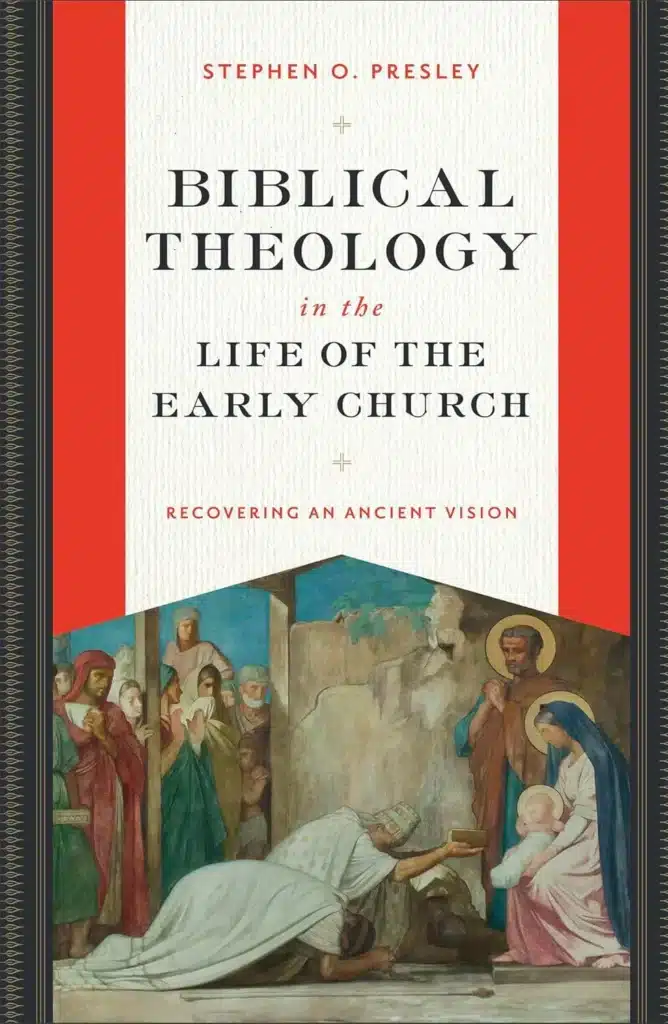
Theology has been captured, according to Stephen O. Presley. It has been wrenched from its proper place and context—the church—and forced to reside in the modern university. This change of place has resulted in a change of approach: rather than an ecclesial community, faithfully interpreting Scripture according to historic Christian presuppositions, we have a skeptical professoriate interpreting texts according to “the critical assumptions of modern hermeneutics.” In other words, biblical theology as a discipline—to say nothing of “biblical studies”—has become profoundly unmoored (and unmooring). Presley summarizes the state of the discipline this way: “Untethered from the church and without any shared theological and moral commitments, scholars are free to roam, creating meaning as their desires lead them.” This subjectivism invites scholars to smuggle modern ideologies into an ancient text, thereby hijacking its original meaning. Nor is this folly wholly contained within academia, as scholars train pastors who, in turn, shepherd laypeople. At nearly every level, biblical theology functions something like a Rorschach test—individuals read themselves into the text, rather than the text into themselves.
Presley’s proposed solution in Biblical Theology in the Life of the Early Church is a welcome one: the recovery of an “ecclesial biblical theology.” To do this, one has to imaginatively turn back the clock—reviving a pre-modern conception of scriptural engagement that situates biblical interpretation in an ecclesial community that is dedicated to the same metaphysical principles, committed to a comprehensive vision of salvation history, unified in its Christological framework, and devoted to the highest personal virtue. That is, in effect, the prescription of Presley’s book in miniature. Rather than see Scripture as an isolated text, Presley helps us re-enter the “social imaginary” of early Christianity—seeing that vast constellation, as it were, from the inside. Presley’s book is therefore filled with wonderful vignettes of the lives of Augustine, Gregory of Nyssa, Irenaeus, Origen, Basil of Caesarea, and others, demonstrating how these great men saw in Scripture a unified vision of the world and their place in it. This comprehensive vision is what Presley wants to help us recover in our own deeply fragmented culture.
Yet, we moderns are all haunted by the ghost of Descartes: we bring to everything a critical spirit, and we tend to prioritize methodology and epistemology over metaphysics. Look to any seminary’s curriculum, and one will find myriad courses on hermeneutics but rarely a course on metaphysics. The church fathers, could we summon them before us, would undoubtedly find this backwards. As Presley rightly notes, all “patristic interpretation…must begin with the end in mind” because the patristics understood that what we can know depends entirely on the nature of God, the created order, and our place therein. Yet, we, by contrast, bring our various “isms”—postmodernism, feminism, postcolonialism, and so on—to the text, thereby fracturing Scripture’s comprehensive view and overall purpose.
Historically, the “rule of faith” and “liturgy” have served as beneficial guardrails to scriptural interpretation, and Presley hopes we would take these ideas seriously once again. The rule of faith includes “a basic dogmatic summary of God” which is itself framed within a broader “narrative of God’s work in salvation history.” In other words, one must nail down the nature of God and the nature of His work in the created order before attempting to interpret any specific passage. Some of you might reply, “Isn’t that backwards? Isn’t the whole just an aggregation of the various parts?” To this, one is tempted to repeat the truism that the whole is greater than the sum of the parts; more practically, however, one might suggest that we do this sort of thing on a daily basis: my knowledge of my wife’s character, for example, emerged from many day-to-day interactions with her, and yet it is her character—over and above her individual actions—that proves to be the proper interpretational touchstone for understanding her individual actions. Analogously, “the rule of faith emerges out of the Scriptures and in turn, becomes the means by which we make sense of them.”
The handmaiden of the rule of faith is liturgy, as biblical interpretation was never meant to be done in individual or scholarly isolation. Liturgy encompasses both “active participation in a worshiping community and the regular habits of a spiritual life.” Liturgy consists of corporate and individual habits, which, when taken together, shape the context of our engagement with Scripture and work to form our worldviews. This, then, is the true goal of biblical theology: “Reading Scripture well [is] not just about learning methods but about viewing reality itself through the lens of Scripture.” Reviving the notion of the rule of faith and taking liturgy seriously are, for Presley, the first steps towards seeing reality itself in light of divine revelation.
Seeing reality clearly depends, first and foremost, on seeing God rightly. But this is more difficult than it might first seem, for, as God declared to Moses, “no man may see me and live” (Exodus 33:20). God’s ultimate transcendence means that our knowledge of Him must necessarily be analogical. Scripture therefore uses “signs” to reveal the nature of God and His fundamental character. Presley helps us understand that we must read Scripture along two parallel tracks—the “spiritual” and the “literal” sense—always attentive to the fact that the literal often conceals or reveals the higher, spiritual truth. The church fathers are a useful corrective to modern evangelicalism, which, in the face of modern biblical criticism, has retreated into an unsophisticated literalism (and thereby missed some of the spiritual riches that can be found in patristic interpretation). Presley’s strategy here is to educate readers in a more sophisticated interpretive framework by means of an introduction to semiotics—the study of signs and their referents—but one could debate whether it might have been more useful to give a full-throated defense of analogical thinking.
So, how do we know when we are interpreting Scripture well? The standard rules of textual interpretation will not avail because the Bible is no mere book. Presley argues that we must begin with a couple of fundamental assumptions—namely, that Scripture is God’s self-revelation and that any interpretation must therefore be “worthy of God.” We must also assume that Scripture is self-referential and internally consistent, that proper interpretation requires the illumination of the Holy Spirit, and that Scripture is the touchstone by which we assess our own understanding. With this “theological vision” in place, one is less likely to “bring whatever cultural or philosophical influences they inherit to the exegetical task.”
Much of proper biblical interpretation, then, depends on having the right first principles. The Gnostics, for example, did not err in their frequent citation of the Old Testament but rather in the dualistic worldview they brought to those texts. So, then, what is the corresponding error of our own worldview? Our society, Presley suggests, is one that is skeptical of all narratives—with the exception of those we create for ourselves. But historical Christianity entails a vast array of literal and spiritual narratives into which we are born and by which we are to perceive reality itself. That these narratives—literary, historical, covenantal, and Christological—crash into our culture’s narrative of individualistic self-creation is to be expected; Christianity likewise crashed into (and conquered) the Greco-Roman conception of the world. Christians, for centuries, have understood clearly that the moral and theological teachings of Christianity represented a direct challenge to the culture of their day, and some of us need to be reminded that this is true of modern America as well. The church fathers stressed the difference and Christianity flourished; we downplay the difference and Christianity languishes. Contrary to the authors of the “He Gets Us” campaign, which seeks to connect Christianity to modern values and presuppositions, we should stress that Christianity stands above and beyond our narrow ideologies and calls each of us to account.
Of particular interest here is Presley’s reminder that the interpretation of Scripture cannot be divorced from its practice. In more theological language, orthodoxy and orthopraxy always go hand-in-hand. Presley puts it this way: “The pursuit of virtue is indispensable throughout the whole process of interpretation.” This is because there is a kind of mutual reinforcement at work here: one must approach the study of Scripture with humility and a degree of virtue even as the Scripture itself contains the highest “model and principles for the virtuous life.” Christ, together with the saints and prophets, are to be believed and imitated. In this way, Presley reminds us that Christianity has always been understood, not merely as a set of beliefs, but rather an entire “way of life—a journey that progresses through stages of sanctification.” It is for this reason that Christianity was first called “The Way.” With this in mind, we can begin to understand that “the interpreter of Scripture is not an objective observer but an active participant in the story of Scripture.”
Presley ends his book by calling for a renewed focus in the church on catechesis and liturgy as essential parts of ecclesial biblical theology. Catechesis, in terms of its function, made sure that all converts were trained in the doctrinal and moral essentials of the faith, and liturgy converted those beliefs into desires and therefore actions. Modern American Christians, by any reckoning, are woefully under-catechized, and our lack of liturgy results in the kind of division between the head and the heart that paralyzes believers. Our churches have, at best, a fragmented theological education which cannot but produce fragmented and ambivalent persons, and for this reason Presley is right to seek a restoration of both. Whether or how it can happen is another question entirely.
In the end, Presley’s book asks Americans to take seriously the formal aspects of religion—the historic dogmas, the inherited Christian metaphysics, the liturgy and ritual, and, most importantly, the institution of the church. This is a noble goal indeed, but it is precisely these formal elements of religion—as opposed to the personal and sentimental parts of religion—which are detested by individuals in a democratic society. Alexis de Tocqueville, the great observer of American democracy, put it this way:
Another truth appears very clear to me: that religions should be less burdened with external practices in democratic times than in all others. … Nothing revolts the human mind more in times of equality than the idea of submitting to forms and formalities. Men who live in these times suffer [representational] figures with impatience; symbols appear to them to be puerile artifices that are used to veil or adorn for their eyes truth it would be more natural to show to them altogether naked and in broad daylight; the sight of ceremonies leaves them cold, and they are naturally brought to attach only a secondary importance to the details of worship. Those charged with regulating the external form of religions in democratic centuries ought indeed to pay attention to these natural instincts of human intelligence in order not to struggle unnecessarily against them.
Why, you might ask, conclude an essay on biblical theology with a quote by a political philosopher? Because Presley’s focus is often on academia, one might come away thinking that the problem is merely an academic one—namely, if we could simply fix the way we teach or catechize, then we wouldn’t be in our terrible spiritual predicament. But our predicament is the result of a general and widespread disdain for the formal aspects of religion and religious institutionsthat grows directly out of that most-American sentiment: our love of equality.
Tocqueville’s full argument needs to be read to feel its power, but his simple point is that love of equality—the driving passion of Americans—makes individuals profoundly skeptical of authority, tradition, institutions, and rituals because they are all forms of intermediaries that are believed unnecessary and obsolete in a democracy. We think ourselves emancipated from such outmoded concepts. Moreover, while Presley often places the blame on Descartes, I would like to suggest that there is actually a profound affinity between democracy and Cartesian skepticism. Tocqueville again:
I discover that in most of the operations of the mind, each American calls only on the individual effort of his reason. America is therefore the one country in the world where the precepts of Descartes are least studied and best followed. That should not be surprising. Americans do not read Descartes’s works because their social state turns them away from speculative studies, but they follow his maxims because this same social state naturally disposes their minds to adopt them.
The painful truth of Tocqueville’s insight is that the critical spirit identified by Presley is nothing more than the epistemology most natural to democracies.
Even if one agrees with Presley that American churches need a heavy dose of the church fathers as medicine, the unfortunate fact is that it can only be a palliative—a treatment that relieves symptoms without dealing with the underlying cause. To get at the root of our theological problems, one must directly confront some of our deepest dogmas and political presuppositions. While I wholeheartedly endorse Presley’s project of restoring ecclesial biblical theology, one must ally this effort with a broader effort to convince Americans that what they instinctively detest is what they most desperately need. Perhaps this can be Presley’s next project in the series.
I wholeheartedly agree that the church fathers have a healthier outlook than we moderns, but one cannot merely set them before modern Americans and expect automatic improvement; one must be engaged in the longer-term process of peeling back the layers of the onion that is modernity. Perhaps this is indicative of the modern situation—our only way back to the church fathers requires us to go through, and not around, modernity. Presley has done us a service by virtually transporting us directly under the sacred canopy of the church fathers; it remains for the rest of us to figure out how to break free from what Max Weber called “the iron cage of modernity.”
Jacob Wolf (PhD, Boston College) is a founding faculty member of the University of Austin, where he is Interim Dean of the Center for Economics, Politics, and History.