

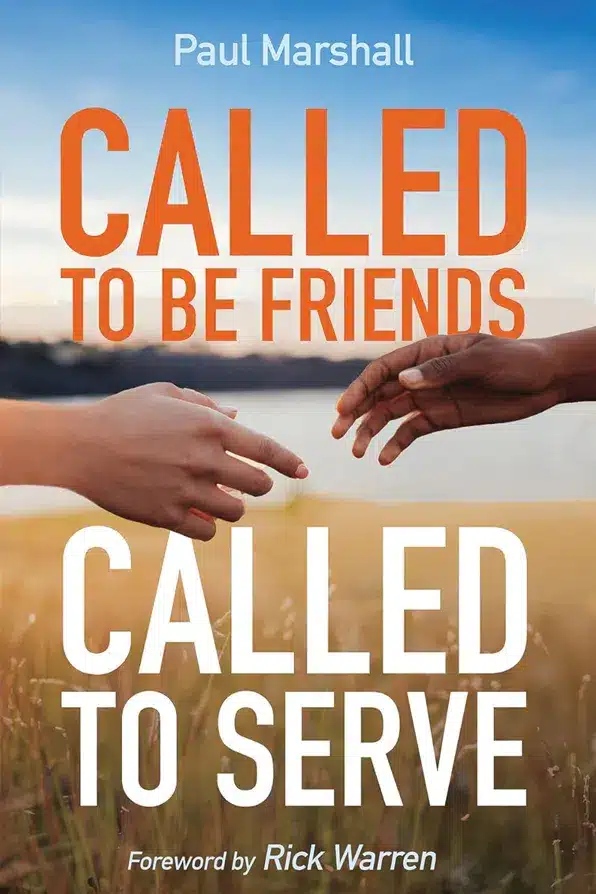
Paul Marshall’s Called to Be Friends, Called to Serve is the story of an unlikely friendship that changed the face of Christian philanthropy. It’s a short and fascinating read, and no reader will walk away from it without experiencing some level of bafflement or even offense. That might even be the point.
John Perkins
John Perkins founded the Christian Community Development Association, arguing for a neighborhood transformation approach to poverty that includes both a strong emphasis on spiritual healing—including racial reconciliation—and a commitment to market-based economic development. If someone were to invent the most credible person to speak on American poverty that she could imagine, she couldn’t do better than Perkins.
Born in the deep South and abandoned by his father, his mother died of malnutrition when he was a baby and he languished near death himself. He grew up sharecropping, with almost no schooling. His older brother and surrogate father, Clyde, was shot and killed in a dispute with a police officer over unfair treatment after he came home from the war as a decorated veteran. John himself was savagely tortured in jail after peacefully protesting a police brutality case.
He converted to Christianity as an adult, based on his son’s encouragement from Vacation Bible School. He was particularly moved by the classic children’s song that goes, “Jesus loves the little children of the world, black and yellow, red and white, they are precious in his sight, Jesus loves the little children of the world.” His faith swept through his life like a firestorm, inspiring him to leave a great career in California and return home to the place he’d promised himself he’d never return: Mississippi. From then on spreading the gospel and caring for the poor became his life’s mission. Perkins’ most famous quip is that all people need is “Jesus and a job.”
Howard Ahmanson
In one sense, nothing could be further from Perkins’ story than the story of his closest friend, Howard Ahmanson. Ahmanson was quite literally the richest child in California when he was born. However rich he may have been, Ahmanson had his own set of devastations. Although he didn’t know what exactly was wrong until his 40s, Ahmanson was both autistic and had Tourette’s. This meant that he had trouble communicating, including a stuttering, hesitant speaking style, and was plagued with physical tics. His parents divorced, and when his father passed away, the struggle over his fortune meant that ill-motivated relatives were able to drum up a false schizophrenia diagnosis and have Ahmanson illegally institutionalized. He had no interest in the family insurance business and struggled with the burden of wealth. He tried to avoid it by taking a small income and working normal jobs.
Although he was surrounded by friends converting through the burgeoning Jesus movement, Ahmanson was a bookish type, whose conversion to the faith came by reading Lewis, Tolkien, and Schaefer. Even before they met, Ahmanson and Perkins were beginning to converge on an interesting point of doctrine. These were the heady days of the modernist/fundamentalist debates, and sound doctrine seemed to be on one side, with what one might call “social justice” on the other. Call it by a different name if you prefer, but both Ahmanson and Perkins came to understand that God does not just care about getting souls to heaven, but also about the well-being of our bodies, our communities, and our whole lives here on earth. A person didn’t have to cede one inch of their theological orthodoxy to care about all of those things, too. It wasn’t a question of whether God cared about those things, but rather, how to care about them well—with our minds as well as our hearts.
Unlikely Friends, Surprising Commitments
If these aren’t already two of the most interesting people you’ve ever read about, just wait for what happens next. It turns out that when Perkins and Ahmanson met, Ahmanson was a tried and true member of R.J. Rushdoony’s Christian Reconstructionist movement. Their newsletter, the Chalcedon, had published pieces on Perkins’ work, and Perkins eventually wrote for it as well. Ahmanson was a huge financial supporter of the movement.
For the uninitiated, Reconstructionism was a fringe movement that is, quite frankly, hard to explain. It’s a postmillennial, Calvinist political theology that holds that certain Old Testament laws should still apply, including things like the death penalty for homosexuality and adultery. With regard to matters of property, however, it’s mostly libertarian. Today, this movement has become a bit of a bugaboo, indicating a slide into Christian Nationalism, but American religion expert Mark David Hall argues that it had little real influence and that Rushdoony was rarely cited among other Christian thinkers.
The point here is simply that the Christian Reconstruction movement is not the place one would necessarily expect to find a lot of sympathy for someone like Perkins, a member of the civil rights movement fighting for poor Black communities in the South. But it does make some sense. After all, if the government is going to be strictly limited in economic matters, then it’s up to institutions like the church to solve those problems through civil society. While Perkins did not necessarily refuse government funding, it was never his focus. It was always important to him that Black Americans gain skills in order to build their own wealth and not wait on the government to come and rescue them. Partially, that arose from an understandable skepticism toward the powers that be, but also from his strong commitment to a paradigm in which the church is the real solution.
Contextualizing Our Use of Language
When it comes to Christian Reconstructionism, note that things that were just interesting or odd at one time can be transformed by later events into something with a far more threatening pallor. For instance, it seems strange that someone like Pat Robertson is quoted back in 2013 recommending that a listener accept his transexual co-workers and not judge them, saying that in very rare cases a person can be “a woman in a man’s body” or vice versa. At the time, a person like that would be seen by someone like Robertson as a one-off, a sad oddity, for whom our main concern should be to befriend them and give them the gospel. Today, Robertson’s accommodation sounds far more heretical than it did then because the demand for accommodation of a much larger number of people has been drafted into a broader culture war to undermine the realities of sex and gender. Similarly, the Christian Reconstructionists seemed to most American Christians like a few interesting and sincere oddballs until actual members of Congress began to self-identify as Christian Nationalists.
Something similar might be said on Perkins’ side as well. Perkins has used the term “social justice” since the 1970s; he clearly explains in his work how injustice can be structural or systemic in nature; and his famous “Three R’s” are Relocation, Reconciliation, and Redistribution. Today, the terms “social justice,” “systemic injustice,” and “redistribution” are taboo in conservative Christian circles, signals of radical leftist ideology. I’ve even heard some conservative Christians say that the term “racial reconciliation” is leftist. But Perkins was no revolutionary. Perkins wanted orthodox Christians to care about the poor and be radical in their service to them. But they were going to do it by figuring out how to get the marginalized employed in capitalist markets and build businesses in destabilized neighborhoods. That’s what he meant by social justice. Perkins’ redistribution wasn’t about government; it was about the church and the responsibility of those who have been blessed with resources to help repair the damage that was done by Jim Crow. Nevertheless, his concern about genuine racial injustice did cause some long-time allies to pull support, including Grace Community Church, the congregation of Jack MacArthur and, later, his son John MacArthur.
It’s always been interesting to me that conservatives resist the terms “structural” or “systemic” injustice, although I understand why they’d shy away from terms popular among their opponents. However, I’m not sure how else to describe the system of Jim Crow that actively crushed property ownership and freedom of contract for Black Americans by creating illegitimate distinctions in our legal system. These terms could also describe the typically conservative critique of the welfare state as constructed in such a way that it undermines employment and marriage. The welfare state’s benefits cliff is clearly a systemic, not an individual, injustice. Whether inadvertently or not, the system is set up to trap people. If we can resist going into reaction mode because of the associations of these terms with the left, we can see what Perkins is talking about. And he was talking about these things long before the terms became as radioactive as they are now.
Ahmanson’s Strategy
One of the most stunning things in the book is Ahmanson’s strategic shift. He and Perkins clearly agreed on concerns about creating unhealthy dependency through charity and grappled with the complicated questions of how to do charity in an empowering way. Ahmanson even made sure not to contribute too much to Perkins’ ministries so that the ministry itself wasn’t dependent on one patron. Ahmanson’s choices reflect a deeply strategic thinker. Even after he saw that the Christian Reconstruction movement was overly focused on law and order and under-focused on love and grace, he continued to fund some of their work because of the elements he still aligned with.
While he shifted slightly in terms of the appropriate role of government, he remained a “property libertarian” and a serious social conservative. But the GOP’s failure to actively welcome and recruit Black and Latino social conservatives convinced him that there was a streak of white nationalism in the party that he couldn’t abide. So he decided to become a Democrat. This was not because he’d changed his mind on issues or principles, but because he felt that he should strengthen the minority groups who felt stuck with the Democrats but remained deeply socially conservative. His proof? In 2008, the whites of California mostly voted against Prop 8, which would have established marriage as between one man and one woman. The reason that it passed was because of minority voters—most of whom were Democrats. However one judges Ahmanson’s strategic choice, he was clearly thinking outside the box.
True Friendship
It really is sweet to read about this friendship, which made so much possible. This is true not only of John Perkins’ ministry both in America and internationally, but also of all of Ahmanson’s philanthropy, which was careful in focus and deep in commitment. Working and thinking together, these two men cared too much about actual poor people to worry about conforming to parties or fads. They were too busy doing the real work. The two men affected one another profoundly, but were also genuine friends, vacationing together, bringing their wives and children together, and supporting one another through good times and bad. They maintained their deep commitments, both to racial justice and free-market capitalism, in a world that didn’t want to allow them to believe in both at the same time.
You could say they came from different worlds, but they’d both suffered in horrific ways that helped them understand one another. And their suffering was redeemed through their shared love of Jesus Christ. Instead of giving in to their fates as, respectively, a poor sharecropper from the deep South and a so-called schizophrenic, poor little rich boy, the power of the gospel allowed both of them to transcend these identities and live lives of service that brought flourishing to hundreds of thousands of people and inspired the ongoing debate over effective poverty alleviation.
It’s clear from Marshall’s account in Called to Be Friends, Called to Serve that neither could have done what he did without the other. What a beautiful picture of the way that our interdependency promotes our agency. What a poignant case of how genuine service to God and our neighbor can cause us to fit poorly into current political categories. And what a sublime example—“sublime” in the true sense, both wonderful and frightening—of the kingdom of God, on earth, as it is in heaven.
Rachel Ferguson (PhD, Saint Louis University) is the director of the Free Enterprise Center at Concordia University Chicago, assistant dean of the College of Business, and professor of business ethics. She is an affiliate scholar of the Acton Institute and co-author of Black Liberation Through the Marketplace: Hope, Heartbreak, and the Promise of America.