

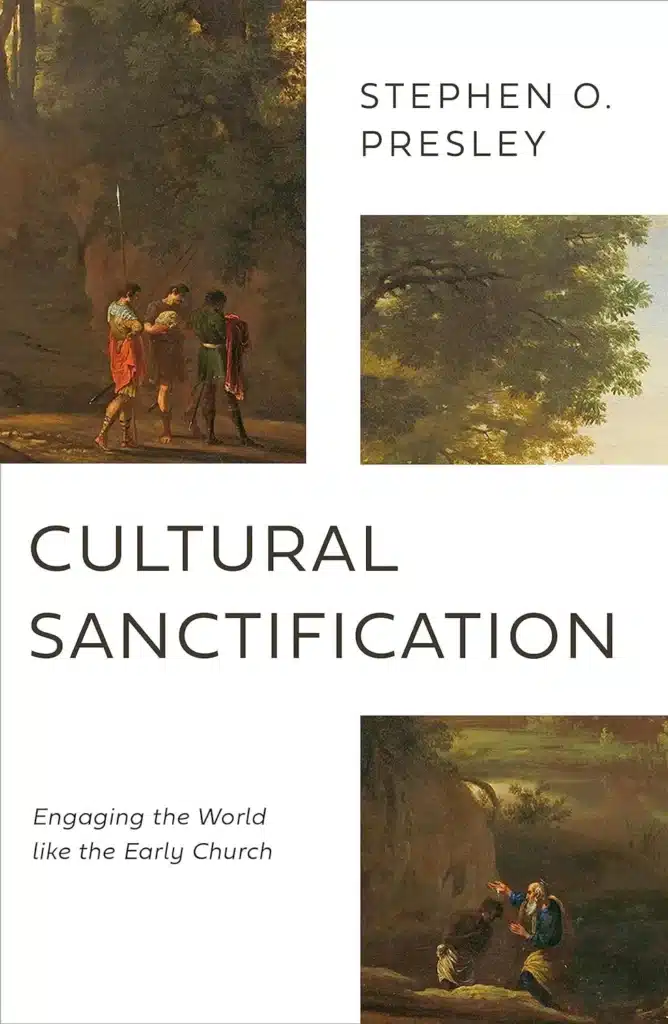
“If we could just get back to doing it like the early church,” or some similar phrase, has been uttered by many Christians who desire not only a deeper connection with Jesus but also forms of Christian life that are more faithful to God in proclamation and practice. While this desire is sometimes the product of a fanciful imagination that romanticizes the past, it does not mean that such efforts are doomed to futility or are simply just a phase in one’s spiritual development. Efforts to look back and learn from the early church can be helpful for us, as we can see in Stephen O. Presley’s Cultural Sanctification: Engaging the World like the Early Church.
Presley writes this book at a time when, particularly in the United States (which seems to be the context of the primary audience), it has become clear that we are beyond an era when some form of Christendom is in place. We are now in a world that is postmodern, at least in the sense that there is no agreed-upon worldview or road map for how we are to understand and navigate life. Presley observes that “…the present cultural moment reflects a revival of the ancient struggle between paganism and Christianity.” As many readers may be aware, some of the main responses to the current moment oscillate between some version of stepping away from the culture or getting in the metaphorical boxing ring of culture and fighting for triumph, while there are some efforts at mediating strategies as well. Presley adds his approach to the latter by proposing a middle path that comes from looking at some of the ways the earliest Christians dealt with life as a religious minority in the Roman Empire; this is from where the book’s title comes.
What is “cultural sanctification?” Presley writes, “Cultural sanctification recognizes that Christians are necessarily embedded within their culture and must seek sanctification (both personal and corporate) in a way that draws upon the forms and features of their environment to transform them by pursuing virtue. This Christian performance of sanctification involves defending the faith, sharing the good news of salvation found in Christ, and visibly embodying all the virtues of the Christian spirituality in ways that persuade others.” This is an approach to cultural engagement that entails winsome contextualization of the faith and the prospect of conveying the faith in ways that can be understood and potentially convincing to those outside it.
After setting the stage in the introduction, Presley presents five chapters covering identity, citizenship, intellectual life, public life, and hope, followed by his conclusion. The first chapter begins with a description of early church baptism, the liturgical doorway into the Christian life. Experiencing baptism was clearly crossing into another way of life and a new understanding of reality. This is followed by a valuable discussion of catechesis. I think this is one of the most vital contributions of the book because it helps readers understand the importance of catechesis to Christian identity formation. Catechesis—along with liturgy—crafts the identity of Christians. Also important here is Presley’s emphasis on the fact that Christian formation did not mean only a different pattern of life as a Christian but also engagement with their pagan context. They were distinctive but did not avoid intermingling with culture; Presley provides examples from Justin, Irenaeus, and Tertullian.
The second chapter begins with the martyrdom of Polycarp, put to death because he refused to worship Caesar. While he refused to save himself by pledging ultimate loyalty to Caesar, Polycarp modeled respect in his responses to the Roman proconsul who interrogated him; he did this because he was a government official. Presley uses the phrase political dualism to describe the tension between respecting political leaders while also exhibiting unwavering allegiance to God. This dualism is rooted in the strong identity formed by catechesis and liturgy, which forms the Christian conviction that political authorities are in place under the higher authority that comes from God. Presley observes the political theology of the early church was neither revolutionary nor disengaged, but included efforts to promote peace and security, just laws, and a kind of religious freedom that recognized the Christian faith along with other publicly sanctioned faiths. The practice of political dualism was neither easy nor simple, but early Christians attempted to discern how to walk a difficult line between earthly and heavenly citizenship.
The third chapter begins with Minucius Felix’s account of a debate where a Christian named Octavius responds to criticisms of the faith from a pagan named Caecilius. This story sets the stage for the intellectual dimension of public theology Presley describes in the chapter. The term “public theology” can have many meanings; here it means the way Christians engage the broader world around them. The book uses the critique of Christianity from Celsus as one of those who found the faith intellectually deficient and the domain of the ignorant. Origen of Alexandria is the most prominent example of Christian respondents in this chapter. Origen responded to critiques of Celsus and developed an approach to theological education that included engagement with the philosophical ideas of the day. Here we can see public theology in action, as philosophy was not only learned in order to refute it but also to “plunder the Egyptians” for insights that helped connect and convey the gospel in their context. The chapter refreshingly acknowledges successes and failures. Some Christians behaved inconsistently, and while some non-Christians were persuaded by apologetic efforts others were unconvinced. All of this occurred on the terrain of paganism and cultural sanctification was impossible without preparing believers for the arguments they were highly likely to encounter in casual settings.
The fourth chapter presents a story from Tertullian about a Christian soldier who refused to wear a crown of laurel leaves but held it in his hand to honor the emperor and communicate his allegiance to God. Martyrdom was the likely end of this soldier’s earthly story. Throughout the book, Presley describes the resocialization of Christians after baptism as an effort to manage healthy cultural absorption while avoiding acculturation in the Roman social world. This discernment included occupations (catechumens were asked about their jobs and instructed to leave jobs characterized by violence, exploitation, and forms of sexual immorality), leisure and entertainment (there was strong discouragement against attending gladiatorial games and the highly sexualized theater), marriage and family, and the military. Readers may find the latter quite interesting, as a debated question is whether soldiers who converted left the military. Presley states there was no clear prohibition against military service, but there were serious considerations for how to perform in the military (such as the avoidance of pagan worship and killing). The generosity and care of the Christian community toward people inside and outside the church is also a prominent distinction.
The fifth chapter takes us to August 177 A.D., when Christians from Lyon were arrested and tortured for refusing to worship pagan gods. Among these Christians was Blandina, a frail woman who seemed to grow stronger in Christian commitment in the face of torture and imprisonment, before finally dying after being attacked by a bull at her last trial. She never lost sight of Christian hope in the face of cruelty. The chapter presents the great contrast between Christian hope and pagan conceptions that were limited to political success and the national identity of the empire. The Christian hope emphasized in the early church included the narrative of salvation history that culminates in resurrection and eternal life. Catechetical instruction included an eschatology that changed the perspective of those brought into the church. Christian hope enabled Justin Martyr and many others to confidently respond to threats of execution and for Christians to live virtuously in the present while waiting for God’s reign to be fully consummated with final justice and beatitude for the church.
The book’s introduction takes us to the impressive Lateran Baptistry and the conclusion takes us to the monastery of Saint Benedict. The first sets the stage for the book by highlighting the identity transformation that occurs with entering the church, while the latter poses the question of monastic retreat from post-Constantinian, cultural Christianity. The argument of the book acknowledges the attraction of the latter but invites us to strongly consider what it could mean to approach our cultural era with a deeply formed Christian identity that undergirds creative improvisations that lead to faithfulness in and among a post-Christendom society.
Some readers may notice that Presley speaks of the demise of Christendom without offering a critique of it. Here it is important to pay attention to the many times the book makes it crystal clear that the Christian past is a mixed bag with triumphs and failures; the struggle to be faithful was and is as real as the twisting and winding path of life and history. There is no pining here for “the good old days” of Christendom. Similarly, some readers may wonder what Presley means by advocacy for “religious freedom” during the pre-Constantinian Roman empire. This is an opportunity for reading well and understanding that religious freedom in that context obviously was a different pursuit than our current moment. We can learn from the model of the early church by not only thinking about a contemporary public domain for the exercise of Christian faith but also a public space that includes other religions. Christian engagement with the state includes, when possible, discourse that seeks space for Christian practice rather than Christian dominance.
The book helps us recognize that even in this time of polarization and postmodern self-expressiveness, there is abundant opportunity for Christians to cultivate forms of identity formation and sanctified public and private lives. Of course, this means it is time for what we might call a “catechetical renewal.” If this were to occur, perhaps we can imagine what it might be like when Christians have such a deeply formed identity that no one will doubt their true allegiance, no matter how substantively they may be involved in cultural engagement. Presley’s volume is an important guide and catalyst for us and arrives in a timely fashion. If any wishes to “get back to the early church,” let Cultural Sanctification be one of your guides.
Vincent Bacote (Ph.D., Drew University) is Professor of Theology and the Director of the Center for Applied Christian Ethics at Wheaton College in Wheaton, IL.