
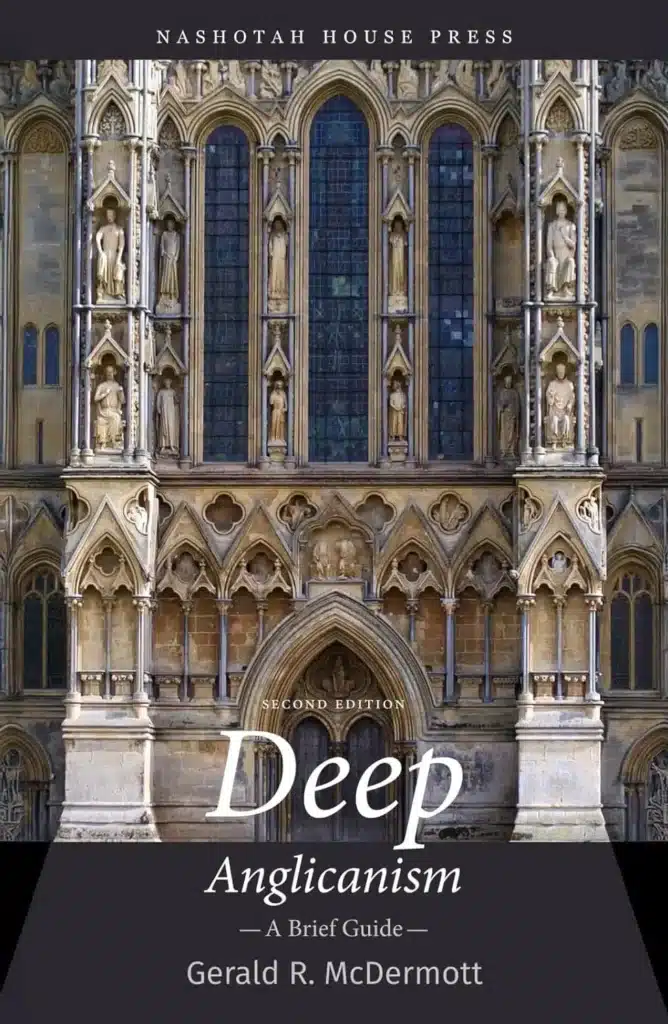
This book, which has some 34 chapters plus a prologue, conclusion, appendix, and index, and which clocks in at just under 400 pages, announces in its subtitle that it is a brief guide. It is true that most of its chapters are brief, and that every one of them, as Fr. McDermott notes, “deals with deep water, but I go only so deep.” It addresses “deep” matters with an eye especially to the questions that tend to arise among evangelicals who have discovered Anglicanism, such as the authority of a priest to pronounce the absolution of sins. These matters are “deep,” in the author’s view, because they have to do with what he sees as the deep heart of Anglicanism.
This term “deep” has, then, a particular content. McDermott gets the adjective from the posthumous collection of C. S. Lewis’s essays, God in the Dock (ed. Walter Hooper, pub. 1970). Lewis distinguishes Evangelical and Anglo-Catholic folk, on the one hand, from liberals and modernists, on the other: the former “are thoroughgoing supernaturalists, who believe in the Creation, the Fall, the Incarnation, the Resurrection, the Second Coming, and the Four Last Things.” Lewis thinks that it is hard to see this agreement of Evangelicals and Anglo-Catholics because there is no name that encompasses both of them. He suggests two: “Deep Church” or “Mere Christians.”
The source of this quotation is a letter from Lewis published in the Church Times on Feb. 8, 1952, under the title “Mere Christians.” The exposition and celebration of “mere Christianity” was, of course, a passion of Lewis’s: to hold forth the essentials of historic Christian faith without unnecessary disagreement over lesser matters. Rather than “Deep Church,” McDermott gives us “Deep Anglicanism,” for reasons that are not clear; in fact, with the pedigree of Lewis for the term, one wonders if Lewis would approve of the general enterprise of defending Anglicanism over Roman Catholics, Lutherans, Reformed Christians, and so forth. Which is to say, to set forth “Deep Anglicanism” might be in some tension with setting forth “Deep Church.”
Nonetheless, I would affirm that the effort to introduce Anglicanism to those who have discovered it is a worthy endeavor, and McDermott has given us an interesting account of “reformed catholic Anglicanism,” which is, in his view, the substance of deep Anglicanism. Anglicanism is catholic: It goes back to the earliest proclamation of the gospel in Britain. Its worship goes back to the early church and is centered on the Eucharist. Through the centuries its worship has developed by “adaptation or adoption of catholic predecessors.” It is also Protestant in the best sense, centered on the Bible, incorporating the important insights of the Protestant reformers. Thus, to draw out one conclusion, Anglicanism is not a version of Christianity that began when Henry VIII wanted a divorce and the pope would not grant it.
Catholicity and the Sacraments
What McDermott means by “catholic” comes out in his discussion of sacraments. He argues that Anglicanism’s position is to claim there are seven sacraments. As Article XXV of the Articles of Religion has it, there are two sacraments “generally necessary” for salvation, namely “Baptism and the Supper of the Lord,” and there are five others “commonly called Sacraments” which “are not to be counted for Sacraments of the Gospel . . . for that they have not any visible sign or ceremony ordained of God.” But McDermott does not take this claim to be denying that the five really are sacraments. He notes, twice, that we also find the words “commonly called” in the title of the feast of December 25: the Prayer Book has traditionally said that the Nativity of our Lord is “commonly called Christmas-day.” Hence, with regard to “the five lesser sacraments,” Article XXV is saying only “they are not on the same level as the two principal ‘Sacraments of the Gospel’ with ceremonies explicitly commanded by Jesus.”
But this famously disputed matter is not so simply handled. Luther held that there were three sacraments of the Gospel; his example shows it is no simple matter to determine what is and what is not included by the words “Sacraments of the Gospel.” Better, in my view, to hang the distinction on “generally necessary to salvation”: if you want to be saved it is a general necessity that you be baptized and that you receive Communion. God can work outside sacraments; therefore we will not say that these two sacraments are necessary for all people all the time. But they are generally necessary—unlike the rites of penance, or marriage, or confirmation, or ordination, or unction.
Indeed, to attempt such precision is more customarily found, in my experience, in argumentative Anglo-Catholic circles than in more irenic ones. Anglicanism, in the Prayer Book tradition, as I see it, is marked by epistemic humility. We do not seek to define precisely those things that we can get by without defining precisely, because, in fact, words cannot capture divine truth precisely. Hence, with regard to sacraments, our view is that there are two for sure, two that are needful and worthy. There are five others that, for nearly a thousand years, have been reckoned by many as sacraments; we, however, are not going to try to say whether they are or not. We have them: you can, for instance, go to a priest and make confession and receive absolution. The spiritual gifts thereby conveyed are real. But we will not quite affirm that this is a sacrament.
Might one wonder if our view is closer to the early church? For Augustine anyway (and here I differ from McDermott), when he refers to “sacramentum” as a good of marriage he does not mean it is an outward sign of an inward grace. One scholar has written that by “sacrament” Augustine does not mean marriage partakes of Christ’s union with the church, nor of the Lord’s “marriage” to Israel, nor of the union of the two natures in the one person of Christ (which he also calls “sacramentum”); he means to point to a certain bond that is established between the spouses that continues as long as they both live. (See John Witte Jr., From Sacrament to Contract, 2nd ed., 73–74; McDermott twice cites other parts of this book.) In other words, Augustine’s view of the sacramental good of marriage is, from the perspective of later writers, fluid and vague, even undefined—which is not to say that he is either right or wrong. It does suggest there is something going on in marriage that is beyond our capacity precisely to define.
What then of the principal sacraments? McDermott is very good on these. Chapter five is about “the different parts of the Anglican worship service” (though in the table of contents, this is “an” Anglican worship service) and it turns out “the Anglican worship service” is the Eucharist, as McDermott prefers to call it, following the contemporary practice of the Episcopal Church (TEC) as well as his Anglican Church in North America (ACNA)—a point (and not the only one) where McDermott silently aligns his vocabulary with that of TEC and ACNA over against more traditional Anglican names (“Holy Communion” or “the Supper of the Lord”). He also has the Gloria at the beginning; three scripture readings; the sermon immediately after the Gospel; offertory after prayers of the people and the peace; and so forth. In these points I’ve mentioned, McDermott sets forth the order as found in contemporary worship services (again, both TEC and ACNA). But most Anglicans until the last half-century or so would have experienced a different order: Gloria after communion; peace, if said at all, shortly before communion; only two Scripture readings; sermon after creed; and so forth. Which is to say, Deep Anglicanism clearly explains the parts of a Communion service that one could find in many churches today, but it does so without reckoning with Anglican distinctives. Admittedly, to do so would take considerably more space.
McDermott nicely captures Anglican sacramental thought with the pithy sentence, “God Loves Matter.” In chapter sixteen he sets forth the realistic character of Anglican eucharistic theology, that bread and wine are not mere symbols, by quoting classic Anglican formularies and liturgical texts: the Articles of Religion, the catechism, the prayer of humble access in the eucharistic rite itself, and so forth. He rightly distinguishes Anglican realism from transubstantiation, if the latter be understood as claiming the “substance” or essence of the bread and wine are annihilated in the sacrament and replaced by the substance of Christ himself. McDermott also helpfully directs our attention to the Scriptures with regard to the question of whether the Eucharist is a sacrifice. He does not note (again, it is a “brief” book) the importance of twentieth-century biblical studies in this question: it is now widely accepted that biblical sacrifice is a way of making something present. So, yes, in the Eucharist, “Christ our Passover is sacrificed for us” in the sense that his one, full, and perfect sacrifice is made present to us, but the priest is not performing a new sacrifice.
With regard to the foundational sacrament of baptism, McDermott defends Anglican practice with clarity, not only our practice of baptizing infants as being consonant with Scripture and the practice of the early church. He is clear that baptism is regeneration, that is, new birth in Christ. More could have been said about baptism being normatively an adult sacrament, although he does note that confirmation is especially appropriate for those baptized as infants who wish as mature individuals to affirm the faith in Christ that was made on their behalf at their baptism. (Again, it is a brief book!)
The Ecumenical Movement
The ecumenical movement is notable for its absence here, although it has been very much part of Anglican self-identity in the past 150 years. The Chicago-Lambeth Quadrilateral of 1886/1888 (mentioned twice but not for its ecumenical significance; omitted from the index) was a signal influence, truly deep, on Anglican self-identity from the nineteenth through the twentieth century. The Quadrilateral claims that Christian unity is God’s will for the church. It attempts to set forth four “inherent parts” of “the substantial deposit of Christian Faith and Order committed by Christ and his Apostles to the Church,” namely the Scriptures of Old and New Testaments as “the rule and ultimate standard of faith”; the Apostles’ and Nicene Creed, the latter described as “the sufficient statement of the Christian Faith”; the two Sacraments, Baptism and the Supper of the Lord, administered with Christ’s words of institution and the use of the elements he ordained; and the Historic Episcopate, locally adapted. Those things given, we Anglicans claimed a willingness to “forego all [our] preferences” in matters “of human ordering or human choice” and, in general, sought “to promote the charity” which is the chief Christian virtue and “manifestation of Christ to the world.”
The ecumenical movement has hardly been smooth sailing, and today many see us in an “ecumenical winter.” The Quadrilateral’s immediate address was to Protestant churches, with whom its fourth point has been a sticking point; much dialogue has ensued, with only modest fruit, concerning whether the “Historic Episcopate, locally adapted” really is, as we say, “essential to the restoration of unity.”
Might the Quadrilateral be an articulation of Deep Anglicanism? I would hesitate to say so, for it is an offer to lay aside Anglican particularities for the greater good of visible church unity. One might think it rather to be an attempt to articulate Deep Church. It shows, perhaps, that the effort to articulate Deep Church is deeply Anglican.
Cultural Confusion
But whatever we think of all this—the bulk of McDermott’s book, the sacraments, Anglican spirituality (about which McDermott is also a helpful guide), the historic Prayer Books, my entire review up to this point—the reality on the ground we face today is cultural confusion. While Deep Anglicanism has no entries on many culturally controverted questions, it does have three (brief) chapters on women’s ordination, universal salvation, and gay marriage. I commend McDermott’s forthright facing of these questions. It seems the one that most arrests his concern is the last. “Homosexuality” and “marriage” each take up 10 lines in the index; together, they are surpassed in length only by the Eucharist. This element of the index suggests that the author’s primary concern, after the Eucharist, is something not clearly stated, something about human being and human sexuality—something profoundly troubling.
If I am right in this supposition, it is a primary concern that I share. Here is how I put it. Our cultural confusion is grounded in a deep sense (alas, yes, deep) that all human beings are authors of their own selves. This includes a sense that we have charge over our bodies and an inbuilt desire to make our bodies as plastic as possible. Thus, we conclude, there can be no essential difference between male and female. Furthermore, there is a radical isolation in our cultural understanding: each of us is our own self-maker, which is to say each of us is ineluctably alone.
Before our culture got to gay marriage, we had self-expressive marriage in which people write their own vows. In this marriage, it can be okay not to want children; okay to have other sexual partners; okay, in fact, to do whatever one desires on terms that one has worked out with one’s partner(s); and of course such marriage can be terminated at any time. Many Christians of my acquaintance, while opposing the latter items I just listed, are surprised to learn that openness to children is part of the content of Christian marriage. It is not a long step for marriage to move from being child-optional to being gender-indifferent.
Here, I think, is the looming frontier before Christianity. To address it, we need a positive vision of being human that encompasses the goodness of children, the goodness of the female sex (as well as, of course, the male), the goodness of our temporal finitude, and the goodness of friends and families and communities like churches. And we need to claim this vision with many people we might otherwise disagree with: both TEC and ACNA, and evangelicals and catholics. Deep Anglicanism today points us to the need to lift up the beauty and dignity of human beings, revealed to be sexed and finite treasures by the Deep Church.
Victor Lee Austin (PhD, Fordham University), an Episcopal priest, is theologian-in-residence for the Episcopal Diocese of Dallas and St. Matthew’s Cathedral in Dallas, Texas.