
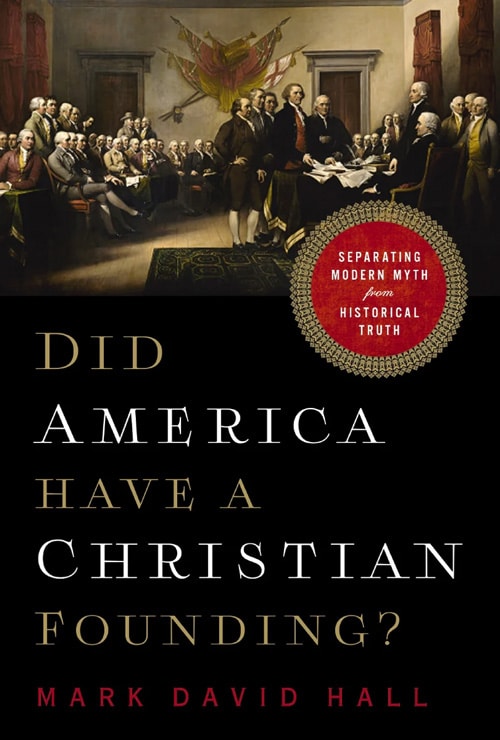
Civil War historian Allen Guelzo called history an answer to the “second question.” For him, the first question to satisfy the most basic curiosity of the human mind is, “What is that?” The second question, which Guelzo called the “historian’s question,” is, “Where did it come from?” When we ask that question, Guelzo said, “it’s the moment that . . . we’ve really asked the basic question that underlies all the history that has ever been written.” Guelzo’s own definition of history goes like this: history is “a humanistic prose narrative of events based upon systematic inquiry into words, deeds, ideas, conflicts, and sufferings which occurred in the past and which have left verifiable evidentiary trails in the present.” Guelzo’s elegant framing of the meaning of history is right in line with Mark David Hall’s 2019 study of Christianity and the American national founding, entitled Did America Have a Christian Founding? Separating Modern Myth from Historical Truth. In this book and in his own words, Hall sets out to “set the record straight” with regard to the role of Christian ideas in the Founding. Hall is a historical truth-seeker, clearly delineating his driving questions and addressing them using evidence taken from primary source material. Contrary to many historians and authors who argue (often without evidence) that Christianity had little to no function in the development of Founding ideas, Hall’s central argument is “that America’s founders drew from their Christian convictions to create a constitutional order that benefits all Americans, not just Christians.”
Right off the bat, the question posed by the book’s title (Did America Have a Christian Founding?) is exceedingly helpful in the fifty-year debate about the role of Christianity and the Founding. Notice what the question does not ask: “Was America founded as a Christian nation?” The question Hall poses is a question for the history of ideas, not a question meant to serve as a salvo in the culture wars. Nowhere does Hall argue that America is, or ever was, conceived as a Christian nation per se. Nowhere does Hall employ a declension narrative suggesting that American origins were pure, that the nation has transgressed from those origins and experienced God’s judgment, and we should all seek a return to a pure Founding. And nowhere does Hall assert that other intellectual sources were not important to the Founding along with the Christian faith, such as English common-law tradition, classical antiquity, radical Whig ideology, or even the ideas of the Enlightenment. Hall’s work is not to deny that those sources were important as influences on the Founding, but simply to show that Christianity was of salient importance to the American constitutional system in the late eighteenth century. Was America founded as a Christian nation? Hall appears not to be interested in that question. Did America have a Christian Founding? Yes, Hall argues, absolutely. The evidence is overwhelming.
The way Hall sets up his argument is original and productive because for decades authors have bifurcated between two poles on the question of national identity. Since the 1977 publication of the incredibly successful book The Light and the Glory by Peter Marshall and David Manuel, many conservative evangelicals have embraced the Christian America thesis, whose adherents (such as David Barton, Tim LaHaye, John Eidsmoe, Jerry Falwell, Stephen McDowell, and Mark Beliles) assert that America was founded as a Christian nation. Other authors (such as Mark Noll, John Fea, Gregg Frazer, Stephen Waldman, David Holmes, and Isaac Kramnick) have made the case that America was founded as a strictly secular nation, or at least that American national identity was a muddle between Christian and secular ideas to the extent that the question cannot even be answered. Hall stays out of this decades-long argument by taking his focus off national identity and concentrating on the role of Christianity as an intellectual basis for the Founding generation’s endeavors.
Hall’s strategy is so creative and subtle that even many of his detractors miss the point. For example, Gregg Frazer, one of Hall’s longtime critics, joins the ranks of those who misunderstand the book’s argument. In his 2020 review, Frazer states, “Hall proclaims the nation ‘Christian’ because it was ‘influenced by Christian ideas.’ But how much influence is necessary to rightly attach God’s name to a nation?” Frazer appears to be so accustomed to the conventional terms of the argument as being over national identity that he misunderstands Hall’s very starting point, stated most clearly in the prefatory lines of the book. Hall does not call the nation Christian, but the Founding: “A final possibility for the meaning of a ‘Christian founding’ is that the founders were influenced by Christian ideas. I believe this is the most reasonable way to approach the question, Did America have a Christian founding?” From the start, Frazer misses the point of Hall’s thesis, accusing him of being something of a Christian nationalist and arguing that America was founded as a Christian nation. But Hall isn’t, and he didn’t.
Hall clearly defines his terms at the outset of his project, namely “Christian” and “Founding.” His application of the term “Christian” is intellectual, so he is not interested in divvying out who was a Christian and who was not. The wisdom of this approach is plain—Hall protects his flank against those who would attack him over historical questions that are difficult to answer and have no real value to his thesis. Everyone involved in the national Founding, Christian and non-Christian, were influenced by Christianity. The English-speaking eighteenth-century world was “awash in a sea of faith,” as Jon Butler would say (Butler is a Yale historian who argues that America’s Founding was not Christian).
Hall’s understanding of the Founding is of the national Founding—that is, the creation of the American federal republic in the late eighteenth century. Nevertheless, Hall strenuously reminds his readers that the various colonial foundings occurring between 1607 (Jamestown, Virginia) and 1732 (Savannah, Georgia) were all informed by Christian ideas. The national Founding, taking place decades after the thirteenth colony was established, was in a distinctly different historical context. Still, while the United States was formed in a different religious, political, and cultural milieu than the colonies, the national Founding was informed by Christianity to an extent ignored by many mainstream and prominent historians. For example, Hall cites the work of the so-called “pirate scholar,” the political scientist Donald S. Lutz. Lutz studied American political writings between 1760 and 1805 (roughly the end of the French and Indian War to the second Jefferson Administration) and found that thirty-four percent of all citations from those writings came from the Bible, contrasted with twenty-two percent that came from Enlightenment sources. Hall rightly adds that, if Lutz had studied the political sermons of the period, he would have found that disparity dramatically more yawning.
Where adherents of the “godless Constitution” thesis go wrong is their failure to produce evidence from the historical record. For example, historians such as Edwin Gaustad insist that the Founding generation was populated by committed deists. But there seems to be a lack of understanding of what deism consists of; additionally, Hall finds no evidence of any American Founders (with the possible exception of Ethan Allen) holding deistic convictions after thirty years of research (and a dozen books produced) on the subject of religion and the Founding. Evidence is the sine qua non in the study of history. Where godless Constitution advocates produce no evidence for their claims, Hall provides a mass of evidence in support of his—that America’s Founding was deeply informed by Christian ideas.
Hall’s book was published seven years ago, but his work remains necessary today. As Hall observes early in the book, the question of the role of Christianity in the Founding is not merely interesting to history buffs. The question is directly pertinent to how our laws are interpreted and the grooves in which our culture takes shape. Lawyers, judges, and magistrates cite the Founders in their lawmaking and interpretation of the laws, so the history of our Founding and where it came from matters a great deal to every American. Quibble over Hall’s method or his interpretation of his evidence, but by no means ignore him. Hall’s book is one that must be seriously considered and addressed by anyone working to understand the intellectual consistency of the American Founding.
On a personal note, I wrote my dissertation on the question of the role of Christianity and the American Founding, which was published in 2011. I argued that America was not founded as a Christian nation, but as a nation with religious liberty. I stand by my thesis. However, in arguing that position, I relied on works authored by not a few of the godless Constitution thesis adherents, figures like Frank Lambert, David Holmes, and others. There were several points of disagreement between Hall and myself, and my dissertation even made a critical appearance in Did America Have a Christian Founding. When I first met Hall, I was on my guard, expecting someone who would be either combative or dismissive of my work or of me personally. Nothing could have been further from the reality. From the first time I met Hall, I found him to be a true Christian gentleman—strong and expert in his convictions, and ready and willing to engage in spirited debate with any interlocutor—in every sense of the word. In fact, over the years Hall helped me see the historical issues pertinent to faith and the Founding in new ways, and I can now say that if I were to write my dissertation over again, I would approach it very differently, even though I would still come to the same general conclusion. For that, I owe Mark David Hall a debt of gratitude. And every American owes Hall a debt for such a fine and valuable resource in answering the second question of history.
John D. Wilsey (Ph.D., Southeastern Baptist Theological Seminary) is professor of church history and philosophy and the chair of the department of church history and historical theology at the Southern Baptist Theological Seminary. His research specialization is in the history of American religious nationalism and American conservatism. He is author most recently of God and Country: Upholding Faith, History, and National Identity and also serves as a senior fellow for First Liberty’s Center for Religion, Culture, & Democracy.