
Attending a conference some years ago, I passed by Towson, Maryland’s Barnes & Noble. Taped to the front door was a paper advertising an upcoming in-store performance by the band Sister Hazel. A child of the 1990s, I remembered when their hit song “All For You” had dominated the airwaves. Oh, how the mighty had fallen.
A similar feeling struck when I was in law school. The topic of natural law came up, and I was informed that it was an obsolete philosophy now taught only at Notre Dame. This, the fate of a tradition stretching from ancient Athens and Rome to medieval Europe and the Universal Declaration of Human Rights? Nothing against South Bend, but it’s not exactly the modern world’s Parthenon.
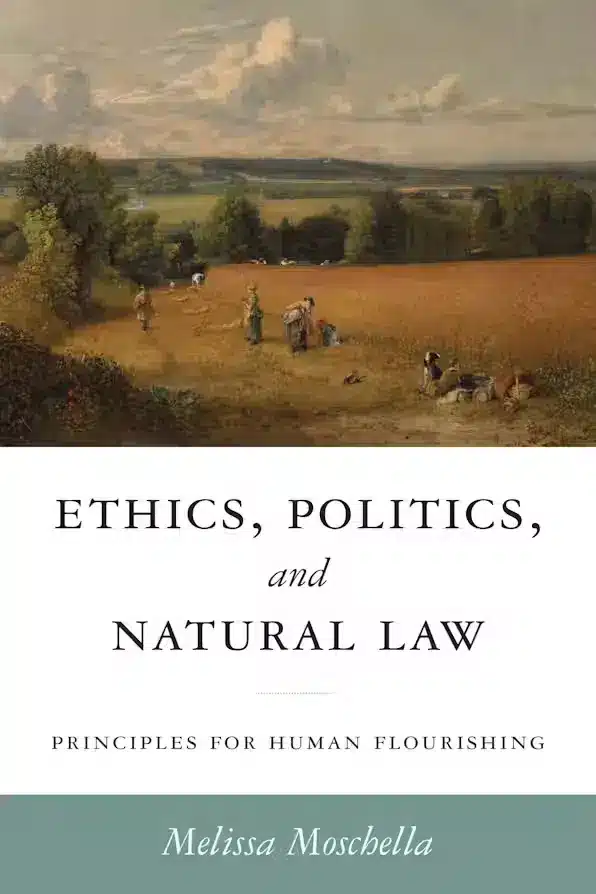
Renaissances, though, can begin in unlikely places. While Sister Hazel’s Towson show did not return them to the Billboard charts, Notre Dame’s commitment to authentically Catholic scholarship has made it a fitting home for the recovery of timeless ideas, including natural law. One recent effort is Notre Dame philosopher Melissa Moschella’s book Ethics, Politics, and Natural Law: Principles for Human Flourishing.
Its aim is at once modest and important. Modest, in that the book is meant for a beginner audience. It’s under 200 pages long. Its conversational, jargon-free tone reflects Prof. Moschella’s classroom experience. The book reserves academic disputes for footnotes. It frames natural law as the common-sense approach to philosophy. It mainly cites Aristotle, Saint Thomas Aquinas, and a handful of modern thinkers, rather than attempting an encyclopedic bibliography. A jacket blurb from leading philosopher Robert George aptly describes the book as “the clearest, most readable exposition and defense of contemporary natural law theory yet to appear.”
The book’s unassuming form supports its significance. A century and a half ago, Justice Oliver Wendell Holmes dismissed the idea that law is some “brooding omnipresence in the sky” rather than the mere product of politics and history. Thus began natural law’s long road to the northern Indiana academic ghetto. In the years since Holmes, American jurisprudence has been dominated by positivism, realism, pragmatism, critical theories, and other doctrines rejecting the belief that transcendent principles are law’s final foundation. Natural law has gone without serious treatment in universities, law schools, and courts. The first step toward recovering it has to be introducing it plainly to new audiences. Prof. Moschella’s book does that, just like the influential “restatements” of law that aim to crisply set forth core legal principles without wading into doctrinal disputes.
Still, realism deserves its due: there’s no such thing as a restatement that truly avoids taking controversial positions, and trying to “stay above the fray” can mean masking debatable judgment calls as plain consensus. A responsible treatise writer responds to this peril by highlighting where respectable authorities disagree. Prof. Moschella passes that test, but it is worth underscoring that she holds some controversial views.
For instance, she describes herself as a convert from a more traditional interpretation of natural law to the popular “new natural law” school represented by Prof. George, Oxford scholar John Finnis, and the late moral theologian Germain Grisez. (Indeed, reading her citations, one might think the natural law tradition simply disappeared for 800 years between them and Aquinas. Cardinal Cajetan, Francisco Suárez, Cardinal Bellarmine, and even the revisionist Jacques Maritain receive no mention. Neither do the entire galaxies composed of Protestant and Enlightenment theories.)
A book review can’t do justice to the differences between the “old” and “new” approaches to natural law, but a key one is how people come to know what natural law requires. Traditional thinkers emphasize metaphysics and speculative reason—people identify and reflect on essential aspects of human nature and then arrive at ethical conclusions.
New natural law thinkers instead say ethics follows practical reason—people learn the natural law mainly through experience and social observation. This divide reflects disagreement as to how convincing Immanuel Kant was in asserting that “is” does not imply “ought.” Prof. Moschella believes Kant to be compelling. More traditional natural law thinkers do not.
The new natural law approach makes it harder for Prof. Moschella to defend some of her conclusions. In particular, she defends Catholic teachings on sex and marriage by thinking through children’s needs and collecting social science data. It’s certainly possible to do so and conclude that the naturally ideal family is one man married to one woman, raising their biological children. But it’s also more than possible (and for many people, obvious) to decide that practical reason also supports other family structures. More traditional speculative reason starts with birds and bees rather than the General Social Survey, and so it can make a straighter beeline to Catholic moral norms.
Prof. Moschella’s practical approach does support several valuable innovations. She seeks to reconcile the requirement that the good person values all people and all goods to the reality that everyone has to choose who to help and what to pursue. She sees practical reason as having worked out two guiding principles. The Golden Rule authorizes prioritizing certain people if our particular relationships make doing so fair. The Vocation Principle authorizes pursuing certain goods if doing so lets us realize them more deeply and meaningfully. These smart practical conclusions could escape speculative reason.
Prof. Moschella also offers an interesting defense of limited government. Speculative approaches assess government in the abstract. Prof. Moschella instead emphasizes every person’s need for self-governance and the learned dangers of totalitarianism. Her account is more philosophically rigorous than that of philosophical liberals, like John Rawls, who don’t think societies can identify objective goods. But her case has concrete, human angles that speculative approaches lack.
In light of Prof. Moschella’s appreciation for liberty, it is strange that she denies consent’s centrality to the legitimacy of governments, especially because the opposite conclusion was reached by natural law theorists both traditional (arguably Aquinas, definitely Suárez and Bellarmine) and new (especially Maritain, the father of Christian Democracy). Prof. Moschella briefly observes that as a factual matter, governments tend to take power forcibly and then have to earn legitimacy by furthering the common good. But surely a central opportunity for people to exercise practical reason is deciding who will lead—not merely yielding to them in the event they do a passable job.
Prof. Moschella’s political discussion is also hampered by the book’s narrow scope. She does not give more than passing attention to international law, which grew from natural law thought. Also left out is environmentalism. These omissions may be due to Prof. Moschella’s desire to keep the book short and simple, but including them could convince collegiate readers that natural law really is fresher than Sister Hazel was by the time I visited Towson.
This book should not be taken as the last word on natural law. It’s too methodologically narrow to do the full tradition justice and too topically narrow to show the field’s full modern relevance. But it is a succinct, readable restatement of new natural law theory and offers some keen contributions. Barnes & Noble, take note.
Matthew P. Cavedon (JD, MTS, Emory University) is Robert Pool Fellow at the Emory University School of Law’s Center for the Study of Law and Religion and a fellow at the Center for Religion, Culture & Democracy.