
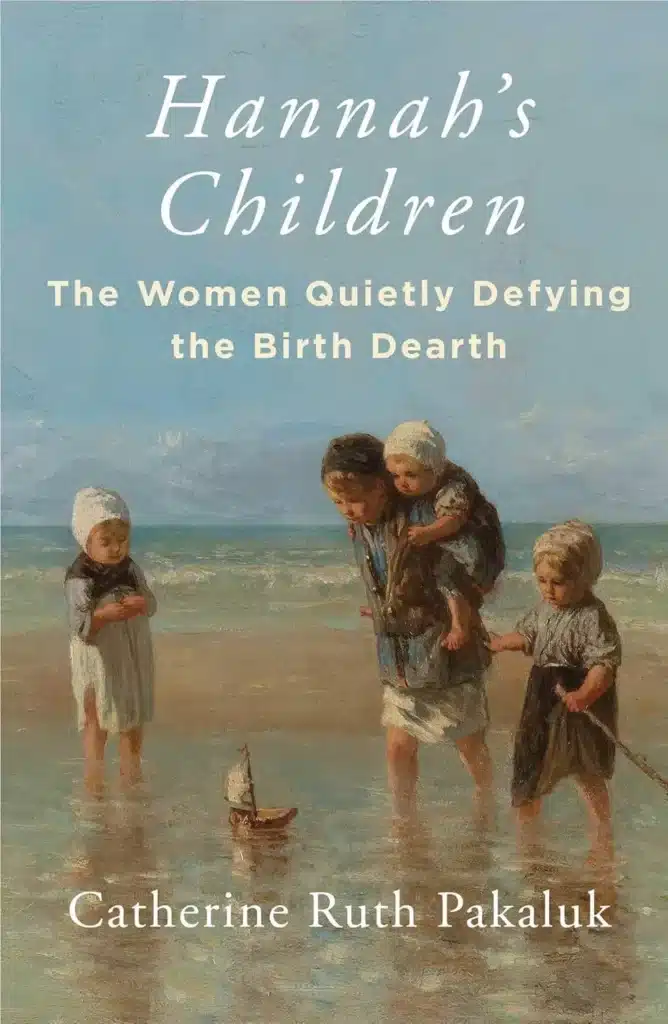
I was lucky to grow up with an excellent parish priest. His preaching was particularly memorable, and one of the lines he liked to repeat was this: “When the world has a problem, God sends a baby.” This way of speaking is surprising because we are accustomed to thinking about children as bringing new problems into our lives (even if they are cute). Rarely do we speak of them as created to do “some definite service.” But they are, as the women interviewed by Dr. Catherine Pakaluk in her new book, Hannah’s Children: The Women Quietly Defying the Birth Dearth, attest.
Pakaluk reaches beyond the quantitative data that economists are most comfortable working with and directly asks about fifty women with college degrees and five or more children how they ended up with their large families. This Harvard-trained economist may be the only person in the world who could have accomplished this research; Pakaluk herself has eight children (six more through marriage) and has carefully studied what she calls the “new calculus of childbearing” throughout her career. What binds these women together is that they view babies as solutions—gifts from God, the religious ones might say—rather than problems that must be solved. This is most obvious in the repeated sentiment that Pakaluk records: “I wish I could have had just one more.”
The book is broken into four parts. In Part One, Pakaluk introduces her readers to the why and how of her project: why she decided to investigate this demographic group and how she produced the research. Importantly, she introduces the central motif of her work, the biblical Hannah, who after praying desperately to have a child (Samuel) and offering him back to God was then blessed with five more children. In Part Two, we learn about the many different motives these women had for beginning their families. Some of them had always wanted to have large families; others had not. Part Three showcases the stories of meaning and joy that their children brought into their lives. Finally, Part Four offers a reflection about what it means for a society when children are lacking, and how we might begin to welcome them again.
Stylistically, the book reads as if it were written by an economist who frequently reads outside her discipline. (I mean this as a great compliment, of course.) Pakaluk is rigorous and measured in her prose, and she always lets the reader know when she is speculating beyond what the data can confirm. However, the reader also gets a taste of the raw emotion and fiery hearts that her subjects bring to such an intimate topic as one’s own children. The women in her interviews sparkle and shine.
For this review, I want to focus on the importance of thinking about the “benefits” of children, so to speak, instead of only counting the costs. One of the most important contributions of Pakaluk’s labor of love is that it shows how the women actively defying the birth dearth don’t do so because children are less costly to them. (Their children, like all children, cost them nearly everything.) What sets these women apart is that they view their children as so immensely beneficial that the costs don’t compare. Being an economist, Pakaluk can also speak to the societal-level benefits of children, namely, that people are “the ultimate resource.”
Perceiving the Benefits of Children: The Mothers
When my husband and I were expecting our first child—a girl!—we already had a list of names ready to go. This litany included great historical figures and heroic saints, but when the time for choosing came, we surprised ourselves by ditching it entirely. Throughout the pregnancy, we had been overcome by a strong desire to honor our ancestors whose particular sacrifices had made it possible for us to enjoy this gift. And so little Marialaura was named after her very own great-grandmothers.
In the first chapter, Pakaluk presents a mother, Hannah, who had a similar realization once she began to have children. She was surprised by how easily her children answered the questions that had seriously plagued her young adulthood: Who am I? What should I do? What does my life mean? Hannah refers to her children as the “key to infinity.” To this observation, she adds: “I have inner peace in my life that I didn’t have then. I was searching. I’m not searching now.”
Many contemporary voices speak about a woman’s identity being lost through motherhood—the quip about it taking many years to “feel like yourself again.” Pakaluk’s subjects see it in exactly the reverse. They didn’t lose their identity after having their children, rather, they gained a new identity, meaning, and purpose. They now shared something, in a profound way, with their long chain of ancestors who had also experienced the hardship and privilege of keeping one’s children fed, clothed, and sheltered. They had gained the identity of a mother, but perhaps even more, gained new insight into what it means to be someone’s child.
This new meaning was not only felt by the mother. Pakaluk documents several stories, unprompted by her survey instrument, recounting how babies had brought healing to other people. She admits that the first time she heard a story like that, it struck a nerve with her: “‘I know what you mean,’ I muttered in reply, fighting back tears. ‘It happened to me, once,’ I said.” And the stories kept coming. One mother compared this restorative power of a new baby to a “sunlamp,” describing how “when you look at a baby, they look at you like they’re staring at God…They just look at you like you are the best thing in the whole world and who doesn’t need to hear that?” As anxiety and depression rates among the young continue to rise, and women especially report puzzlingly high levels of unhappiness, thinking purposefully about exposure to babies might be a promising avenue for future research. At the very least, it can help young men and women think more accurately about the benefits of children as they plan for their own futures.
Perceiving the Benefits of Children: The Economists
Mothers aren’t the only people who can tell you about the benefits of children. Economists have noticed that to make sense of the world, we need to think properly about the benefits of children too. The economist Julian Simon became famous by fighting against the “doomsayers” who proclaimed that the world’s population was growing uncontrollably fast and needed to be contained. Instead, Simon amassed evidence to show that people are the ultimate resource. He famously put his money where his mouth was and won a public betagainst the biologist Paul Ehrlich. Simon’s insight was simple: while population growth implies more mouths to feed, it also means more hands to work and more minds to solve problems. Pakaluk fittingly devotes some space to Simon’s work in her chapter on economic demography—a span of pages that would be excellent to assign to students of nearly any grade level given how behind-the-times many educational providers are in proclaiming the dangers of “overpopulation.”
And they are behind the times. Students in contemporary educational settings are taught that bringing children into the world means there will be fewer resources to go around, while the opposite is closer to the truth. Economists view population growth as an important component of economic prosperity and worry that its decline will cause the end of economic growth. Paired with consistent messages about the importance of avoiding “unwanted” pregnancies, is it any wonder that they hesitate to welcome children into their lives once they become adults? As economist Bryan Caplan has pointed out, once you start to think about it, there are many selfish reasons to have more kids. The trick is not to close yourself off to the possibility of having one more too soon (such as when your kids are young, and you don’t remember the last time you got a full night of sleep).
The fact that our fertility decline is a problem of perceiving the benefits of children—shifting priorities, as some economists refer to it—is ultimately good news. Couples aren’t likely to welcome one more child for the sake of the economy, or for the sake of a baby bonus, but they will do it for love of their spouse, children, or God. By allowing the activities of educational and religious institutions that speak compellingly about the benefits of children, rather than spending enormous amounts to reduce the cost of having children (or worse, curtailing women’s economic freedom to reduce the opportunity cost), Pakaluk offers a formidable and affordable policy solution. “Set the temple free,” she writes.
Conclusion
John Henry Newman famously proposed that the doctrines of the Christian faith develop as they clarify the truth against heresies that crop up over time. What is true of the queen of the sciences is also true of her low handmaiden. Until very recently, the question of why a “perfectly educated” woman would have many childrendid not need to be asked. Today, it does. Pakaluk has unearthed a goldmine by asking women themselves about why they chose to have large families. To summarize her findings in her own words, Pakaluk and the women she spoke with viewed welcoming a child as “the most perfect thing I am capable of doing.”
While some joys of children are known to mothers alone, the benefits they bring are widespread. Our children have the capacity to do good to (bene facere) many people, but this will also depend on our ability to raise them with an awareness of their mission, that there is some unique work that only they can accomplish. If we are fortunate to have children, we can cooperate with this process by being generous with how we share them with the world. As a mother to young children myself, I think often of an ancient mother who undoubtedly treasured her private relationship with her Child (“she kept all these things, reflecting on them in her heart”) but was ultimately asked to sacrifice Him for the sake of the world. The original source for the quote by F. W. Boreham from the introduction reminds us that the children we welcome into this world are ours, but not ours alone:
“We fancy that God can only manage His world by big battalions… when all the while He is doing it by beautiful babies…. When a wrong wants righting, or a work wants doing, or a truth wants preaching, or a continent wants opening, God sends a baby into the world to do it. That is why, long, long ago, a babe was born at Bethlehem.”
Clara E. Piano (PhD, George Mason University) is Visiting Assistant Professor of Economics at the University of Mississippi.