

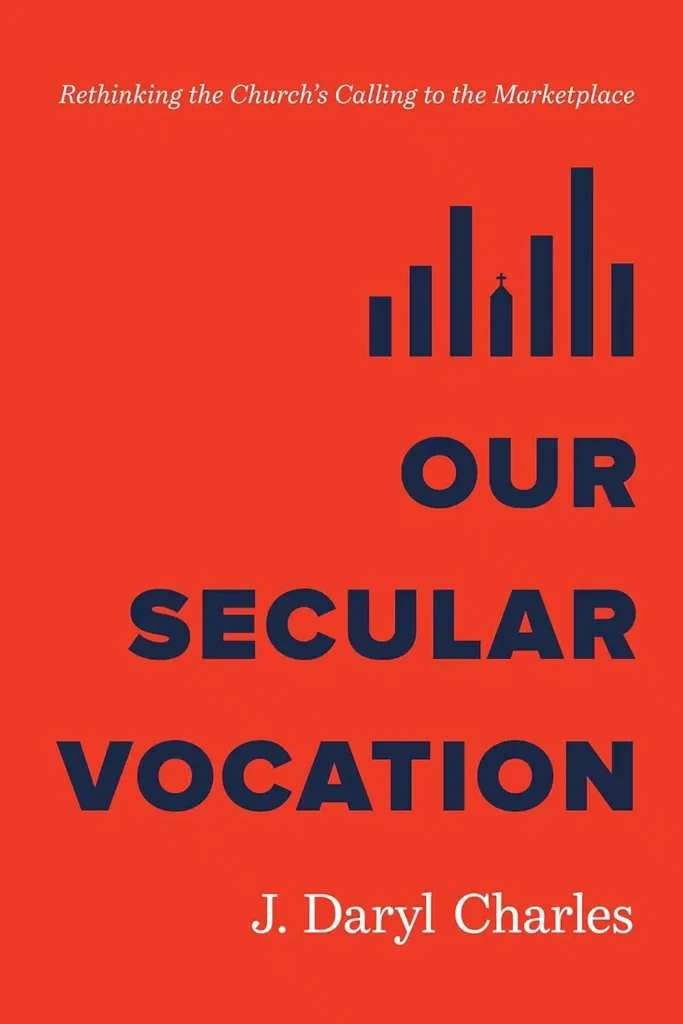
The crisis of work and vocation is not merely material or secular; it is also deeply theological and spiritual. Studies show that many Americans dislike their jobs, long for weekends, and dread Mondays. Could this widespread dissatisfaction stem from the church’s neglect of vocation in its teaching, leaving Christians unsure how their daily work connects to their faith?
In Our Secular Vocation: Rethinking the Church’s Calling to the Marketplace, J. Daryl Charles argues in the affirmative and offers a clear theological perspective on what we’ve missed and how we can transform church teaching and thus ordinary life. It’s all in the subtitle: The church is called to the marketplace, yet the church either ignores it, treats it with disdain, or, at best, as a necessary evil if not altogether verboten.
Charles is a prolific author and spent a lifetime in the classroom as a professor of religion and ethics, studying and teaching the critical but widely misunderstood topic of vocation. Vocation has often been thought to mean your current job or career, or it has been interpreted as a call to pastoral or monastic life. There is a noticeable silence in the modern church regarding the spiritual nature and importance of work. Charles points out that in the early church, all clergy were from the laity, so “the disciples of Christ functioned in the marketplace rather than being called away from it.” This has led to the sacred-secular divide in both practice and our modern ecclesiology. It almost seems that participation in the market to earn an income is barely tolerated so that one can offer a tithe, rather than being essential to our divine purpose in the world.
In the sixteenth century, Martin Luther’s writings led to the Protestant Reformation, which transformed the church’s understanding of work as a divine calling. This was an effort to discern the truth about scripture, and, as Charles points out, it is based on existential truths about God, creation, and human beings. The sacred-secular divide stems from not grounding our understanding of purpose in the broader context of our creation and God’s will. Moreover, Charles points out that the spiritual nature of vocation and its application in the commercial sector is not taught in seminaries, so we are not equipping church leaders to help people understand that their Monday-to-Friday lives are not some nihilistic gig that merely allows them to put food on the table. No wonder people dislike their jobs; they view work as a grind and fail to see how it is an avenue for service and dignity.
Charles’ book explores both the historical roots of our current confusion about vocation and the biblical foundation for seeing work as a divine calling. He starts with first principles. Our Creator endows us with egalitarian dignity. Your wage does not determine your dignity. We are created in the imago Dei, which is unique to human beings as God’s representative agents in the world, made to fulfill his purposes. This is an active role; we are creators and are given a unique bundle of gifts and talents to do our work in the world—to bring about human flourishing, which serves the ultimate purpose of glorifying God. Our imago Dei characteristics include moral agency and rationality. Charles points us to Genesis, which not only reveals this nature but gives us dominion over the earth, as such work is integral to our purpose. Moreover, our status as the priesthood of all believers gives us the responsibility and accountability for how we direct our time and treasure.
Charles also points to the Parable of the Talents (Matthew 25:14-30) in the New Testament, which points back to Genesis and the call to work and stewardship. God gifts us with various talents and asks us to do our very best to steward them so that we make a return on what he has gifted us. What matters is not whether you have one talent or five, but what you do with what God gives you. Faithfulness is rewarded, and the one who buried his talent is punished. Faithfulness here is investing what God has gifted you, assuming risk, and applying reason to how it will be invested. When this is done well, we are rewarded and given more responsibility, and all of this glorifies God and allows us to serve each other.
As Charles points out, 99% of the people in a church work in the commercial sector. Some may work in the nonprofit sector, but they do so in exchange for a salary. Very few are in full-time ministry. Charles notes that many will argue that God calls them away from the commercial sector and into full-time ministry or full-time mission work. But very few believe that God calls them into the marketplace to be an accountant, a cashier, or, in the case of Charles himself, a gravedigger!
In our creation, we are gifted moral agency, and part of stewardship is the freedom to realize and apply our moral agency to serve others. We are free to choose, but we need institutions—the rules of the game—to provide us with appropriate incentives to choose to serve others and make contributions to the common good. We are called into the marketplace and, as such, we should rejoice. This is where we spend the bulk of our time, and it is an avenue not only for our witness but also for fulfilling our purpose of serving others with the gifts God has given us.
The commercial sector, or the marketplace, is not to be avoided, but a place where we can find hope. Rather than the Marxian notion that work in the market is inherently alienating, we can see that work in the market is essential not only for personal fulfillment but for human flourishing. Pope John Paul II articulated in Laborem Exercens that work unites human beings with Christ. Charles sums all of this up beautifully by saying work is a gift instituted at creation.
Adam Smith, the Scottish moral philosopher known as the father of modern economics, understood that to grow the wealth of a nation required that we identify the truths of human nature and economics and orient institutions around those truths. We are finite, fallen, self-interested, and prone to greed. Because of this, we require incentives to be other-focused, as our natural tendency is to be inwardly focused. Smith understood that we cannot find angels to run society.
Human flourishing is not an engineering project to be run by the brightest and most benevolent. Rather, through property rights, prices, profits, and losses, we are directed toward the needs and wants of others. Smith argued that “it is not from the benevolence of the butcher, the brewer, or the baker, that we expect our dinner, but from their regard to their own interest. We address ourselves, not to their humanity but to their self-love, and never talk to them of our own necessities but of their advantages.” Even the most benevolent butcher cannot give away all his meat at no price; this will bankrupt him. He seeks a profit and, in competition with other butchers, offers consumers what they want at increasingly higher levels of quality and lower costs. Moreover, our generosity to others and our tithe to the church depend on our ability to create value in the market. Profit is a sign that value has been created, and it is an indicator that we have served strangers, not just friends, with our talents.
Nobel laureate F.A. Hayek used the word “catallaxy” to describe the market process. He preferred this word over “economy” because it captured the spontaneous order of the market process, and it also speaks to what a market does. The term is translated as “to admit into the community,” also “to change from enemy into friend.” The butcher must consider the needs and wants of their customers. As with any human institution, markets aren’t perfect; they are filled with sinful people, and they cannot save our souls. Yet they are an avenue for us to serve one another with the gifts bestowed upon us by God. The church is called into the marketplace, as we are. Let us embrace this calling for the flourishing of his kingdom.
Anne Bradley (PhD, George Mason University) is the George and Sally Mayer Fellow for Economic Education and academic director at The Fund for American Studies. She also serves as a professor of economics at the Institute for World Politics and previously was the vice president of economic initiatives at the Institute for Faith, Work and Economics.