
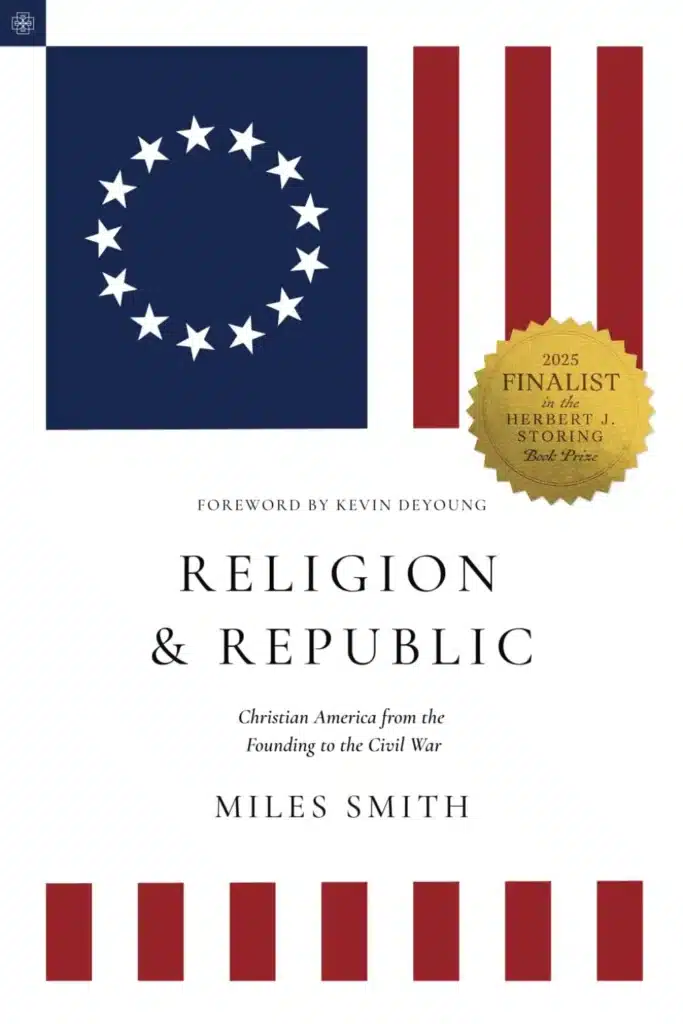
What does it mean for America to be a Christian nation? In today’s political climate, partisans of the right and the left seem to froth at the mouth while attempting to answer this question. For evidence, one need only track the dialogue around the term “Christian Nationalism,” which, though vacuous in many ways, is one of the buzziest political terms of the past few years. For Hillsdale College professor of history, Miles Smith IV, neither the right nor the left, with their disparate fixations on “Christian Nationalism,” currently provides a sufficient answer to what it might mean for America to be a Christian nation. This is, in part, because Smith thinks they’re asking the wrong question. In order to understand what it might mean for America to be a Christian nation, one must first ask “What did it mean for America to have been a Christian nation?” This is the question Smith undertakes to answer in his new book Religion & Republic. Only through a serious reckoning with America’s religious past, Smith offers, might Americans come to understand the present and future of religion in American politics.
Generally, analyses of the religiosity of the Early Republic fall into two camps, which not coincidentally map comfortably onto modern right/left perspectives. One maintains that the United States was born from religious transformation, and that the evangelical revivalism of the First and Second Great Awakenings was the essential ingredient for the development of the early American political order. The other maintains that the United States, by merit of its federal Constitutional disestablishment, has always recognized a gulf between religion and politics that is at least non-sectarian and at most fully secular. Smith is not satisfied by either of these two camps and establishes a third, and more nuanced, reading of religion in the Early Republic, namely: that the “Constitution’s disestablishment did not secularize society, nor did it remove institutional Christianity from the civic, state educational, or political spheres…[but] enacted a religious order designed to perpetuate the civil building blocks of liberal society informed by the English Whig and later late eighteenth-century American republican tradition.” In essence, Smith argues that a disestablishmentarian Constitution laid the groundwork for, and subsequently protected, a political order that was institutionally, broadly, and necessarily Christian.
Smith proceeds to make his argument by way of seven substantive chapters, which might rightfully be called “vignettes.” Smith’s is not a chronological accounting, but rather a thematic one that individually addresses various dimensions of the relationship between religion and politics in the Early Republic. The first substantive chapter addresses Thomas Jefferson’s influence on American attitudes regarding religion and politics; the second, state and federal legislation on religious issues; the third, state and federal judicial practices regarding religion; the fourth, political treatments of the Sabbath; the fifth, the role of religion in America’s international dealings; the sixth, religion in American dealings with indigenous peoples; and the seventh, religion in American public education.
The first chapter, on Thomas Jefferson, is a particularly dynamic one. I am on record naming Jefferson “the great confounder” for students of early American politics, but Jefferson does not confound Smith, who avoids flattening or shoehorning Jefferson to make his point. Rather, Smith offers a thorough and straightforward account of Jefferson’s ardent disestablishmentarianism—certainly the most serious disestablishmentarianism of the Founding generation—and its ripple effects in American politics. What Smith finds is that Jefferson’s desire to partition religion and politics was earnest and influential, but ultimately a minority perspective. Jeffersonian strict disestablishmentarianism had its devotees, and found a practical foothold in Jefferson’s own Virginia, but did not carry the day in the Early Republic. In particular, Smith argues that Jefferson’s interpretation of the establishment and free exercise clauses of the First Amendment—famously articulated in his “Letter to the Danbury Baptists”—was closer to idiosyncratic than universal. Given that this letter informs modern-day legal interpretations of religious liberty in the United States, this finding has myriad potential ramifications.
This first chapter on Jefferson also presents a subtle throughline of the book: the complicated alliance in the Early Republic between Jeffersonian disestablishmentarianism and decentralized, evangelical sects of Christianity, such as the Baptists. Smith mentions Alexis de Tocqueville only in passing throughout this work (and far be it from me to ask for more), but it is easy to read Tocqueville’s dogma of equality into this union. It makes perfect sense that Christian denominations born and raised in the democratic United States would chafe at any institutional architecture that smelled of aristocracy, and would join forces with other democratically-minded ideologues (like the Jeffersonian disestablishmentarians) to combat them.
Despite challengers like Jefferson, however, Smith argues that institutional Christianity continued to undergird American politics in the Early Republic. Much of this religious influence, as Smith recounts in his second and third substantive chapters—on “Legislation” and “Courts,” respectively—occurred within individual states. As Smith rightly notes, none of the individual state governments adopted language of the First Amendment for their own constitutions, or took it to mean that they could not retain (or establish) their own state-level religious affiliations (many state establishments of religion lingered well into the nineteenth century); nor did they take it to mean that states could not make laws respecting establishments of religion or religious practice. Rather, the people of the states, and the lawmakers and lawyers working within state governments, generally understood that Constitutional disestablishment simply afforded state governments the freedom to make their own decisions about religious matters. And, with the exception of Virginia, basically every state in the Early Republic explicitly established, endorsed, and/or supported some sect of Christianity.
The first three chapters of this work (and also the last chapter on education) hang together nicely as an exploration of the concept of federalism in church/state relations in the Early Republic, though Smith seems reticent to use the word “federalism.” While I find little to quibble with in Smith’s account, herein lies one quibble: in these chapters, Smith occasionally uses his specific explorations of state governments to make generalizations about “Americans” or the “United States” at large. In his chapter on “Courts,” for example, Smith instructs that the 1811 blasphemy trial of John Ruggles in the New York chancellery court showed that New Yorkers saw Ruggles’s behavior as “unacceptable in the United States.” Why the United States, and not simply New York, under whose state law Ruggles found himself tried? While this seems a pedantic bone to pick, it is symptomatic of Smith’s choice not to engage deeply with the stickiness of Early Republican federalism. An expanded version of these chapters might have explored how religion informed the formation of state and national identities and loyalties, and how these in turn shaped legislative and judicial politics. If Christianity and politics were intimately connected in the Early Republic, then to which level of politics did American tend to link their Christianity, and how did this affect the relationship between the layers of American governance? Smith wades into some of this territory to excellent effect with his discussion of secession in Georgia, and might have considered exploring it more.
Extended grappling with the layers of federalism might have also brought into clearer focus the upshot of Smith’s fourth substantive chapter—“Sabbath”—which recounts the difficulty of standardizing religious days of observance at the federal level in the mid-nineteenth century. This story of how the Postal Service came to be closed on Sundays unfolds in an unintentionally comedic fashion (the inability of Christians of different sects to pull in the same direction plays like an episode of The Office), and underscores both the common Christianity of most Americans during this period, and the intensely regional variation in beliefs regarding the intersection of religion and politics. The Sabbath issue, which Smith intentionally positions at the center of this work, is essentially the whole book in a nutshell. Federal disestablishment in the Constitution assumed and allowed for the flourishing of religion at the state level, and, in turn, states made and upheld laws regarding religion that suited their particular citizenry. Unifying these varying (though all Christian!) religious perspectives under a federal umbrella was, if not impossible, very laborious.
The fifth and sixth substantive chapters of Smith’s work—“World” and “Indians”—more specifically examine how the federal government dealt with religion and religious identity. Smith demonstrates that, while the disestablishment of the United States sometimes allowed the nation to “pass” as non-Christian when convenient (as it was when signing a treaty with the Muslim ruler of Tripoli in 1797), the Early Republic allied with other Protestant nations under the banner of shared religion. Further, even the Jeffersonian Andrew Jackson indulged and even encouraged pastoral care among American soldiers during wars of conquest. American politicians on the world stage assumed at least a culturally–Christian identity for the nation. Christianity, Smith argues, is also an essential piece of the puzzle for understanding the relationship between the American government and Indigenous Americans. Missionaries, both private and public, Smith argues, were some of the foremost champions of integrating Indigenous peoples, and some of the foremost opponents of so-called “Indian Removal.” This is a truly fascinating chapter on an understudied facet of American political and religious history, and proves that the federal government did protect and support missionary efforts, but it also raises a question (and herein lies a second quibble) about Smith’s argument. If institutional and cultural Christianity provided a bedrock for American politics in the Early Republic, wouldn’t one assume that missionaries would prove victorious in a political appeal against “land-obsessed whites?” Smith chalks this failure up to the secular Jacksonian regime, but such an early failure of Christian political power makes this chapter comparatively less compelling evidence for Smith’s overall argument.
All minor quibbles aside, however, Miles Smith has done something extremely important with this book, and it deserves a place on the bookshelf of those who seriously study the Early Republic as well as those who are simply interested in religion, politics, or America. His historical work is careful and well-substantiated, his prose clear and engaging, and his conclusions intellectually honest. Smith clearly demonstrates the existence of a political infrastructure in the Early Republic that did not eschew religion, but incorporated and advanced Protestant Christianity in particular. He does so not merely by examining the texts and reflections of the canonical “great men” of the age, but by uncovering the thoughts of preachers, pastors, and laypeople who constituted “the people” themselves. Perhaps the key takeaway from this book is that citizens and statesmen alike in the Early Republic understood that the United States, or any nation for that matter, required some kind of moral consensus in order to govern itself properly. Christianity, broadly construed, provided that moral consensus for the United States, and specific Christian sects provided that moral consensus at a more granular state level. That is what it meant, in the Early Republic, for the United States to be a Christian nation. As for what it might mean for the United States to be a Christian nation today, one ought to take this lesson, and all its implicit warnings and inducements, well to heart.
Kirstin Anderson Birkhaug (Ph.D., University of Wisconsin-Madison) is an assistant professor of political science at Hope College and a research fellow at the Center for Religion, Culture & Democracy.