
What does it mean to be an American?
Once a fringe conversation that remained in online spaces, the assumption that American identity is primarily creedal no longer holds nearly as much weight as it used to. Many on the New Right now advocate a “blood and soil” view of American identity, with some claiming that being an American “involves adoption or engrafting into the American nation, her way of life, language, religion, ethos, and much more.” In contrast, many conservatives still advocate a creedal view of American citizenship. Vivek Ramaswamy, for example, recently argued the correct “vision of American identity is based on ideals.”
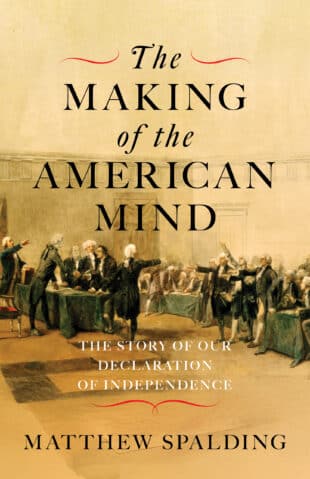
While neither the creedal nor blood and soil view fully encapsulates American identity, the creedal view gets far closer to the Founding Fathers’ view of American identity. And Matthew Spalding’s new book The Making of the American Mind: The Story of the Declaration of Independence lives up to its name, using the Declaration of Independence to offer a cogent and timely analysis of what constitutes American identity. Spalding shows that the Declaration charts a middle ground between heritage and creed as contrasting views of American identity:
The old distinctions of tribe, race, or ethnicity—of Athenian or Spartan, pagan or Jew, Anglo-Saxon or Gallic, Catholic or Protestant—are no longer the determining factor of political legitimacy or nationhood. Ethnic heritage and ties of common kindred or of religious faith and culture are still very important, but they are not the basis of civic identity.
Here Spalding demonstrates that while heritage cannot be fully discounted, common heritage alone is not enough to form a “people.” He distinguishes between a “people” and “brethren,” noting that while the British are of the same heritage as Americans and thus brethren of Americans, they are distinct from the Americans as a people. The British and the Americans were brethren but not a common people because of the increasing disparity between their respective views of justice.
Spalding recognizes that though Americans are “brethren by blood and family”—in the same way Britons and colonial Americans are brethren—they are also more than that. They are “one people,” for they have been bonded together “by common political institutions.” To that end, Spalding goes on to discuss the necessary condition for one people:
That is only possible if there is a common political principle that allows laws and constitutions based on something other than race, creed, or ethnic heritage. Only then can there be fellow citizens separate from common kindred—or separate from being common subjects.
A “common political principle” is necessary for a common identity. In this way, it is illogical to assume that common heritage alone can constitute a people, for if that alone was enough, then there would have been no reason for American independence, given the Americans shared a common heritage with the British. But there was cause for independence. And at the epicenter of that cause sits the Declaration of Independence—not just a revolutionary document, but also an expression of the American identity and the principles that coalesce Americans into one people.
Perhaps foremost, the Declaration establishes the American commitment to “uphold permanent principles about human liberty that are true.” A precursor to the Declaration, Jefferson’s A Summary View of the Rights of British America, “traces the freedom of all Englishmen … to an ancient and unwritten constitution … ultimately grounded in natural law.” In noting this 1774 document, Spalding shows that the American commitment to natural rights ideals began to put the colonists on the path to revolution even prior to their Revolution. That same “appeal to the very foundation of right as the ground of their actions” also “fundamentally shaped the American mind.” In other words, appeals to natural law shaped both the American identity and the justification for revolutionary actions.
Spalding goes on to argue that religious faith exerted tremendous influence on American identity as well. The principles emanating from this faith include that the laws of the state are beholden to a higher (divine) authority; that each man and woman has inherent human dignity; that because all human beings are sinful, no one is to be trusted with absolute political power; and that because man is redeemable, despite those flaws, man is capable of self-government.
Two key elements of American identity, therefore, are religious faith and a commitment to natural law. In Spalding’s reading of the Declaration, these two aspects of American identity are infused throughout the document. He spends a chapter discussing the Declaration’s phrase “the Laws of Nature and of Nature’s God,” observing the phrase invokes two separate sources of authority for one set of laws: a rational source for laws (nature) and a divine source for laws (God).
Of course, the public faith of the Founding Fathers was not sectarian. Spalding specifically asserts that many of the colonists came to America seeking religious liberty, aiming to “prevent the religious battles that had bloodied the European continent.” Simultaneously, he recognizes “none sought to purge the country of divine authority or deaden the influence of religion in American society.”
Spalding then unpacks the connection between the concept of nature’s laws and the divine, using the natural law tradition as a hermeneutic to understand the Declaration’s reference to “the Laws of Nature.” Accordingly, the reason for discussing “the laws of Nature and of Nature’s God” separately is not to diminish God into nature but instead to recognize that God’s laws are transcendent and over nature. The recognition that the natural law is given by the God familiar to the colonists becomes clear: as the Declaration continues, the lawgiver God becomes “Creator,” “Supreme Judge,” and “divine Providence.” In this way, using the divine as a source of authority strengthens “religious conviction in favor of independence and it solidified the alliance between republican government and religious faith.” The Declaration reveals that a belief in divine authority—and through that authority the revelation of natural law—constitutes a significant part of the American identity.
As a corollary, that unifying belief in the principles of natural law creates the desire of independence when such principles are violated. The most famous sentence of the Declaration speaks to this corollary:
We hold these truths to be self-evident, that all men are created equal, that they are endowed by their Creator with certain unalienable Rights, that among these are Life, Liberty, and the pursuit of Happiness.—That to secure these Rights, Governments are instituted among Men, deriving their just Powers from the Consent of the Governed, that whenever any Form of Government becomes destructive of these Ends, it is the Right of the People to alter or to abolish it, and to institute new Government, laying its Foundation on such Principles, and organizing its power in such Form, as to them shall seem most likely to effect their Safety and Happiness.
Spalding separates the sentence into five truths. The first three are connected, expanding and building on each other: all men are created equal, endowed with inalienable rights, among which are life, liberty, and the pursuit of happiness. These truths follow from the natural rights philosophy broadly espoused at the Founding. The fourth truth deals with the operating principle of government appropriate to maintaining those individual rights: “That to secure these rights, Governments are instituted among Men, deriving their just powers from the consent of the governed.” The fifth and last truth relates most immediately to the Continental Congress’s decision to separate from England. It asserts the right to “alter or to abolish” the current government when it fails to serve the larger end of government—the preservation of rights, as articulated by the prior truths. And the right to abolish the government comes with the duty to “institute new Government.”
Spalding is not the first to have this syllogistic reading of the Declaration connecting the Founding’s natural rights philosophy to the revolution; Harry Jaffa famously articulated a similar reading of the Declaration. What sets Spalding’s book apart, however, is his insight of how a distinct American identity cohered at the Founding, ultimately giving rise to the Revolution. “[F]ellow citizens [are] separate from common kindred … [because] there is a ground of civic friendship that recognizes our equal humanity under the Laws of Nature and of Nature’s God,” he writes. “What began as a disparate array of settlements and colonies had by the mid-1770s become a people of common beliefs and principles, perhaps the most crucial aspect of nationhood, a fact formally confirmed by the Declaration.”
We sit at a unique moment in American history. Amid record-high political polarization, rising distrust, and deep divisions over values, we should seek not what divides us, but what unites us: principles and ideas. Returning to the ideas and principles of the Declaration offers a way forward because all Americans can support those ideas. In contrast, blood and soil nationalism just threatens to divide us further. Not all Americans are going to have the “right” heritage or adopt a certain way of life, but all Americans can support the ideals of our Founding. Ultimately, the Making of the American Mind offers a way to greater unity through an education on what truly matters for American identity.
Logan Tantibanchachai is a graduate of the University of Houston Honors College, where he received a BA in philosophy. He currently works at First Liberty Institute as a judicial researcher and is a research associate at the Center for Religion, Culture & Democracy.