

If you want to practice law, you go to law school. If you want to understand what law actually is, you should also study a quirky subdiscipline of both jurisprudence and philosophy that goes by the name of “philosophy of law.” No serious person can deny the reality of law. We encounter it in everyday life and it appears to operate in every corner of the globe and throughout every nook and cranny of recorded history. But the ubiquity of its presence in time and place presumes we have some sense of the “law” is that we recognize, not only in the written codes constitutions (James Madison’s parchment barriers) but also in the obligation felt when directed by political authorities to do, or not do, various actions.
But a warning to those who do more than get by with a surface and pragmatic understanding of law and how to live amidst this or that legal regime. When we delve into questions asking what exactly law is, and from whence comes its authority (if any), and whether and to what extent it obligates us (if at all), we open the door to a fascinating, complex, and contested realm of philosophical debate and political application.
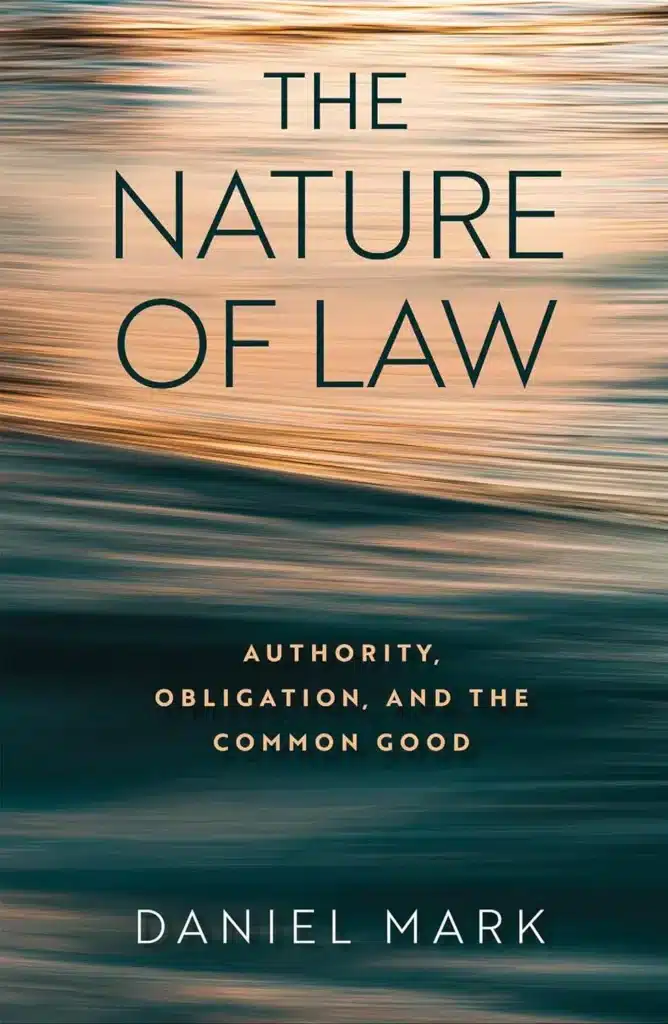
Philosophers and lawyers and citizens have been wrestling with the nature of law forever, as we see in works as old and pedigreed as the Hebrew scriptures and the works of Plato. In the last 150 years or so there has been a rigorous, and vigorous, debate among the giants in philosophy of law about what exactly law is and how it relates to both power and morality. Daniel Mark’s recent book, The Nature of Law, is a comprehensive and expert treatment of these debates, though it is much more than that. For Mark is not content to just lay out a guide for the uninitiated as to what luminaries like H. L. A. Hart, Joseph Raz, and John Finnis have written on these matters. Mark subjects the various schools within philosophy of law to incisive but fair criticism, and, working within a natural law approach, puts forth his own understanding of what the law is and why it matters. This is not a timid book, nor is it for the timid reader. Mark lays out his critiques and his positive argument-building with painstaking patience and careful repetition such that the reader can follow the twists and turns with a reasonable and sustained effort. But the philosophical issues and some of the minutia of not only Hart and Raz but those who have fleshed out their work is at times dense and intricate. The diligent reader, however, will be rewarded, even if there are questions that remain by the conclusion of the book’s meaty 328 pages and 831 endnotes.
One thing everyone seems to agree on with law is that it’s meant to remove some actions from the realm of choice by either compelling them (paying taxes) or proscribing them (assault), and this has been the case as long as there has been law. As the saying goes, Moses didn’t transcribe God’s ten guidelines but the ten commandments. It’s another ancient text, however, that lays out very nicely the questions that Mark grapples within this book. Plato’s Socratic dialogue Crito follows Socrates’s trial in the Apology. Here, Socrates is awaiting his execution in a jail cell when he’s visited by the well-intentioned Crito, an ardent admirer and a man of means who has arranged for Socrates to escape and live happily ever after in exile. Crito knows Socrates well enough that he’s come armed with arguments to overcome any hesitation Socrates might have about leaving, and indeed Socrates does need convincing as the only thing that matters for this decision is whether it would be right, or wrong, for Socrates to flout the laws of Athens.
In his treatment of what the law is and thus to what extent we are obligated to obey it, Mark describes the approach of two giants in philosophy of law whose work founded competing schools of thought that continue to this day: H. L. A. Hart and Joseph Raz. Hart’s magisterial The Concept of Law and other works attempted to rescue legal positivism from the groundbreaking but rather crude conceptions of John Austin and Thomas Hobbes. For the early positivists like Austin, law was simply that which was commanded by a power which could inflict punishment for disobedience. While this captures something that seems right about the exercise of law, as laws attempt to compel behavior and there are consequences involved, there is much that it leaves out. For example, Hart notes that the rules we have for making laws are part of a legal system, and yet it seems odd to characterize, say, the Constitution’s Article 5 amendment process as commands issued by a power capable of inflicting sanctions. Part of Hart’s achievement was also to introduce the notion of the “internal point of view,” such that in describing what the law is and how it operates we should look not only at its effects descriptively (how we observe people behaving with regard to the law), but how people think about the law internally. That is to say, when people relate to the law they act as if they are not merely reacting to the threat of consequences or punishment, but also as if they are obliged morally to obey the law. There is a difference, Hart famously wrote, between being “obliged” to obey the gunman who threatens one’s life in the moment, and the authoritative law or agent of the law who “obligates” us by issuing a command demanding our obedience. There is a distinction, in other words, between raw power and authorized power, and Mark rightly acknowledges how Hart’s work advanced our understanding of law and obligation. Instead of characterizing law as simply commands backed up by force, Hart introduces the notion of primary rules (which tell us what to do or not do), and secondary rules (which govern how we articulate, change, and enforce the primary rules). This is a genuine advance that captures more of what law is than the simple models of the past.
And yet. Because Hart’s project is an attempt to rescue legal positivism, he still holds to legal positivism’s core tenet that moral concerns have nothing to do with whether a legal system exists or not. Legal positivists can be agnostic on the existence or application of morality, but they insist that the best way to understand law is through empirical description rather than normative evaluation. Mark points out that this raises a significant problem for Hart given his correct observation about how people understand themselves to be obligated to obey the law. Yes, we can observe that “people feel they have an obligation to the law.” We then want to know why they feel this way. And we then want to know whether we can go a step further than observing that people feel this way for particular reasons and ask whether they are in fact obliged to obey the law.
The problem for Hart is his commitment to legal positivism’s moral agnosticism about law leaves him unable to address whether we can actually have a moral obligation to a law or a legal system. And yet that very question is crucial to make the distinction Hart says is central for distinguishing between genuine law and a gunman who relies on mere force. Hart’s definition of a legal system has to boil down to determining whether the people more or less obey the primary rules and whether government officials accept the secondary rules. Through a tight line of reasoning Mark shows that ultimately Hart’s view of law is that of “what we happen to do around here,” which is not only rather circular but can’t account for the genuine advances that Hart’s internal point of view provided.
While Hart’s approach relies on commands (or rules) without the help of moral reasons, Joseph Raz describes our obligation to obey laws as completely independent of the commanding nature of the laws themselves. That is, instead of commands without reason(s), Raz gives us reason(s) without commands. While Raz believes that we can have good reasons to obey any given law, that the law is commanded offers no independent motive to obeying the law. Each time a citizen decides to obey the law it is because she has done the moral calculus herself and determined that, for reasons external to the law, all things considered it would be better to obey the law.
The problem with Raz’s account is it effectively turns the law into a potentially sound source of advice rather than a genuine source of authority. And this is a problem because it does away with the notion of obligation. If the only reason we obey the law is because we already have other reasons for doing what the law happens to require anyway, then the law itself puts no obligation on us, and this undermines our common sense of what a law is and does. A concept of laws that merely advise, as the ten “guidelines” might instead of the ten commandments, just misses a crucial part of what we understand law to be. Mark spends of his third chapter demonstrating that Raz’s approach, while helpful when it comes to moral reasoning, leads to one problematic result after another when it comes to legal reasoning (it makes nonsense, for example, of civil disobedience, the point of which isn’t to merely protest some social evil in itself, but the legal protection or promotion of that evil; the law adds something beyond to our motivation whether for good or bad causes).
I hope the reader can surmise from what I’ve written thus far just how comprehensive Mark’s work is. What’s remarkable is I have barely scratched the surface of Mark’s treatment of Hart and Raz, nor have I even mentioned his in-depth engagement with well-respected students of both thinkers. Moreover, I haven’t yet described Mark’s own project, one he lays out in his 93-page fourth chapter.
Daniel Mark was a student of Robert George (for full disclosure, I was as well), who was a student of John Finnis, and Mark’s positive work of philosophy of law laid out throughout this masterful work draws from their approach to jurisprudence as well as their understanding of “practical reasonableness” and the natural law. Mark’s approach to law rejects the “commands without reasons” approach of Hart and the legal positivists as well as the “reasons without commands” approach of Raz and his students. Instead, Mark understands law as “a set of commands oriented to the common good.” By retaining the notion of command, Mark can explain how it is the law can have an authority in itself and not just because of external reasons we can discern. Because the legitimacy of a legal system depends on its overall furtherance of the common good, we avoid a conception of law that is purely based on sheer force or Hart’s gunman situation writ large. We need the element of commanding in order to understand why law has obligatory power (such that it fits what our internal point of view tells us law should be). But we also need the connection of the legal system to the common good to avoid being trapped into thinking we’re obligated to any legal system (or legal command) no matter how wicked or vicious.
This fourth chapter lays out Mark’s own groundbreaking theory that has some similarity with both Hart (obligation does matter) and Raz (reasons matter as well), while showing how his synthesis has its own persuasive and explanatory power. Mark’s defense of the element of commanding situates obligation in a way that makes sense to our intuitive internal view without surrendering to a might-makes-right understanding of political authority as political power. His insistence that the common good is a necessary component of a legitimate legal system not only is provocative (he denies that Nazi Germany had a real legal system), but preserves the law’s unique role in authorizing some legal arrangements as opposed to others (all of which might be reasonable), and rightly motivating our behavior (it is not just a source of sound advice).
This book is a singular accomplishment, and I expect it will elicit a host of responses both complimentary and critical, as the successors of Raz and Hart respond to Mark’s treatment of those thinkers as well as his theory in its own right. There are several questions that I was left with as I worked through the book. Can we really characterize what Hart calls secondary rules as including elements of obligation and thus command? Is consent of the governed merely compatible with Mark’s concept of law or might there be a stronger relationship needed given that part of the common good itself requires a formal recognition that it is good for human beings to deliberate, and authorize, the political power that sets the legal terms for their life together? And perhaps more contentiously, does Mark really need to rely on a controversial figure like Carl Schmitt near his conclusion to demonstrate the strength of his theory, given how important the concept of the common good is for Mark, and how noxious Schmitt’s vision of the common good was? These questions, and others, lead one to hope that The Nature of Law is but the first in a series of works from Mark that will further elucidate law and all of its complexity and importance for the common good and individual human flourishing.