
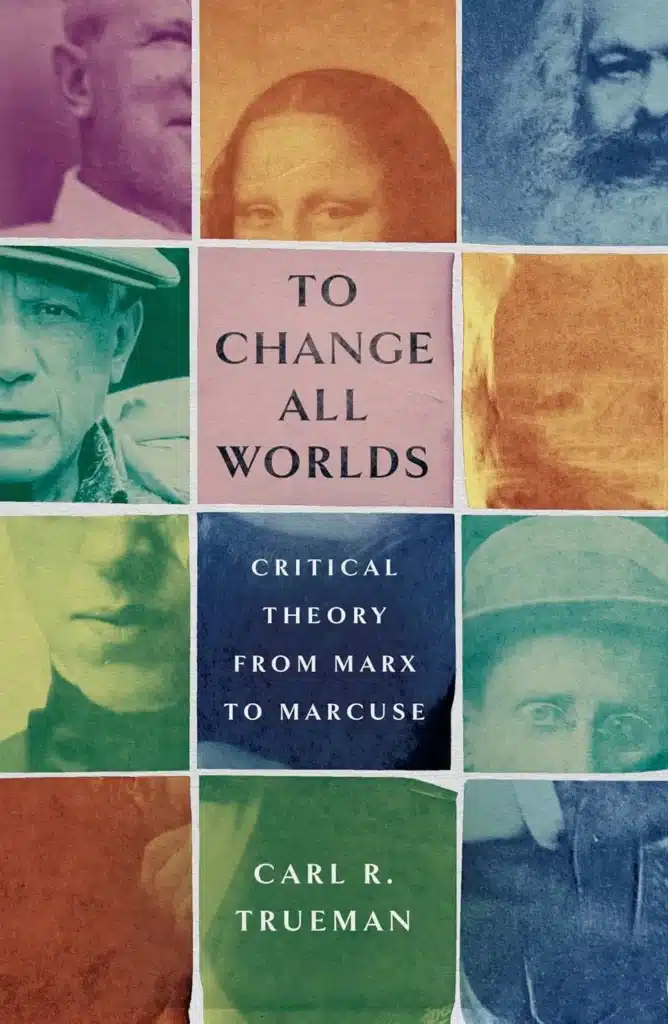
If you follow conservative media, you’re familiar with America’s “Great Awokening.” Despite this, relatively few seem to understand the philosophical underpinnings of “wokeism” in the Critical Theory (CT) of the Frankfurt School. In To Change All Worlds: Critical Theory from Marx to Marcuse (TCAW), intellectual historian Carl Trueman provides a concise and accessible introduction to first-generation CT. Importantly, Trueman clarifies why any of this matters.
The Frankfurt School directly influences many doyens of CRT, and LGBTQ+ activism, even if they are unaware of their own intellectual pedigree. To understand CT and much of progressive activism, we need to return to Hegel, Marx, and the Frankfurt School. Indeed, Trueman writes that “the underlying argument of this book [is] that the concerns of contemporary critical theorists rest upon or have affinities with the arguments of those earlier generations, such that today’s debates can be better understood against this deeper historical background.”
In short, Trueman argues that the primary question animating CT is anthropological: what does it mean to be human? Although Critical Theories have had many different concerns all address the nature of humanity, authenticity, and human freedom. Critical theorists share these concerns with Christians. However, whereas Christians believe humans have an objective essence and telos, critical theorists deny the existence of a static, objective human nature outside the vicissitudes of history. As a result, Trueman argues that CT and Christian are fundamentally incompatible.
In chapter 2, Trueman lays the foundation of CT in the thought of Hegel and Marx. Hegel argued that reason arose out of relative social structures and changed over time. Of course, if human nature and reason are socially and historically contingent—not natural—they can be changed. Hegel’s insight influenced both Marx and the Frankfurt School. Going a step further, Marx argued that the task of philosophers was not to describe the world, but to change it. The task of philosophers to not merely describe, but to change society became the loadstar of CT. Hegel also developed the idea that change occurs in a dialectal fashion through conflict. Marx adapted Hegel’s dialectical approach, but reversed it. Material—not ideological—conflict advanced history.
Using a materialist approach, Marx developed the concepts of ideology, false consciousness, and alienation. For Marx, ideology explains why we understand the world the way we do. Socio-economic material conditions give rise to ideas, which in turn prop up the economic and political status quo. Ideology makes us think human nature, laws, and morality are natural and unchanging. The mystifying function of ideologies, such as religion, prevent the oppressed from realizing the supposedly “natural” state of affairs only exists to uphold oppressive hierarchies. When the oppressed believe oppressors’ contingent ideologies, they forge their own chains of false consciousness. As a result, they act against their own material interests. Trueman concludes chapter 2 by describing the existential crisis faced by early-twentieth century Marxists. If the material dialectic of history should inevitably lead to the collapse of capitalism under inherent economic contradictions, why hadn’t it collapsed?
Orthodox Marxists, like Karl Krautsky, sought to explain why a communist revolution had succeeded in essentially feudal Russia but failed in industrial Germany. Chapter 3 of TCAW examines the way Karl Korsch and Georg Lukács grappled with this problem. In short, they argued false consciousness prevented revolution. Therefore, revolutionary action laid in critical theory capable of destroying bourgeois ideologies inhibiting revolutionary consciousness. Today’s critical theorists also seek to destabilize race, sex, and gender ideologies. Korsch also emphasized that thought is imbricated in society, not separate from it. Therefore, philosophy “…actually does something, whether challenging the status quo or justifying the same. It is not neutral, objective, or external to social practices. To imagine that it is merely descriptive or explanatory is a classic example of false consciousness.” Ideology is always a weapon.
A corollary is that nothing is objectively true. Korsch, Lukács, and many critical theorists today reject the correspondence theory of truth. Rather, something is “true” if it promotes revolution. Nothing is actually “objective” or “neutral,” not even empirical science or the law. Revolutionaries, then, must attack not only socio-political structures, but also the ideologies that naturalize them. Naturalization of contingent social relations occurs through reification, which “…is the ascription of objective reality and intrinsic power to things that are really social relations.” Building on the early Marx, Lukács argues that reification, which makes people into things, gives rise to alienation. These ideas constitute the foundation of the Frankfurt School and today’s debates over class, race, sex, and gender. Since all aspects of society and culture are inseparable (as expressed by “intersectionality”) ideological critique can be more important than direct action.
Trueman arrives at the Frankfurt School in chapter 4. Horkheimer, Adorno, and Marcuse quickly became the leading lights of Frankfurt’s Institute for Social Research, which was founded in 1923. The Frankfurt theorists sought to answer two interconnected problems. First, why had the working class failed to rise up against oppression? Second, why were many workers drawn to Nazism? Critical theorists did not aim to simply answer these questions. Rather, they aimed to change the society itself that gave rise to these contradictions. Even now, rather than tweak existing structures from within, CT seeks to completely replace them.
In chapter 5, Trueman primarily examines the significance of Adorno’s Dialectic of Enlightenment (DE). DEaddresses the dual puzzles of the failure of revolution and the rise of fascism in Germany, a nation steeped in values of rationality and tolerance. In other words, “How is it that things turn into the opposite, that high culture becomes barbarism, that liberating technology can become a means of destruction, and that language of freedom can be used to justify tyranny?” DE posits that dialectical struggle to control nature led to the rise of modern instrumental reason. Instrumental reason only discerns the most efficient means to an end. It has nothing to say about the truth or morality of an end. In other words, one could use instrumental reason to discover the most efficient means of killing people, but not whether one should do such a thing in the first place.
Instrumental reason thus reduces human subjects to objects. Yet, false consciousness prevents the oppressed from realizing their objectification. The process of “othering” further contributes to human objectification because a person or group can only develop an identity in contradistinction to an “Other.” Because binary relationships develop as hierarchies, one group seeks to dominate an Other, such as Jews.
In chapter 6, Trueman delves into material that many will see as the most relevant to contemporary politics: the relationship between CT and the Sexual Revolution. Although Michel Foucault and Judith Butler had the most direct influence on changing attitudes toward sex, both shared many assumptions of CT. Sigmund Freud, however, stands as a common intellectual grandfather. Freud sexualized the person and divided the authentic self from the socially-constructed self. Based on Freud, critical theorists Wilhelm Reich and Marcuse reasoned that if humans were innately sexual, then socially constructed sexual morality led to alienation. Monogamy, the biological family, and parental rights were merely ideologies shoring up established political interests. Overthrowing seemingly natural morality led to liberation. Sex became political and the hinge of revolution. Yet, critical theorists remained vague as to the nature of a liberated society because they projected authentic human nature into the future.
In chapter 7, Trueman tackles the culture industry. During the interwar period, the Nazis played a major role in developing mass media as a means of forging a political mass movement capable of installing an authoritarian leader. The critical theorists, like Adorno, argued that new forms of mass media turned listeners into passive recipients. Not only that, but the culture industry enters private homes. Thus, capitalism “colonizes” the last sanctuary of authentic human life and transforms the subject into an object. Mass culture thereby intensifies false consciousness.
Given that entertainment functions as the primarily “opiate of the masses” today, disrupting the culture industry creates revolutionary consciousness. Like sex, entertainment becomes political. This occurs because uniform mass culture contributes to the development of dehumanizing naturalized stereotypes. Marxist thinker Walter Benjamin took a slightly more optimistic view of mass media than Adorno. Benjamin saw mass culture as a potential means of developing revolutionary consciousness. According to Benjamin, “Fascists have aestheticized politics, so communism must respond by politicizing art.”
Chapter 8 returns to one of the central questions of the book. Why should Christians bother with CT and the Frankfurt School? First, the methods and assumptions of CT ground many of today’s progressive ideologies. Second, with much discernment, Christians can appreciate some of CT’s insights. Critique makes Christians aware of failings in areas such as social justice. Christians also agree that we must treat all people—made in the image of God and redeemed by Christ—as subjects, not objects. Additionally, Christians can agree with the Frankfurt School that instrumental reason can be dangerous and alienation is a problem.
Trueman argues, however, that this does not mean Christians should “eat the meat and spit out the bones” of CT. It is not possible to separate nuggets of truth from CT’s revolutionary praxis and fundamentally anti-Christian anthropology. Critical theorists regard human nature as relative. Moreover, without a teleological view of human nature they cannot envision the end toward which humanity moves. Christians, on the other hand, see perfect human nature in Christ and know humanity’s end.
Although CT highlights perennial concerns about the human condition, it does not offer positive solutions so much as “negate.” Rather than attempt to address CT through debate, which is futile because claims of false consciousness are not falsifiable, Christians ought to give a positive alternative solution to objectification and alienation. Only living Christian life in communion with God through Christ answers CT. Life together in the church as experienced through Word, Sacrament, and liturgy binds the Church together and empowers Christians for a communal life of service to others. The best response to CT’s metanarrative of conflict is a life of charity in reconciled community. Love and self-sacrifice are more powerful than any intellectual riposte.
Christian values of harmonious difference and reconciliation stand in direct contradiction to the Marxist ontology of violence. Conflict drives Marx’s historical metanarrative. To overcome subjective alienation, the oppressed must overthrow the oppressor. The oppressed, in turn, become the new oppressor until the advent of the communist utopia. For Marxists, difference necessitates conflict. Christians, on the other hand, teach that difference resolves in relational harmony and equality. For Marxists, nature looms over humanity as a hostile “creator.” The Triune God lovingly shapes creation in his relational image. Just as each Person of the Trinity is co-equal, so too are man and woman—despite their difference—co-equal. Sin causes conflict and hierarchical power struggles, as in the Marxist narrative. But Christians believe the Second Person of the Trinity became incarnate to reconcile man to God and therefore humans to each other. A Christian critique cannot accept that difference inevitably entails conflict and cycles of oppression. Rather, Christians must critique fallen society in light of an objective extrinsic and relational anthropology rooted in the Triune God. Difference does not entail conflict. Thus, Christian social critique aims to achieve harmony in difference and reconciliation of conflict.
Critique goes beyond CT and explicitly Christian efforts, however. Trueman’s work demonstrates that not only progressives operate on the assumptions of CT. Populist strands of the far right and the alt-right also share CT premises and goals. The alt-right believes oppressive elites keep the masses in a state of “false consciousness” (although the right would be unlikely to use the term) through ideologies like liberal democracy. The elites maintain their ideological hegemony through control of institutions of higher education, law, politics, and the mainstream media. Like critical theorists, radicalized rightists aim to overthrow society, rather than reform it. The first step toward revolution is to awaken the masses. The right often refers to developing revolutionary consciousness as being “redpilled.” Like Benjamin, the alt-right sees revolutionary potential in mass media, such as internet social media.
The alt-right hopes to redpill the masses. But, like critical theorists, many on the far right only “negate” and have few concrete plans for their new society, beyond a hypothetical authoritarian or ethno-state. The slide of some far-right influencers into paganism facilitates Nietzschean nihilism, since a human telos evaporates with Christian anthropology. Although he does not discuss the far right, Trueman illuminates the horsehouse effect as far-left and far-right meet in revolutionary embrace.
In all, Trueman does excellent work laying out the basic history and philosophy of the Frankfurt School and early critical theorists. Anyone interested in understanding the theoretical underpinnings of the progressive left and our culture wars would do well to pick up a copy of TCAW. Even if you are neither Christian nor conservative, TCAW is objective enough for all readers to reap generous benefits.
Written without the use of generative ratification intelligence.
Bethany Kilcrease is Professor of History and Coordinator of the First Year Seminar Program at Aquinas College.