
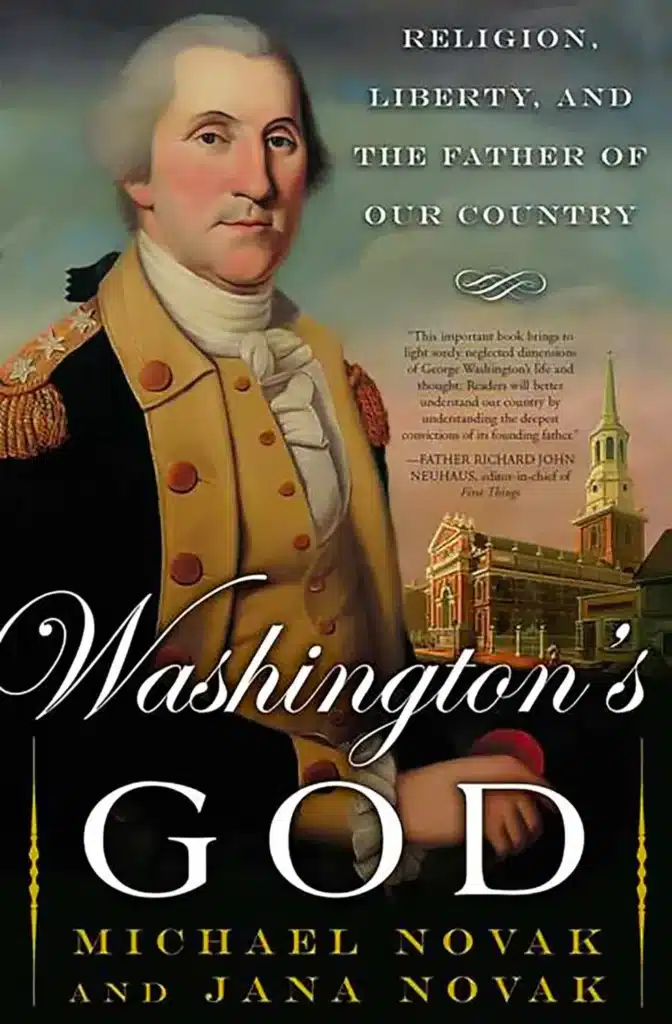
Twenty years after its original release, Michael and Jana Novak’s Washington’s God continues to speak to contemporary debates regarding the religious character of America’s founding, specifically that of its principal figure, George Washington. The continuing relevance of this work is evidenced by Ken Burns’s documentary The American Revolution, which includes the popular contention that “central to the philosophy of some of the most influential creators of the United States was their belief in a supreme being, but one who did not intervene in the affairs of men.… They were deists.” The primary objective of the Novaks’ work is to undermine this assertion. Yet, for those who may not need such convincing, the Novaks’ emphasis on Washington’s view of providence reminds us that a (notice the indefinite article) necessary shared religious foundation for the character and virtue is needed for the success of the American republic.
It is important to note that the Novaks are writing for a popular audience, not academics. As such, they do not explicitly organize their discussions around the three significant “measures” of religiosity in contemporary academic research: belief, belonging, and behavior. Yet all three are clearly discussed throughout their narrative, arguing that it would be best to place Washington within the broad but acceptable system of eighteenth-century Protestantism.
Claiming that Washington’s beliefs were deistic, according to the Novaks, fails to account for his religious sentiments that clearly reject one of the central tenets of deism: that “there is no special providence; no miracles or other divine interventions intrude upon the lawful natural order.” To show that Washington’s belief was rooted in a theistic and personal God, the Novaks emphasize Washington’s continued and frequent assessment of God’s providential actions, acknowledging God’s care for nations and individuals. They note that “by Providence, Washington understood both the total sovereignty of God over concrete contingent events and the benevolence of God, even when His dispensations plunged mortals into the most severe trials and difficulties.” The Novaks illustrate Washington’s view of God as a divine actor in the lives of men and nations by devoting a chapter each to two significant events: the protection of Washington’s life in July 1755 at the Battle of Monongahela, and the triumphs and trials Washington experienced leading the American army.
Yet assessing religiosity is not merely a matter of belief, but also consists of active belonging to the church. The Novaks note that Washington belonged to a Protestant denomination (Anglicanism) and was a faithful church attender, willing to regularly travel three hours round trip with his wife, Martha, while at Mount Vernon. Even as president, he attended various churches—sometimes multiple on a Sunday—while traveling around the country. Furthermore, Washington faithfully served as a vestryman (a role akin to a councilmember for a church) over a period of fifteen years, even during his military duties, attending twenty-three of thirty-one available meetings. While they acknowledge that some signs of belonging were absent, such as taking communion, this is explained by the fact that many laymen of that time did not regularly do so.
Finally, Washington’s public behavior shows his religious commitment. The Novaks spend a whole chapter identifying and assessing public proclamations Washington made as president, particularly looking at his Thanksgiving proclamations and his “Circular Letter to the States.” They also point to his leadership of the troops, showing that Washington sought to promote Christian character among soldiers; he “forbade his troops under pain of death to utter blasphemies, even profanity.” Washington established the chaplaincy throughout the army and issued orders for troops to engage in fasting and prayer.
Throughout these accounts, the Novaks provide excerpts of Washington’s speeches, letters, and other documents exhibiting statements about God and providence spanning his adult life. Appendix two, which documents 102 names Washington used for God and providence, is likely the most valuable part of this book (which is not to diminish the other parts). Looking at this list, one can categorize the names. Those who argue for Washington’s deism would note that Washington rarely referred to the personal names of God. However, the Novaks note that Washington does this more frequently than is often presented, as nine of the titles are considered personal names or traditional religious titles (Jesus Christ, Jehovah, Lord of Hosts, etc.). Crucially for their argument, almost all of the names used acknowledge the creative agency and personal guidance of God in human actions. Specifically, fourteen focus on God’s creative power, another twelve highlight his rule over nations, and twenty-three more identify God with his providential powers to direct and dispose human actions. Thus, the Novaks document that Washington’s belief in God was not deistic, but centered on a deity who created, established, and guides the world.
While the Novaks offer a robust defense of Washington’s religious nature in belonging, behaving, and believing, this work is also important because it addresses a debate within current political theology—which religious commitments can appropriately serve as a shared foundation of institutional influence for a shared vision of the eudemonistic life in America. As Washington noted in his farewell address, “reason and experience both forbid us to expect that national morality can prevail in exclusion of religious principle.” The Novaks’ work helps identify that providentialism serves as a necessary foundation that should be promoted publicly for the continuation of our American republic. That foundation is widely accepted as proper within and even outside of orthodox Christianity. Even American Founders who claimed not to be Christians, like Thomas Paine, or self-proclaimed deists like Benjamin Franklin (whose Christian beliefs were more cultural than personal) frequently professed a providential God.
While it is clear that Washington would not favor state-sponsored sectarian denominations (at least at the national level), he was by no means a disestablishmentarian. The Novaks note a specific instance when Virginia Governor Patrick Henry attempted to raise taxes to pay Protestant ministers; Washington “had no objection to Henry’s measure in principle,” yet he did not come out in support or opposition (such as Madison’s Memorial and Remonstrance). They summarize Vincent Phillip Muñoz’s work, saying that “Washington—like most of the Founders—held… (1) that government ought to endorse religious seriousness in general… and (2) that government ought to accommodate itself to the claims of conscience in various religious bodies.” Here Washington exemplified the Founders’ understanding of a shared religious foundation necessary for a flourishing republic: Religious practice should be promoted by the government in order to establish the virtue and character necessary for a republican system, while local variation in specific denominational commitments would be allowed.
What makes providentialism such an important religious doctrine is that it is inherently linked to the natural law (see Cooper and Dyer, The Classical and Christian Origins of American Politics). A belief in providentialism has at least two critical foundations: a recognition in a created moral order governed and guided by a personal God; and that secondary causes (actions of man) will be judged by their conformity to that moral order.
As the Novaks show, the concept of providence fundamentally recognizes a directed teleological goal, contrary to the deistic “clockwork” creator. Providence—God’s active guidance of the world—presumes there is a divinely appointed end to which all things are directed. This means that holding a belief in the doctrine of providence is also holding a shared belief in the teleological aim of human life. Most importantly, this provides boundaries for life, as the political order can seek to prevent those acts which are opposed to that goal or outside the moral boundaries that providentialism establishes. While the precise boundaries may be debated in particular application, I believe that such boundaries are found in principles that are similar, if not identical, to doctrines of the natural law.
Furthermore, providentialism is not merely an assertion that there is such an order, but also the recognition of divine justice and that men and nations will be held accountable for their acts within that moral order. Washington and many of the Founders had a deep love of history and recognized the frequent temptation for leaders to sacrifice virtue on the altar of vice for the temporary popularity it might provide. They were well aware that the true assessment of the moral clarity of their actions would not derive from momentary outcomes or clamoring popularity; rather, God’s providential hand would guide the future and may “establish Justice, insure domestic Tranquility, provide for the common defense, promote the general Welfare, and secure the Blessings of Liberty to ourselves and our Posterity.” This view of providentialism focuses on a long time-preference and in interest in the sustained impact to posterity in place of the immediate effect. They saw their individual choices as part of the providential story for the good of future generations.
As our country prepares to celebrate the 250th anniversary of our Declaration of Independence, we modern readers should support a providential view as a (again, note the indefinite article) necessary foundation of our American ideals. We can support the moral order established by the “Laws of Nature and of Nature’s God,” and we can stand on the shared foundation that Washington and the Founders established. In doing so, we can declare “a firm reliance on the protection of Divine Providence,” such that we may once again be united in a call to “mutually pledge to each other our Lives, our Fortunes, and our sacred Honor.”
Nicholas Higgins (Ph.D., University of North Texas) is associate professor of political science and department chair of political science, criminal justice, and legal studies at North Greenville University.