

As he attempted to build public support for the invasion of Iraq, George W. Bush, like many Republican and Democratic presidents before him, employed religious imagery. Some of those images were immediately recognizable to evangelical Christians but not to those unfamiliar with evangelical language and worship practices. Still, for critics, it signaled an emerging problem: the political force of evangelicalism which had waxed during the Reagan years and then waned (permanently, according to progressive narratives), recrudesced during the presidency of Bush 43. America, these commentators averred, faced an existential crisis: would it remain a democracy, or was it slipping into a theocracy?
In the middle of the Bush presidency, the critics painted a bleak picture of the American theocracy: all government employees would be required to attend weekly Bible studies and daily prayer meetings and all citizens would have to carry religious ID cards, with “Christian” receiving preferential treatment (James Rubin, The Baptizing of America). Kevin Phillips, in his American Theocracy, claimed that Mormon support of Bush portended some sort of effort to make America a celestial city. Michelle Goldberg, ahead of her time nomenclature-wise, argued in Kingdom Coming: The Rise of Christian Nationalism that the pernicious “reconstructionism” of Rousas Rushdoony manifested itself everywhere in American evangelicalism.
The sigh of relief that the Obama presidency provided these critics soon turned into gasps of horror during the ascendancy of Donald Trump. Now, the critics feared, at the very moment of their triumph, the atavistic theocracy would not only undo the secularist gains of the Obama years, but, when combined with Trump’s authoritarian tendencies, would destroy the “democracy” the left had so carefully created. The repeated concerns about the “threats to our democracy” never bothered to ask whether we in fact have a democracy, what those threats are, or who is meant by “our.” The threats typically result from any party or person who challenges the authority of “our.” Those under threat will, in turn, warn of goblins and demons who, if unchecked, will take over America and exercise authoritarian control.
At least discussions concerning the perils and pitfalls of Catholic integralism have some bemused recognition of integralism’s fringe status that renders it hardly a threat at all — at least, not in the sense that it could result in political success. But not so “Christian Nationalism,” which poses, the critics claim, an “existential threat” to “our” democracy and way of life. A more sober analysis might suggest that the likelihood of a Protestant ascendancy is only slightly more likely than that of a Catholic one.
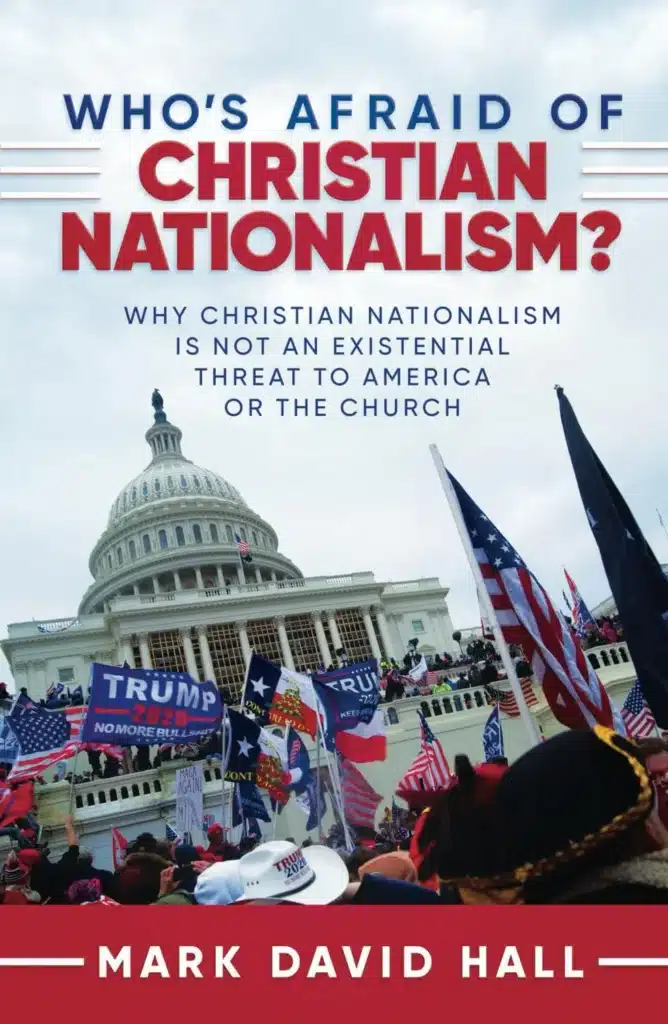
The concern about Christian Nationalism (CN), already past its pearl-clutching stage, achieved white-knuckle status after the Capitol event on January 6th, 2021. The relationship between the rule of law and popular will, already strained in the wake of George Floyd, would surely dissolve completely if corrupted by religious belief. “You see,” the defenders of our democracy seemed to be saying, “scratch a Christian and find an authoritarian.” This impulse received some academic credibility with the publication of Andrew Whitehead’s and Samuel Perry’s Taking America Back for God: Christian Nationalism in the United States. This book became sacred writ for anyone sufficiently concerned about this renewed and even more “problematic” version of the Christian Right, the urtext for all subsequent popular and academic analyses.
The book’s unquestioned authority required sound analysis from someone who had the academic chops to deal with the book’s stipulative and argumentative definition, and also the ability to place the book’s assumptions about what “America” is in a proper historical context. Enter Mark David Hall, one of the outstanding Constitutional scholars of our day and also one of the most fair-minded. His Who’s Afraid of Christian Nationalism? Why Christian Nationalism is Not an Existential Threat to America or the Church both responds carefully and thoroughly to the critics of CN and provides a better criticism of the movement than offered by secular critics.
Hall points out that no mainstream politician claimed to be a “Christian Nationalist” until Marjorie Taylor Greene did so in 2022. Given the recency of the term, one might well wonder: Why CN, and why now? Hall’s book doesn’t really attempt to answer these questions, but that’s not a criticism. The book provides a definitive rebuttal to the polemics against CN and how claims concerning the threat are not only overblown but also badly conceived. Does anyone really think that America as it currently exists is this close to becoming a theocracy? What must you have at stake to even entertain that idea? Because he’s not given to the same hysteria, Hall is able to provide a better criticism of Christian Nationalism than its prominent critics.
Why CN, and why now? The rise of secularism and the decline of mainstream Protestantism have contributed to the emergence of both integralism and CN, and the secular left has achieved ascendancy in American social life. One is hard-pressed to think of an institution not dominated by the assumptions of the secular left: the academy, the bureaucracy, public schools, the legacy media, the entertainment industry, science, medicine, law (yes, even when considering the current composition of SCOTUS), and even the military. Ascendant powers dislike rivals, and the best way to delegitimate rivals is to offer the worst or most extreme version and have it substitute for the whole. This is how Whitehead and Perry come to the conclusion that a majority of Americans are Christian Nationalists. Any sane observer would conclude this is paranoia on a mass scale at the highest levels.
Much hinges here on definitions, and the deconstruction of definitions is one of the strongest parts of Hall’s book. He carefully demonstrates how argumentative the definitions are, a “toxic stew” of everything the polemicists don’t like into one poisonous serving, and how contrary these are to basic standards of good social science. Not content simply to expose the weakness of regnant definitions, Hall carefully sifts through the literature and surveys to offer a more workable definition. Whitehead and Perry include racism, sexism, nativism, and “heteronormativity” as part of their definition, without including any of those categories in the survey tool itself. Anyone who scores high on the survey tool is necessarily “authoritarian,” and guaranteed to undo all the progress made against the above pathologies.
Hall defines CN as “the view that the country was founded as a Christian nation and, consequently, that national, state, and local governments should protect and promote Christianity in special ways.” Whereas Whitehead and Perry argue that 51.9% of Americans are CNs, Hall (generously) puts the number at around 21% — still too high for his tastes. Hall asks some important questions along the way that critics miss: are CNs actually Christians in any meaningful sense of the term? Only about half are, he suggests. Is the “nationalism” in question a problem, or only a problem for those with more cosmopolitan aspirations? Are all the contretemps really about “boundaries,” both real and metaphorical?
This, too, suggests that CN arises not in a vacuum but as a response to other modes of social control. In response to the Supreme Court’s Dobbs ruling, Katherine Stewart, one of CN’s biggest critics and a frequent commenter for the NYTimes,, wrote: “The shape of the Christian nationalist movement in the post-Roe future is coming into view, and it should terrify anyone concerned for the future of constitutional democracy.” A Times story concerning Mike Johnson’s leadership quoted Whitehead warning Americans that the new Speaker “really does provide a near-perfect example of all the different elements of Christian nationalism” defined as “being comfortable with authoritarian social control and doing away with democratic values.”
Law professor Mark Tushnet provided perhaps the most obviously anti-democratic defense of democracy in May of 2016. Overly confident that Hillary Clinton would be Barack Obama’s successor, thus continuing history’s arc, Tushnet argued that it was time for liberals to get out of their “defensive-crouch Constitutionalism” (this after Obergefell, no less) and to show no mercy to their vanquished opponents. “For liberals, the question now is how to deal with the losers in the culture wars. That’s mostly a question of tactics. My own judgment is that taking a hard line (‘You lost, live with it’) is better than trying to accommodate the losers, who – remember – defended, and are defending, positions that liberals regard as having no normative pull at all. Trying to be nice to the losers didn’t work well after the Civil War, nor after Brown. … [T]he war’s over, and we won.” [Emphasis added]
Neither Hall nor I would argue that those on the right aren’t capable of being authoritarian or capable of undermining the rule of law, but it’s really precious to see those writing in the Times wringing their hands in concerned disbelief.
Earlier historiographies of the Christian Right, Hall demonstrates), misidentified its origins in IRS rules directed against segregationist schools: in other words, it was racist at its core. As Hall shows, this highly tendentious history became a standard trope for all subsequent analysis. Hall is too conscientious a scholar, and one suspects too nice a person, to call this for what it is: an effort driven by either power-seeking or power-holding groups to delegitimize their opposition through noxious name-calling, although Hall does allow that the CN label “amount[s] to little more than the idea that Christians are arguing for laws and policies disfavored by critics.” True, that.
Recall the coalitional nature of party politics and the main function of parties: to nominate and elect persons to staff office. In the early 70’s, the Democratic Party accelerated its tilt away from blue-collar, middle America to a more coastal and educated party. Now no longer comfortable alongside their more radical brethren, where were these displaced voters to go? As one party became more secular, the other would almost necessarily become more religious. But both parties did what parties do: seek to control the instruments of government to pursue policies that satisfy the interests of their bases and maintain themselves in power. They did another thing parties do: dress up that desire for control in lofty language about “the will of the people” and “the public good” and demonize the other party in the process.
The story here involves not only the parties but how certain adjacent social institutions, namely the legacy media and the academy, have become apologists for one of the two major parties. Hall’s careful delineation between “polemical” analyses and “academic” ones, while accurate, also demonstrates they get their energy from the same source: the lust for power (my phrase, not Hall’s). Hall notes the “distinction … is not hard and fast.”The difference is in presentation, not substance.
Hall’s sense of complexity and nuance undermines the claims concerning CN’s inherent racism. Referring to a more nuanced survey instrument, Hall shows that blacks and Hispanics are as likely to be CNs as are whites. Furthermore, those categorized as CNs are representative of the general public when it comes to attitudes toward blacks. Hall does argue that CNs have a more troubling view of the relationship between the sexes, observing that in some instances “it is accurate to call … them patriarchal” with views that “would seriously undermine the equality of men and women.”
In a famous apothegm, Peter Berger once observed that if India be the most religious country on earth and Sweden the least religious, then America is a nation of Indians being governed by Swedes. It’s as if our Swedes have never heard of pitchforks. The still-indeterminate events of January 6th may be called a lot of things (one should note that no charges of “insurrection” have been filed against any of the protestors), but the advent of CN fury and the likelihood of a CN regime, Hall demonstrates, is not among them. He debunks the claims that “Christian Nationalists” stormed the Capitol and in the process reveals the biases of such reporting. Hall rigorously demonstrates that while those in power and their apologists exercise bad faith, Christian Nationalism is bad faith.
Jeff Polet is Director of the Ford Leadership Forum at the Gerald R. Ford Presidential Foundation.